


20 Apr Dry Hire Venues in London: Your Ultimate Guide
You’ve found a London venue that looks perfect in the photos. The brickwork has character, the room has height, the location works, and the booking team says it’s available. Then the practical questions start. Where does the caterer set up? Is there enough power for hot food service? Who brings the furniture, the bar, the lighting, the staff, the toilets if needed, and the plan for getting guests in and out comfortably?
That’s the moment many people realise they’re not just hiring a venue. They’re building an event from the ground up.
A dry hire venue is exactly that. You hire the space itself, but not the working event infrastructure around it. The simplest comparison is an unfurnished flat versus a serviced apartment. One gives you freedom. The other gives you convenience. With dry hire, the freedom is often worth it, but only if the planning is realistic.
Your Guide to Dry Hire Venues in London
Dry hire venues in london attract people for good reason. They’re often the spaces with the most personality. Historic halls, industrial warehouses, cultural buildings, courtyards, gardens, blank canvas studios. They let you shape the event around your priorities instead of fitting your plans into someone else’s package.
That flexibility is what couples, corporate teams, and community organisers usually love first. Then the second stage arrives. They realise every supplier now depends on every other supplier. The caterer needs the power details. The bar team needs water access and waste planning. Furniture delivery depends on loading restrictions. Lighting design depends on ceiling height, access times, and where the power sits.
That’s why timing matters so much. Planning dry hire events in London usually needs 12 to 18 months of lead time, and rushed bookings often see 15% to 25% budget escalations, according to EventCage’s guide to dry hire venues in London.
If you’re still comparing styles and trying to understand what sort of space suits your event, it can help to browse examples of general venues to get a feel for how different settings photograph and function.
What dry hire really means on the day
Dry hire doesn’t mean difficult. It means nothing important should be assumed.
You need to check what the venue includes, what it excludes, and what it merely permits. Some sites allow external catering but have strict access windows. Others permit production installs but put limits on noise, candles, flooring protection, or outdoor structures.
Practical rule: If a venue is described as a blank canvas, treat that as both an opportunity and a responsibility.
For readers planning events across the capital, a broader look at marquee hire in London also helps because many dry hire events only work smoothly once temporary structures, catering areas, covered walkways, or weatherproof extensions are factored in from the start.
The Pros and Cons of Choosing a Dry Hire Venue
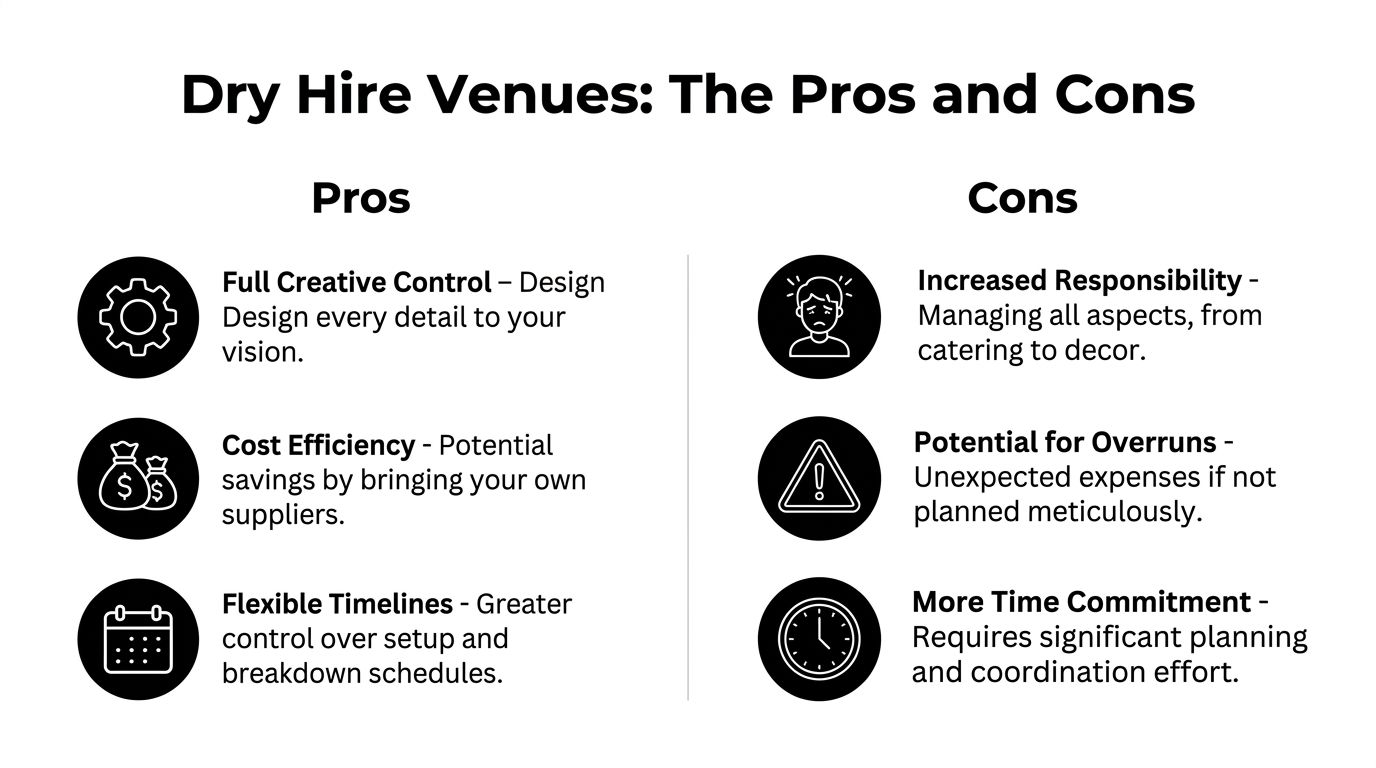
Some events suit dry hire brilliantly. Others become stressful because the organiser wanted freedom but didn’t want operational responsibility. The decision gets easier when you look at both sides plainly.
Where dry hire works well
The biggest advantage is control. You choose the caterer, the drinks setup, the furniture style, the lighting mood, and the overall flow. That matters if you have a clear vision, a trusted planner, or cultural requirements that standard venue packages don’t handle well.
It can also be the better route when you want a more personal event. A wedding with a specific family caterer. A corporate launch that needs branding throughout the space. A community event where food, layout, and timings need to reflect the audience rather than the venue’s house format.
Where people get caught out
The challenge is that every decision lands on your side of the table. The venue won’t necessarily solve a weak power supply, poor loading access, or a mismatch between guest numbers and catering setup. A beautiful room can still be a difficult event site.
The workload usually includes:
- Supplier coordination: Caterers, furniture hire, production, bar staff, cleaners, security, florists, entertainers, and transport all need compatible schedules.
- Operational checks: Access windows, lift sizes, floor protection, delivery routes, and waste collection need confirming before contracts are signed.
- Risk ownership: If something is missing, delayed, or unsuitable, there’s no in-house venue team automatically filling the gap.
A dry hire venue rewards clear planning. It punishes assumptions.
A simple comparison
| Consideration | Dry hire venue | Fully serviced venue |
|---|---|---|
| Creative control | High | More limited |
| Supplier choice | Broad, though venue rules may apply | Usually restricted to house suppliers |
| Planning workload | Heavy | Lower |
| Operational risk | Mostly on organiser and suppliers | More shared with venue |
| Budget clarity | Can be less predictable | Often easier to forecast |
For some readers, comparing event suppliers before committing helps as much as comparing venues. Looking at experienced marquee hire companies can be useful because temporary structures and event infrastructure often become part of the practical solution, not just an optional extra.
Budgeting for Your London Dry Hire Event
The headline venue fee is only the entry point. That’s where many budgets drift off course.
According to Tagvenue’s London dry hire venue data, dry hire venues in London typically average £100 per hour. Daily hires range from £1,500 to £6,000, and spaces for 120 to 200 guests average £150 per hour for the venue alone. That’s before you add any supplier costs.
The venue fee is only one line
A dry hire budget should start with the room hire, but it can’t end there. The practical spend usually sits in the items the venue hasn’t included.
Common budget lines include:
- Furniture hire: Tables, chairs, poseur tables, lounge furniture, linen
- Catering setup: Kitchen equipment, prep space, refrigeration, service areas
- Bar provision: Bar units, glassware, staff, drinks storage, licensing support
- Lighting and AV: Uplighters, festoon, stage lighting, sound, microphones, screens
- Staffing: Waiting staff, bar staff, security, stewards, cloakroom, cleaners
- Guest facilities: Toilets if the venue’s existing provision isn’t suitable for the event format
- Protection and finishing items: Flooring, carpet, matting, drape, weather cover, heaters
- End-of-event costs: Cleaning, waste removal, breakdown labour
What catches people out most often
Three costs are often underestimated.
First, time-based charges. If access is tight and suppliers overrun, extra crew time builds quickly. Second, infrastructure hire. If the venue looks simple but lacks practical event support, you end up hiring it separately. Third, compliance costs. Insurance, security requirements, and specialist sign-off aren’t glamorous, but they matter.
A more useful way to budget is to separate spending into two groups.
| Budget group | What it covers |
|---|---|
| Fixed venue cost | Room hire, contracted access, any mandatory venue fees |
| Build cost | Everything needed to make the event function inside that space |
That distinction helps because some venues look affordable until the build cost is added. Others look expensive at first, but the space is easier to work with and needs fewer temporary solutions.
Budget mindset: Don’t ask only, “What does the venue cost?” Ask, “What does it cost to make this venue event-ready?”
For anyone trying to sense-check overall event spend, reviewing prices for marquee hire can help frame whether a temporary structure, catering tent, covered terrace, or full marquee installation gives better value than forcing a difficult dry hire venue to do a job it isn’t naturally set up for.
The Essential Pre-Booking Logistical Checklist
The venue visit is where good decisions are made. Photos don’t show you cable routes, loading problems, or whether a caterer can serve properly from the available infrastructure.

Power, water and access
If there’s one issue that can derail a dry hire event quickly, it’s power. For dry hire events with 200 guests using professional catering, a minimum 63-amp three-phase power supply is required, and a standard domestic supply can’t safely handle that load, as noted by Hire Space’s guide to dry hire venues for 200 people.
That matters because caterers don’t just need one plug for an oven. They may need reliable support for cooking, hot holding, refrigeration, dishwashing, lighting in prep areas, and service equipment working at the same time.
Check these points on site:
- Power supply: Ask what’s available, where outlets are positioned, and whether three-phase is present if professional catering is involved.
- Water access: Confirm where caterers and bar teams can fill, clean, and dispose appropriately.
- Loading and unloading: Ask about vehicle access, distance from unloading point to event space, lift access, and any timed restrictions.
- Storage space: Find out whether suppliers can leave equipment safely before service or overnight if needed.
Licensing, insurance and capacity
The room size listed online is only part of the story. You also need to know the venue’s operating conditions.
Use this checklist:
Alcohol and entertainment permissions
If you’re bringing in your own bar or live entertainment, ask what the venue licence permits and what sits with the organiser.Public liability requirements
Request the venue’s insurance expectations early so every external supplier can provide the right paperwork.Guest capacity and layout
A standing reception, banquet dinner, and mixed event all place different demands on the same room.Accessibility
Walk the route as a guest would. Entrances, toilets, thresholds, ramps, and wayfinding all matter.
If a venue team answers technical questions vaguely, pause before paying a deposit.
Waste, cleaning and end-of-night reality
The final hour often gets the least attention during booking and causes the most stress later.
Ask who removes waste, how glass is handled, whether grease or catering waste has special rules, and what the handover condition must be. Also check music cut-off, supplier strike times, and whether breakdown can continue after guests leave.
A venue that feels flexible during a sales call can become quite rigid at midnight.
Transforming Your Blank Canvas with a Marquee
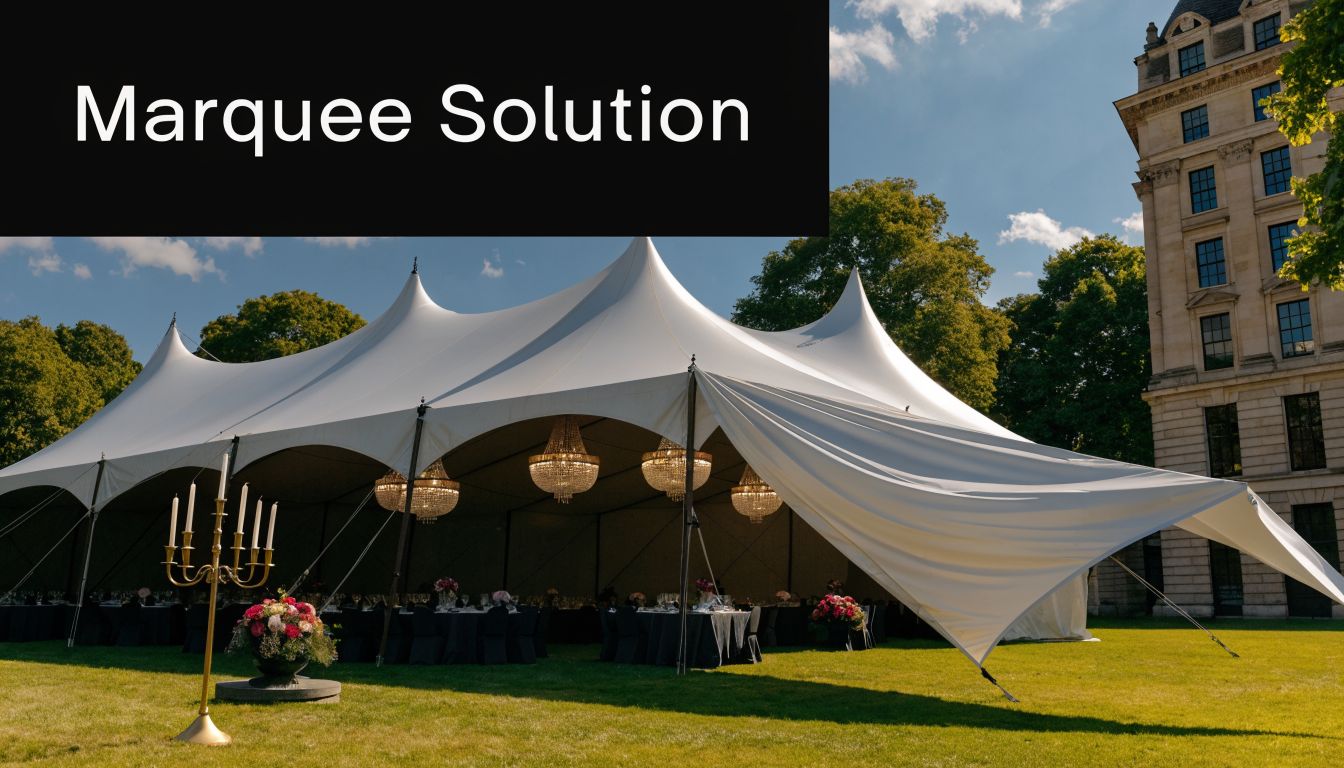
Some dry hire venues don’t fail because the main room is wrong. They fail because the site lacks support space. That’s where a marquee stops being a decorative extra and becomes part of the event plan.
The problems a marquee solves well
A blank canvas venue often needs one of four things. More covered guest space. A proper catering area. Weather protection between zones. Or a cleaner event flow.
A marquee can solve each of those without forcing the whole event into one compromised room.
Examples include:
- Extending the venue footprint: A courtyard or garden becomes usable for dining, drinks, or reception space.
- Creating back-of-house infrastructure: Caterers get a dedicated prep and service area away from guests.
- Improving arrival and movement: Covered walkways and linked structures make multi-space venues feel coherent.
- Making outdoor use realistic: A lawn, terrace, or side return becomes part of the event instead of a risky weather bet.
What works in practice
The strongest marquee setups are planned as part of the site layout, not added late as a panic response to forecast concerns.
That means thinking about:
- guest entry sequence
- catering routes
- staff-only zones
- furniture layouts
- flooring on grass or uneven ground
- heating or ventilation depending on season
- lighting levels for both atmosphere and safe movement
A marquee is particularly useful at dry hire venues where the building itself has character but not enough operational flexibility. Historic sites are a common example. The hall may be beautiful, but the kitchen access may be awkward, the side rooms too small, or the outdoor area underused.
The best blank canvas events usually combine a strong permanent venue with temporary infrastructure that fixes what the venue can’t do on its own.
Why this matters in London conditions
London events rarely get the luxury of simple logistics. Access windows are tight. Weather is unpredictable. Many venues sit in residential or conservation-sensitive areas. Some have lovely outdoor space but need a structure that feels polished rather than improvised.
A well-planned marquee gives you control over those weak points. It also allows the event layout to follow the guest experience instead of being dictated by whatever the original building happens to offer.
That’s often the difference between a venue that merely looks good online and a venue that works on the day.
Local Dry Hire Scenarios in London and Surrey
The planning principles become easier to judge when you apply them to familiar local situations.
A Bromley wedding with limited indoor dining space
A historic barn or hall may be ideal for the ceremony and evening atmosphere, but the internal dining space can feel tight once guest numbers rise and catering needs are added. In that situation, using the permanent building for key moments and a separate covered structure for dining usually creates a calmer flow.
Guests aren’t squeezed. Caterers get working room. The venue keeps its character instead of being overloaded with too many functions in one area.
A Croydon corporate event with an awkward courtyard
This is a common South London problem. The site is well located and practical for staff travel, but the usable event space feels fragmented. A paved courtyard can become dead space unless it’s covered properly and tied into the rest of the layout.
A temporary structure works well here because it turns an in-between area into a proper reception or networking zone. For corporate events, that often improves the guest journey more than changing venue entirely.
A Sutton family celebration spread across several days
At home-based celebrations, the pressure point is usually different. The family wants flexibility, privacy, and room for changing guest numbers across different functions. The house might comfortably handle one part of the event, but not the full programme.
That’s where a garden setup gives breathing space. It creates a dedicated area for dining, music, or ceremonial moments while keeping the home itself usable for family life and service support.
Local knowledge matters because site conditions in Croydon, Bromley, Sutton, and nearby areas vary wildly from one property or venue to the next.
A Surrey venue with great views but poor support space
This is another familiar trade-off. The setting sells the venue, but practical support space is limited. If the event relies on external catering, a bar, and layered styling, the missing infrastructure shows up quickly.
The most effective approach is usually to preserve the best parts of the venue for guest-facing moments and build the support functions separately so service runs cleanly behind the scenes.
Frequently Asked Questions for Large Scale Events
Large dry hire events bring a different level of pressure. Once guest numbers increase, small logistical weaknesses stop being minor inconveniences and start affecting safety, service speed, and overall control.

According to Hire Space’s page on dry hire venues for 400 people, logistics for events over 400 guests are often poorly covered by venue listings, and 62% of blank canvas venues face power shortages. Questions about external marquees for winter festivals or large religious gatherings are also rarely answered clearly.
How do you manage power when the venue supply isn’t enough
Start by treating power as a design issue, not a last-minute technical add-on. Large events often need support for catering, refrigeration, bars, lighting, sound, heating, and supplier back-of-house use all at once.
If the venue can’t support that safely, bring in a qualified power plan with the right generator setup, cable routing, distribution points, and protected access routes. Don’t rely on guesswork or assume a standard building supply will cope just because the room is large.
Can a marquee work for a large winter event
Yes, if it’s planned properly.
The key is to think beyond the roof. Winter use depends on flooring, weatherproof access, heating, sidewall integrity, and how guests move between covered areas without queuing in exposed points. It also depends on what happens behind the scenes. Staff need working conditions that allow service to stay steady even when the weather turns.
For religious gatherings, seasonal festivals, and large community events, this is often what makes an outdoor or hybrid setup viable rather than risky.
What should organisers ask about security and public safety
Large events need a clear security structure, not a vague promise that “someone will be on the door”. You need to know who is responsible for entry control, queue management, incident response, restricted areas, and end-of-night dispersal.
For organisers who want a useful overview of how professional teams approach this, this guide on professional protection in ensuring public safety at large events is a sensible starting point.
Bigger events don’t just need more equipment. They need clearer lines of responsibility.
What about noise, waste and neighbourhood impact
These issues matter more on large-scale dry hire sites because the venue may not have a built-in operating system for them.
Confirm cut-off times, speaker orientation, waste collection responsibilities, glass handling, and vehicle movements before the event is fully designed. If the site is near homes, schools, or places of worship, those details should be part of the planning conversation from day one, not bolted on after contracts are signed.
If you’re weighing up dry hire venues in london and need practical help turning an empty space into a working event, Premier Marquee Hire can help with marquees, flooring, lighting, furniture, bars, and site planning across Croydon, London, Surrey, and the surrounding counties. If you want a clear quote, a site visit, or advice on whether a venue is workable before you commit, get in touch.
Sorry, the comment form is closed at this time.