

25 Apr Marquee Hire for Weddings: The Ultimate London Guide
You’re probably at the stage where a marquee wedding feels both exciting and slightly daunting. You love the idea of creating your own setting, choosing the view, the flow, the timing, and the atmosphere. You may also be looking at a London or Croydon garden and wondering whether any of it is practical.
That’s a normal place to start.
Marquee hire for weddings works brilliantly when the planning is grounded in the actual conditions of the site, the guest list, and the way people will use the space on the day. In Greater London and the South East, that often means working around tighter plots, paved patios, side access, neighbours, and unpredictable weather. None of that rules a marquee out. It just means the details matter more.
A well-planned marquee wedding doesn’t feel temporary. It feels intentional. The structure fits the garden. The layout keeps guests moving naturally. The flooring, heating, anchoring, lighting, and furniture all work together. Once those pieces are handled properly, the marquee becomes one of the most flexible and enjoyable ways to host a wedding.
Choosing Your Perfect Wedding Marquee Type and Size
You’ve measured the garden, counted the guests, and spotted a patch of lawn that looks promising. Then the practical questions start. Will everyone fit for dinner, dancing, and the evening bar queue? In Croydon, Bromley, and across South London, that answer often depends less on the total garden size and more on the shape of the site, the access route, and what has to happen inside the marquee.
Marquee size is a working layout decision, not just a guest-count exercise. A wedding for 100 guests can feel generous in one setup and cramped in another, depending on whether you want round tables, long banquet tables, a stage, a separate bar, or extra space for catering to operate properly.
For many London and South East weddings, frame marquees are the most practical place to start. They usually come in 6m, 9m, or 12m widths, with the length increased in 3m bays, which gives useful flexibility for awkward plots and narrower gardens, as explained in this UK marquee sizing guide. That modular format suits the sites we see regularly in Croydon. Rear gardens with extensions, patios, raised levels, side returns, and tight boundaries often rule out a simple one-size-fits-all approach.
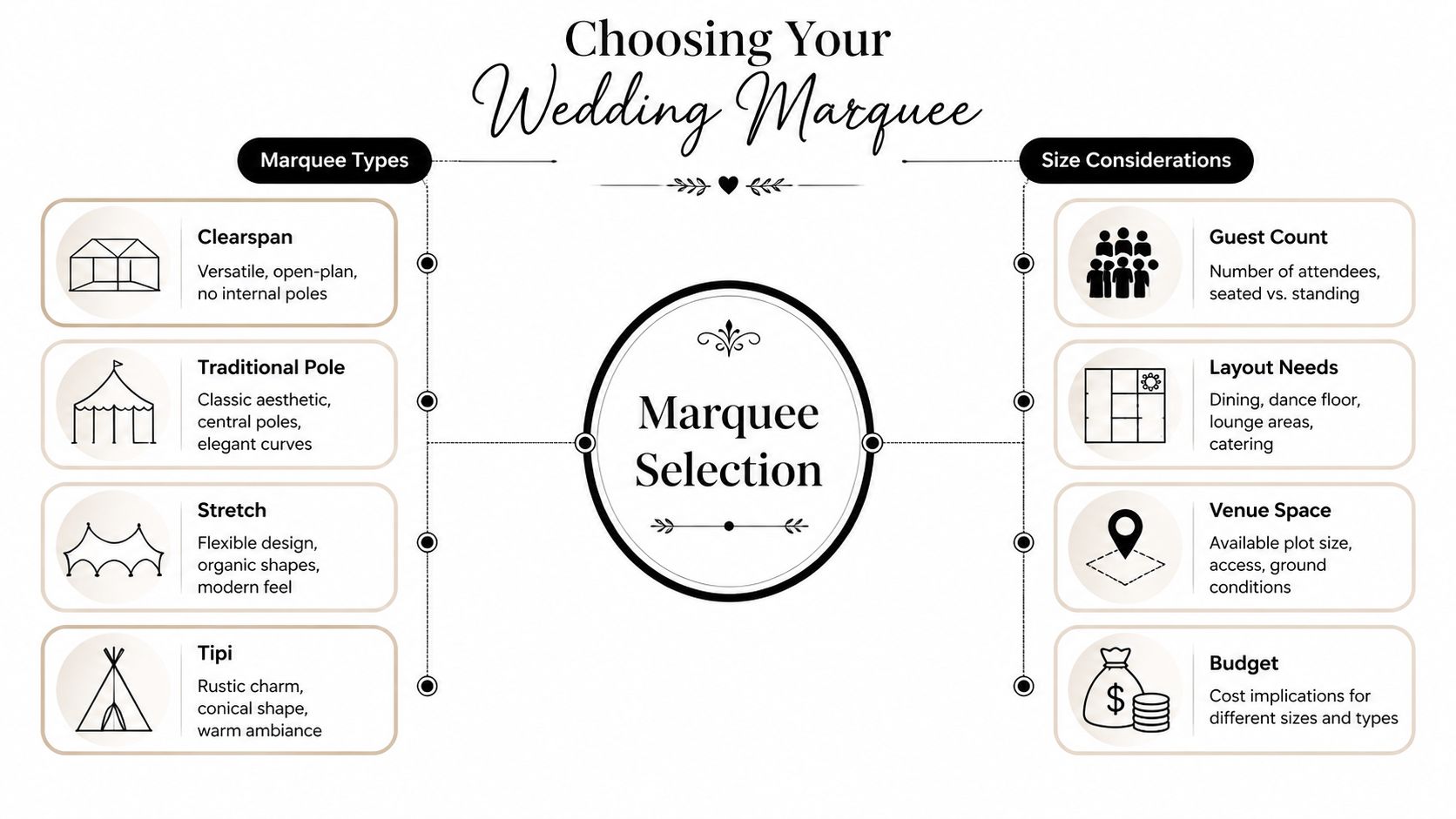
The marquee styles couples usually compare
Different marquee types suit different priorities. The right choice depends on the look you want, but also on how much clear usable space the structure gives you.
| Type | Best known for | Practical trade-off |
|---|---|---|
| Frame marquee | Open internal space, no centre poles, modular sizing | Usually the best fit for flexible wedding layouts and tighter urban plots |
| Traditional pole marquee | Soft lines and classic appearance | Centre poles affect table plans, sightlines, and dance floor placement |
| Stretch tent | Informal, contemporary look | Better for a relaxed format and a site that suits its shape and anchoring needs |
| Tipi | Warm, rustic character | Strong visually, but less efficient if you need a clean dining layout for larger numbers |
For a full wedding day under one roof, ceremony backup, wedding breakfast, speeches, dancing, and evening guests, frame marquees usually make planning simpler. The clear span inside gives more freedom with wedding table and chair hire options and leaves fewer awkward dead corners.
Practical rule: Choose the structure that gives you the best usable floor area. Style should support the plan, not fight it.
A simple way to estimate the right size
A 100-guest wedding often starts with a 6m x 12m frame marquee, which is widely used as a benchmark for dining and dancing, based on Dynamic Marquees’ wedding capacity guide.
That figure is only a starting point.
I’d treat it as the first realistic option to price and sketch, not the automatic answer. If you want round tables with generous spacing, a proper dance floor, a DJ setup, a bar, and room for guests to circulate comfortably, the footprint can grow quickly. If the garden is narrow, a longer marquee may work better than a wider one. If the site is mostly patio or driveway, the structure type and anchoring method also affect what sizes are practical.
For larger receptions, the same principle applies.
- 150 to 200 guests usually pushes the conversation toward a 9m or 12m span frame marquee
- Live bands need their own footprint, not just a dance floor in front of them
- Separate zones for dining, drinks, and dancing make a marquee feel calmer and more organised
- Tight sizing shows up first in the gaps between tables, around the bar, and near the entrance
Headcount matters, but the event format matters just as much.
The spaces couples forget to count
The first draft of a marquee plan nearly always includes the obvious pieces. Dining tables. Chairs. Dance floor. Bar.
The pressure points are usually elsewhere:
- Service space for caterers, waiting staff, and food stations
- Circulation space so guests can move between tables without dragging chairs back every time
- Entrance room for arrivals, greetings, and the first drinks of the day
- Quieter edges for older relatives, prams, coats, gifts, or anyone wanting five minutes away from the speakers
On London and South East sites, those forgotten areas matter even more because you often cannot spill naturally into wide lawns or open terraces. A compact Croydon garden may host a beautiful wedding, but the marquee has to work harder and every square metre needs a job.
A quick size guide for first estimates
| Wedding plan | Useful starting point | Why it works |
|---|---|---|
| Smaller seated wedding | 6m width with added 3m bays | Flexible for tighter gardens and simpler dining layouts |
| 100 guests with dining and dancing | 6m x 12m | A common starting footprint for a full reception setup |
| 150 to 200 guests | 9m or 12m span | Gives more scope for dining, dancing, entertainment, and service space |
If you are between sizes, choose the one that gives your suppliers room to work and your guests room to relax. The quote may increase, but an undersized marquee is much harder to fix once tables, flooring, catering kit, and evening entertainment are all committed.
Mastering the Layout for an Unforgettable Guest Experience
A wedding marquee can be the right size and still feel awkward if the layout is wrong. Guest experience is shaped by movement. Where people enter, where they gather, where they queue, where they pause, and where the energy builds through the evening all affect how the day feels.
The smoothest layouts usually follow the wedding as it unfolds. Guests arrive and have a clear place to stand with a drink. They move naturally toward dining without confusion. The room then shifts into evening mode without staff dragging furniture through a crowded dance floor.
The guest journey matters more than symmetry
A common mistake is placing everything for visual balance rather than practical use. A bar might look neat in a far corner, but if it’s too remote from the evening crowd, the atmosphere splits. Dining tables may be evenly spaced, but if the catering route cuts through the middle of guests, service becomes clumsy.
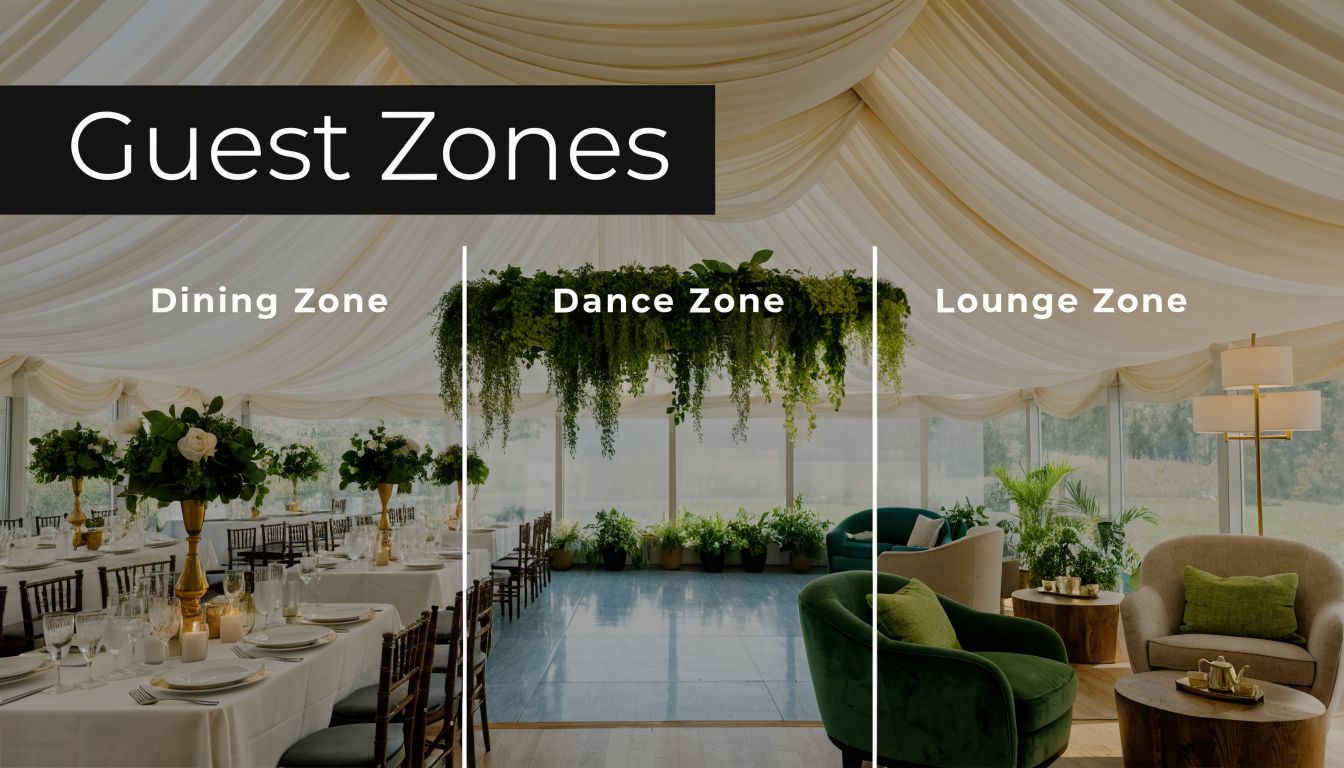
A stronger layout often looks like this:
- Arrival zone near the entrance for drinks, greetings, and a natural first gathering point
- Dining zone in the calmest central area where guests can sit comfortably without constant foot traffic
- Dance floor placed where the room can build energy later
- Bar positioned close enough to the evening action that guests don’t disappear from the party
- Soft seating or quieter edge space for older relatives, parents with children, or anyone needing a break from the speakers
If guests can see where to go next without asking, the layout is doing its job.
What works well in practice
One of the most useful planning tools is a scaled floor plan. It’s much easier to spot pinch points when you can see the tables, dance floor, bar, and access routes on one drawing rather than as a list of items.
That’s where a proper layout service helps. A visual plan can show whether the bar queue will block the entrance, whether staff can move behind the dining area, and whether the dance floor is large enough once tables and chairs are in place. If you’re comparing furniture options, it also helps to look at wedding tables and chair hire layouts before finalising numbers.
A practical zoning checklist
Use this before you sign off the layout:
Walk the entrance mentally
Guests shouldn’t step straight into the back of a chair or the side of a buffet table.Check sightlines
Can guests see the top table, speeches area, or dance floor without awkward obstructions?Test the bar queue
If people line up, will they cut off the route to the loos, catering tent, or dance floor?Protect the quiet seats
A small lounge edge can be invaluable later in the evening.Leave room for changeover
The wedding breakfast and evening party often overlap in the same space. Staff need room to make that transition cleanly.
The best marquee layouts don’t just fit the furniture. They guide the entire day.
Planning for All Seasons and Weatherproofing Your Day
Weather is the question every couple asks, even in summer. That concern is reasonable, but it often comes from picturing a marquee as a basic temporary shelter. A modern commercial marquee is much closer to a flexible venue shell than a simple tent.

The key is to plan for the season you’re booking, not the season you hope you get. In the UK, the weather can turn on the day, and a strong marquee plan takes that into account from the beginning. Sidewalls, flooring, walkways, entrance matting, ventilation, heaters, and linings all shape guest comfort.
Winter weddings can work beautifully
Couples are using marquees beyond peak summer dates more confidently now. UK off-season weddings between October and March have increased by 22%, and modern PVC linings can help retain an internal temperature of 18 to 25°C in colder weather, according to this off-season marquee wedding benchmark.
That changes the conversation. A winter marquee isn’t a compromise if it’s specified properly. It can feel warm, intimate, and atmospheric, especially once lighting and linings are added.
The budget side needs equal attention. The same benchmark notes that heating for a 200-guest marquee in winter can range from £2,000 to £4,000. If you’re planning a colder-month celebration, it’s worth reviewing specialist options for heated marquee hire early rather than trying to add warmth at the last minute.
A winter wedding works when heat retention, flooring, and entrances are treated as core items, not optional extras.
Summer comfort needs planning too
A hot marquee can be just as uncomfortable as a cold one. Summer weatherproofing is about airflow, shade, and controlling how the structure heats through the day.
What usually helps most:
- Openable sides: Useful for airflow during drinks receptions and daytime dining.
- Thoughtful orientation: The way the marquee sits on site can affect glare and heat buildup.
- Shaded entrance areas: These stop guests bottlenecking in direct sun.
- Separate catering space: Keeping kitchen activity out of the main marquee helps comfort.
Rain planning matters in every month. Flooring over damp ground, matting at the entrance, and covered routes to toilets or adjacent buildings make a bigger difference to guest comfort than couples often expect.
A short visual walkthrough helps if you’re trying to picture how weather-ready structures are set up in real conditions.
The practical weatherproofing choices that pay off
If the forecast turns, the strongest wedding setups usually already have the right basics in place.
| Priority | Why it matters |
|---|---|
| Solid flooring | Keeps heels, tables, and guest movement stable |
| Entrance matting | Stops mud and moisture being tracked through the marquee |
| Covered connections | Helps between house, loos, catering area, and main structure |
| Linings and heating | Improve comfort and create a finished interior feel |
| Flexible sides | Allow the marquee to adapt through the day |
The safest approach is to assume the marquee needs to perform in mixed weather. If the day is dry and mild, great. If it isn’t, you’re still ready.
The Essential Site Check Permits and Ground Logistics
The biggest misconception in marquee hire for weddings is that if a garden looks large enough, it must be suitable. In practice, the most difficult issues are often nothing to do with square footage. Access can be tight. The ground may slope. A patio may leave nowhere to stake. Trees, drains, flowerbeds, sheds, and neighbouring boundaries can all change the install plan.
That’s why the site check matters so much.

London gardens often need a different approach
In London and the South East, 68% of gardens are smaller than 100 sqm and often include paved patios, which means traditional staking isn’t always possible. On hard surfaces, securing the structure may require ballast weights of 1 tonne per 10m span for wind speeds up to 50mph under BS EN 13782 standards. Poor assessment and anchoring on hard surfaces can increase wind failure risk by up to 15% compared with a properly staked marquee on grass, according to this guide on marquee setups across different ground types.
That’s highly relevant in Croydon, Bromley, Sutton, Beckenham, and similar suburban areas. Many homes have a mix of lawn, patio, decking, raised borders, and side-return access. A marquee can still be installed successfully, but the engineering and planning need to fit the site rather than forcing a standard setup onto it.
What a proper site survey should look for
A good survey doesn’t just measure the footprint. It checks the whole event route.
- Access for installation teams: Side gates, alleyways, steps, and narrow points all matter.
- Ground condition: Grass, paving, decking, gravel, and uneven levels need different fixing methods.
- Drainage and fall: Water movement affects flooring and guest comfort.
- Obstructions overhead and below: Trees, cables, drains, and inspection covers can influence positioning.
- Support areas: Caterers, mobile loos, generators, and rubbish collection all need somewhere sensible to go.
The best site surveys solve problems before the equipment arrives.
Permits and local practicalities
Many couples worry that a marquee automatically means planning permission. Often it doesn’t, but local circumstances still matter. Borough rules, event scale, structure size, hire duration, noise, licensing, and whether the event is in a private garden or a venue setting can all change what’s needed.
The most sensible approach is to check these points early:
Council requirements
Ask whether your borough has any restrictions for temporary structures or late-night events.Licensing and music
If your wedding includes amplified music, a paid bar, or other licensed activity, there may be extra steps.Neighbour considerations
In closely packed residential roads, timing, deliveries, and evening noise need managing carefully.Utilities
Power for lighting, catering, sound, and toilets should be mapped in advance. Don’t assume the house supply will suit everything.Setup and takedown timing
Tight streets and school-run traffic can affect access windows in urban areas.
A marquee wedding becomes much easier once the site has been treated as a technical project as well as a celebration space. That’s where experienced planning saves stress.
Understanding Marquee Hire Costs and Sample Budgets
A couple in Croydon might both invite 100 guests, book a marquee for a Saturday in July, and still receive two very different quotes. One garden has side access, level ground, and space for a straightforward install. The other has a narrow passage, paving that needs weighted fixing, and no practical area for catering. That difference changes the labour, equipment, and setup method before you get anywhere near styling.
That is why marquee pricing needs reading line by line. The shell is only the starting point.
What usually makes up a wedding marquee quote
A proper wedding marquee quote should separate the costs into clear groups so you can see what is paying for structure, what is paying for function, and what is paying for finish. In practice, most quotes are built from the same core headings, then adjusted for the site and the brief.
Typical cost headings include:
- Marquee structure hire
- Flooring
- Interior linings
- Lighting
- Tables and chairs
- Dance floor
- Heating for colder dates
- Delivery, installation, and collection
- Site-specific requirements such as weights, extra labour, or restricted access
- VAT
In London and the South East, site conditions often have more effect on cost than couples expect. A marquee in a Bromley garden with good rear access is usually more straightforward than one behind a terraced house in South Croydon where every panel, floor section, and chair has to be hand-carried through the house or down a tight side return.
What moves the budget up or down
Guest count matters, but it is not the only driver. Two weddings for the same number of people can sit in very different price brackets because the brief is different.
| Cost driver | Lower-cost outcome | Higher-cost outcome |
|---|---|---|
| Site | Good access, simple install | Tight access, hard standing, extra labour |
| Season | Mild date, fewer weather items | Colder date with heating and full lining package |
| Finish level | Standard furniture and practical lighting | Premium furniture, decorative lighting, stronger visual finish |
| Event format | One main dining space | Separate dining, bar, lounge, and dance areas |
The biggest jump usually comes from complexity. Linked marquees, covered walkways, dedicated catering tents, bar areas, and toilet screening all improve the guest experience, but they also add material, labour, and transport.
Sample wedding marquee budget shapes
These are planning examples, not fixed quotations. I use this kind of framework with couples early on because it helps them set priorities before they start choosing decorative upgrades.
| Item | Classic Wedding (80 Guests) | Luxury Wedding (150 Guests) |
|---|---|---|
| Marquee structure | Mid-sized frame marquee for dining and evening use | Larger clearspan or frame marquee with separate zones |
| Flooring | Standard event flooring | Higher-finish flooring across a larger footprint |
| Lighting | Functional warm lighting | Layered lighting with feature fittings |
| Furniture | Dining tables and standard seating | Dining, bar, lounge, and feature furniture |
| Dance floor | Standard dance area | Larger dance floor with more evening capacity |
| Heating or linings | Added if the date requires it | Often included for comfort and appearance |
| Site logistics | Basic install assumptions | Greater chance of weights, extra labour, or access limits |
| Overall budget shape | Controlled and practical | Higher spend with stronger zoning and visual impact |
A tighter budget can still produce a very polished wedding. The key is to spend first on the parts guests feel. Dry flooring, enough space between tables, lighting that works after dark, and a layout that keeps the bar, dining, and dance floor flowing properly.
The weakest quotes are often the ones that look cheapest at first glance because they leave too much undecided.
A practical way to build your budget
Start with three layers.
First, cost the parts that make the event work. Structure, flooring, lighting, tables, chairs, and weather protection suitable for your date. Second, add the operational pieces such as catering cover, power distribution, bar area, and toilet arrangements. Third, price the visual upgrades like linings, better chair options, statement lighting, and lounge furniture.
That order keeps the budget realistic. It also stops couples spending early on decorative details, such as signage or wedding cake toppers, before the marquee itself has been specified properly.
For a more detailed breakdown of typical spend ranges, what changes the final price, and where couples can trim or add budget sensibly, see this guide to wedding marquee hire cost.
Elevating Your Space with Furniture Lighting and Extras
Once the structure and logistics are right, the marquee starts to become your wedding rather than just the venue. There, the atmosphere is built. Furniture, lighting, flooring finishes, and service areas don’t just decorate the space. They change how it feels and how it functions.
A plain frame marquee can look polished, relaxed, dramatic, romantic, or contemporary depending on those choices.
Furniture shapes the tone of the room
The first decision is usually whether you want the room to feel formal or more social. Round dining tables tend to create a classic wedding layout. Banqueting tables can feel more communal and modern. Chair choice also changes the finish quickly. Standard folding chairs do the practical job. Chiavari chairs immediately make the room feel more refined.
Soft seating has a different role. It gives the marquee breathing room. A small lounge area near the edge of the space can help older guests, anyone needing a quieter conversation, or people stepping away from the dance floor for a few minutes.
Lighting is doing two jobs at once
Good marquee lighting has to look right and work right. Guests need to move safely, find pathways, read place cards, and see each other properly during dinner. At the same time, lighting sets the whole tone once daylight drops.
Useful combinations often include:
- Warm overhead lighting for the main dining area
- Feature lighting such as chandeliers or festoon runs to create focus
- Uplighting to add depth to the walls or lining
- Bar and pathway lighting so practical areas still look intentional
- Dance floor lighting that turns the room from reception to party without changing the whole setup
A marquee looks finished when the practical elements are dressed as beautifully as the decorative ones.
Extras that earn their place
Not every extra is just for show. Some solve genuine event problems.
A dedicated bar unit helps organise queues and gives the evening reception a proper focal point. A black and white dance floor instantly marks out the party zone. Giant letters or a photo booth create a natural gathering point and give guests something to do between formal moments.
Even smaller details can tie the styling together. If you’re coordinating signage, stationery, and cake design, bespoke wedding cake toppers can be useful inspiration for keeping the overall look consistent.
A simple way to make choices
If you’re trying to avoid overbuying, sort every extra into one of these groups:
| Category | What belongs here |
|---|---|
| Must-have for comfort | Seating, lighting, flooring finish, bar layout |
| Must-have for atmosphere | Linings, feature lights, statement dance floor |
| Nice-to-have for personality | Photo features, decorative props, themed details |
That approach keeps the design focused. The most memorable marquee weddings don’t always have the most extras. They have the right extras, chosen with purpose.
Your Wedding Marquee Booking Timeline and Checklist
A good marquee booking timeline starts long before you choose chair styles or festoon lights. In Croydon, Bromley, Sutton, and across South London, the early pressure points are usually date availability, access, and whether the site will take the structure you want without costly adjustments later.
The couples who have the calmest build-up usually make three decisions early. How many people they are realistically expecting. What kind of day they want to host. Whether the site can support that plan.
Start with the booking window
For a peak spring or summer Saturday, get enquiries out as soon as you have a date and address. A private garden in Shirley, a school field in Bromley, or a hard-standing setup at a family home in Purley can all work well, but each one raises different planning questions.
At the first stage, focus on the facts that affect the whole job:
- A realistic guest range, not an optimistic one
- The full site address, so access and local restrictions can be checked properly
- The shape of the day, such as formal seated meal, relaxed mixed seating, or a later party-heavy reception
- Your core suppliers, especially catering, toilets, power, and entertainment
A site visit early on saves time and money. On London and South East jobs, I often find the issue is not the marquee itself. It is side access, overhead cables, tight gate widths, parking controls, or the need to build on paving rather than lawn.
The middle months: from footprint to working plan
Once the date is held and the site has been reviewed, the planning gets more precise. This is the stage where the marquee stops being a rough idea and becomes a workable event space.
Confirm the structure and size first. After that, test the layout against how the day will run. A plan for 100 guests having a sit-down meal, speeches, and a live band needs different circulation space from 100 guests having a shorter dinner and a DJ. In smaller London gardens, every square metre has to earn its place.
Then check the local practicalities before suppliers get too far down the road. If the address sits in a Controlled Parking Zone, near a red route, or on a street with limited unloading, setup times may need tighter coordination. If neighbours are close, it is sensible to deal with noise expectations early. If the marquee is going on a driveway or terrace, anchoring and flooring details should be agreed well before the final month.
This is also the point to pin down the support spaces that couples often underestimate:
- Catering prep and service area
- Generator position and cable runs
- Toilet location
- Waste collection point
- Clear access for setup and breakdown crews
Get those right and the guest-facing areas work better.
Early layout decisions usually lead to better budget decisions, because you can see what the site genuinely needs and what can be left out.
In the final months, lock the details that affect comfort and timing
By this point, broad decisions should already be made. The remaining work is about refining numbers, confirming equipment, and protecting the install schedule.
Guest numbers normally settle enough to confirm furniture quantities. Entertainment plans become firm. Caterers can sign off service space. You can also make sensible final calls on seasonal items, such as heating, extra matting at entrances, or additional lighting for darker evenings.
For South East marquee weddings, I always advise one more practical review of access at this stage. Drives get resurfaced. Building works start next door. Garden landscaping changes levels. A route that worked on the first visit can become awkward if no one checks again.
Final checks for the last few weeks
Keep the last stretch focused and factual.
| Final check | Why it matters |
|---|---|
| Confirm final guest numbers | This affects table count, seating, and spacing |
| Recheck access and parking | Controlled parking, skips, trades, or road restrictions can disrupt install day |
| Agree supplier arrival times | Caterers, florists, band, toilets, and generator delivery need room to work |
| Review the weather plan | Heating, sidewalls, flooring protection, and entrance matting may need adjusting |
| Confirm on-site contacts | The install team needs one reliable person to reach if access or utility questions come up |
The best checklist is practical and local to the site. For a London or South East marquee wedding, that often matters more than adding another decorative extra at the last minute.
Wedding Marquee Hire FAQs from a Croydon Specialist
How far in advance should we book marquee hire for weddings?
For popular spring and summer Saturdays, earlier is always safer. If your wedding is in Croydon, Bromley, Sutton, or nearby areas, it’s sensible to enquire as soon as you have a date and venue location in mind, especially if the site may need a survey.
What happens during setup and takedown?
Installation usually starts before the wedding day so the structure, flooring, and key fit-out can be completed safely and cleanly. Takedown happens after the event once the marquee is clear. The exact timing depends on access, size, and how complex the setup is.
Can a marquee go on a patio or hard surface?
Yes, but it needs proper assessment. Hard-surface installations often require a different anchoring method and more planning than a straightforward grass setup.
Do we need planning permission?
Not always. It depends on the site, how long the structure is up, local council requirements, and whether there are licensing or noise considerations linked to the event.
When do we finalise guest numbers and layout?
Usually once RSVPs are clearer and your key suppliers are confirmed. The important thing is not to leave it too late, because tables, seating, dance floor size, and service space all depend on those decisions.
What should we ask before accepting a quote?
Ask what’s included, how the site affects the price, what weather provisions are recommended for your date, and whether the quote covers installation and collection. Clear answers usually tell you a lot about the company you’re dealing with.
If you're planning a wedding in Croydon, Greater London, or the surrounding counties, Premier Marquee Hire can help you turn an empty garden or outdoor space into a well-planned, weather-ready wedding venue. If you'd like practical advice, a site visit, or a custom quotation, get in touch and the team can talk you through the options clearly and without pressure.
Sorry, the comment form is closed at this time.