

06 May Flooring Marquee Options for London & Croydon Events
You’ve probably had this moment already. The marquee design looks sorted, the guest list is growing, and the garden or venue seems perfect until you stand outside and notice the lawn dips towards the fence, the patio sits slightly proud of the grass, and the route from gate to marquee isn’t nearly as tidy as it looked in your head.
That’s where flooring marquee decisions stop being decorative and start becoming practical. In Croydon, Purley, Bromley, Sutton and across South London, the ground is rarely as simple as “flat lawn, no problem”. One side might be firmer than the other. A lovely family garden may have a retaining wall, a kerb, tree roots, or a gentle slope that doesn’t look dramatic until tables and chairs go on it.
Clients often focus first on the marquee roofline, linings and lighting. Fair enough. But the floor is what guests feel. It affects whether heels sink, whether dining tables wobble, whether a wheelchair can move comfortably, and whether the room feels dry and solid when the weather turns.
Why Marquee Flooring is More Than Just a Floor
A flooring marquee setup earns its value the moment real life gets involved. A wedding in a Bromley garden can look straightforward on paper, then on installation day you find a lawn that falls away just enough to make chairs rock and dining tables look slightly off. A corporate event in Croydon might have a usable hardstanding area, but the transition from paving to marquee entrance still needs thought if you want the space to feel finished and safe.
The common mistake is treating flooring as a style upgrade. In practice, it’s usually doing three jobs at once. It creates a stable base, it improves movement through the space, and it helps the whole marquee feel like a proper venue rather than a tent dropped onto a lawn.
What clients notice straight away
Guests rarely comment on the engineering under the carpet. They notice the result.
- Stable furniture: Chairs sit properly, dining tables don’t rock, and service staff can move with trays confidently.
- Cleaner interiors: A proper floor helps stop grass, mud and surface moisture being tracked into the event space.
- Better finish: Even a simple marquee feels more intentional when the floor is level and neatly fitted.
- More confidence underfoot: Older guests, children, and anyone in formal shoes move more comfortably on a stable surface.
A lot of people researching event surfaces also want broader context on temporary ground protection for homes and short-term setups. If that’s useful, you can discover temporary flooring solutions that show how different temporary floor approaches are used in domestic settings.
For private parties, flooring also affects how the rest of the hire package works. The right floor makes furniture placement simpler, especially once you start planning dining layouts, lounge areas and service zones alongside items such as tables and chairs for marquee events.
A marquee can look beautiful from the outside and still feel awkward inside if the floor hasn’t been planned properly.
In London gardens, that awkwardness usually shows up in small ways first. A drinks table leans slightly. Guests avoid one damp entrance corner. The dance floor feels disconnected from the rest of the room. None of those problems come from aesthetics. They come from groundwork.
The Foundation Understanding Subfloor Systems
Before anyone chooses carpet colour or dance floor style, the important question is what sits underneath. The subfloor is the structural base that supports everything above it. If the subfloor is wrong for the ground, the visible finish won’t rescue it.
Consider the process of fitting out a room in a house. You wouldn’t start with the rug if the base wasn’t sound. The same logic applies to a flooring marquee installation in a Croydon garden, a Wimbledon lawn, or a corporate site with mixed levels.
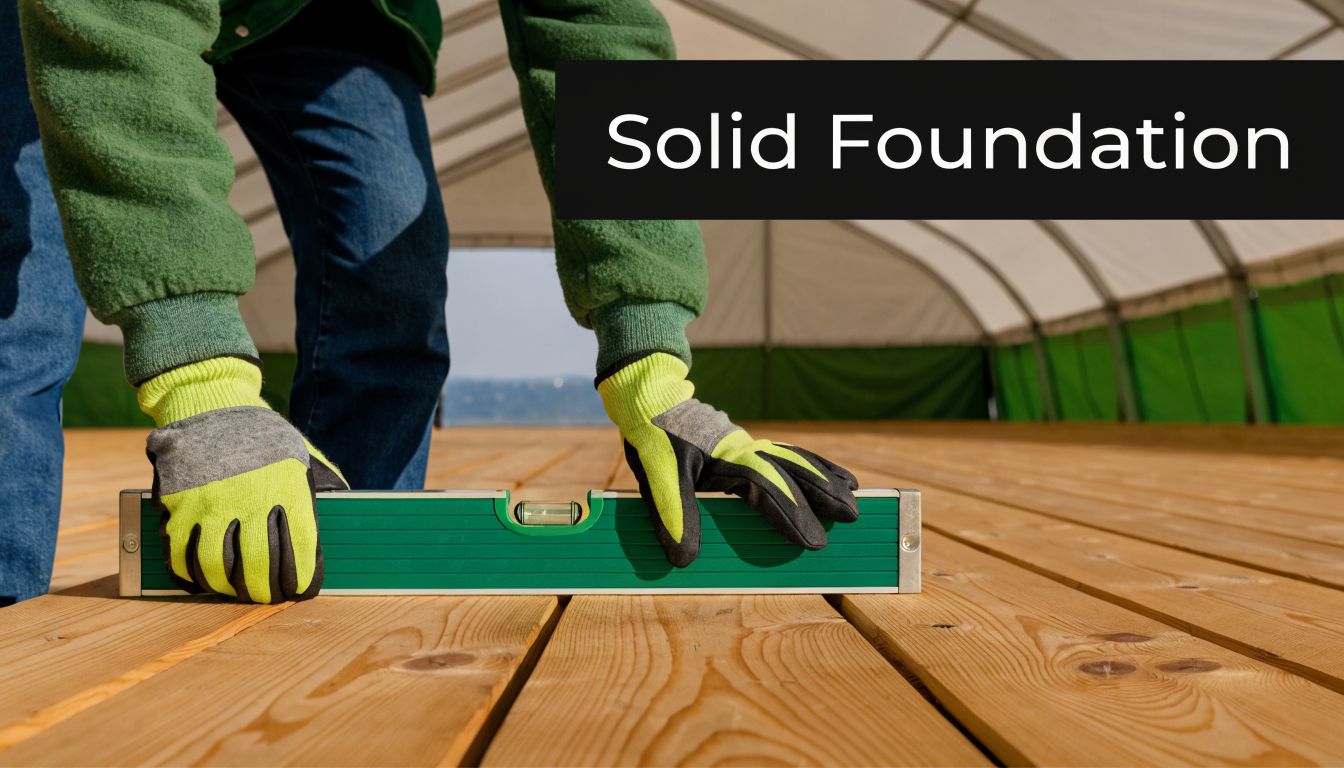
The main subfloor options
Professional suppliers generally work with cassette-based systems chosen according to slope, access and load demands.
| Ground condition | Typical system | Practical use |
|---|---|---|
| Smooth, level ground with minimal slope | Direct Lay flooring | Suits simpler sites where the existing surface is already fairly even |
| Moderate slope | Suspended Flooring with steel or aluminium cassette modules | Useful for many suburban gardens where one side drops away slightly |
| Challenging terrain or obstacles | Floorstak adjustable-leg system | Used where slope or site features make standard approaches unsuitable |
On straightforward ground, Direct Lay flooring uses interlocking plywood sections and can be a sensible, cost-conscious choice. It works best where the surface is already smooth and level.
For trickier domestic sites, the step up is often a suspended cassette system. The verified guidance states that for moderate slopes typical of suburban garden venues across London, Surrey, and Kent, Suspended Flooring systems using either steel or aluminium cassette modules deliver structural stability while allowing individual module adjustment. The same guidance notes that for challenging terrain with significant slopes exceeding 15-20 degrees or ground obstacles such as kerbs and garden walls, the Floorstak adjustable-leg system offers the most versatile solution in the sizes it is available for, according to the Tents and Events flooring guide.
Why the right system matters
A subfloor isn’t just there to flatten the odd bump. It manages how weight is spread and how the finished room behaves during the event.
- Dining areas need consistency: Guests feel instability quickly when seated for a meal.
- Bars and catering routes need firmness: Staff carrying stock or trays need reliable footing.
- Dance floors need support: Even if the visible dance floor is a separate surface, its performance depends on what lies below.
- Slopes need proper correction: A slight gradient can be enough to affect comfort over several hours.
What a proper site survey picks up
A good survey doesn’t ask only “how big is the marquee?” It asks what the ground is doing.
Look for a supplier who checks:
- Level changes across the footprint
- Obstacles at the edges, such as walls, borders, drain covers and raised paving
- Access for installation, especially in tighter South London residential plots
- The intended use of the space, because dining, dancing and staging place different demands on the floor
Practical rule: If the garden looks “almost level”, that’s usually the point where a professional survey matters most.
That’s because small level changes are the ones clients often underestimate. The floor doesn’t need to look dramatic to cause problems. It only needs to be slightly wrong in the wrong place.
A Guide to Marquee Flooring Surface Types
Once the subfloor is sorted, the visible surface becomes the talking point. This is the part guests see, walk on and associate with the event style. But appearance alone isn’t enough. A good flooring marquee choice has to suit footwear, weather, service traffic and the mood of the occasion.
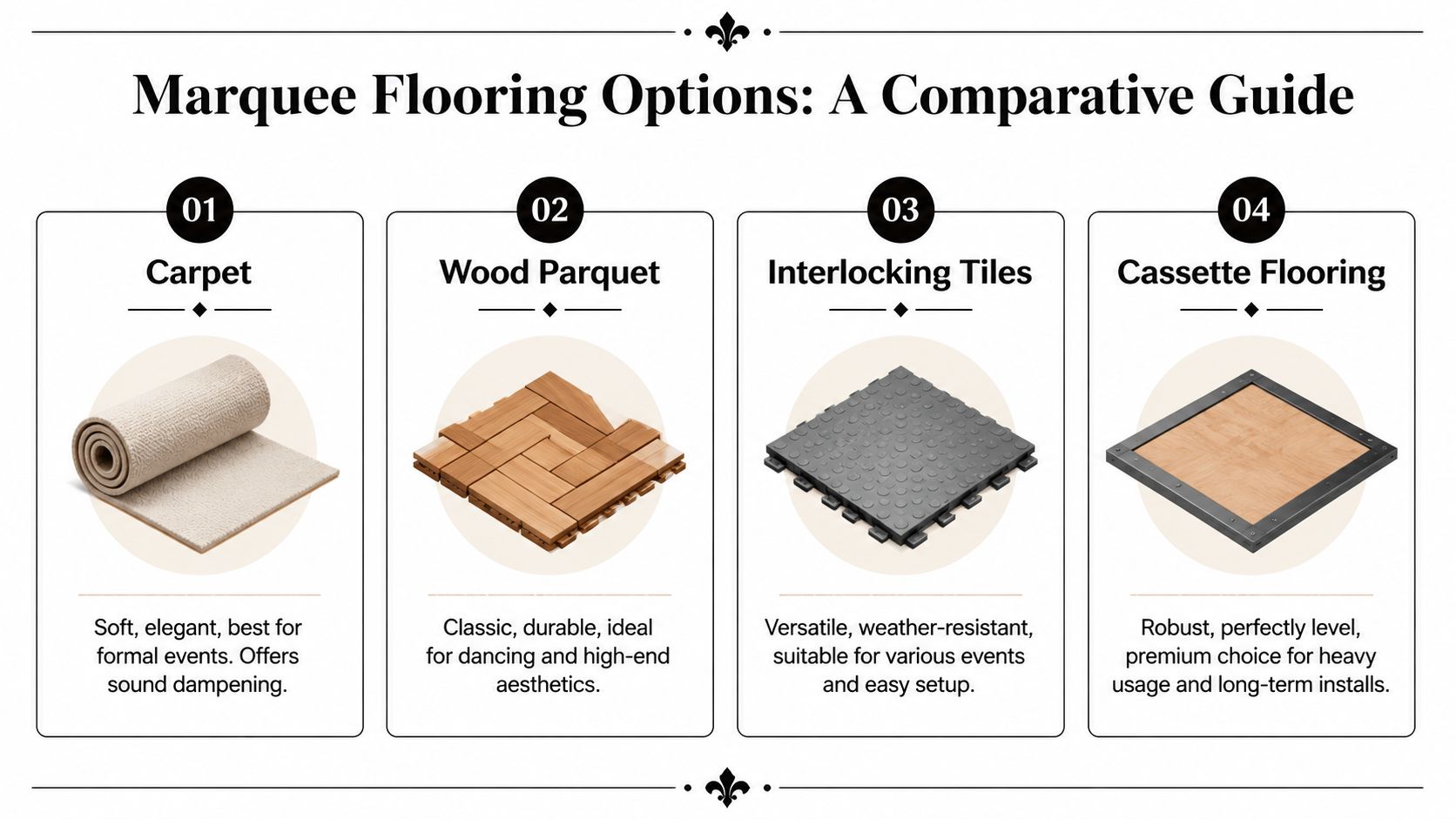
Carpeted finishes
Carpet is usually the easiest way to make a marquee feel warm, formal and complete. It softens the look of the interior, reduces some footfall noise, and works particularly well for weddings, award evenings and seated corporate functions.
A carpeted floor tends to suit:
- Formal dining events
- Ceremony aisles
- Winter or evening functions
- Corporate spaces that need a polished finish
The trade-off is maintenance during the event. In wet weather, entrances and service areas need careful planning or carpet can show heavy traffic quickly. On a dry, well-managed site it looks smart. On a damp lawn with poor access control, it can become the surface that reveals every bit of footfall.
Timber and parquet-style floors
Timber-style surfaces create a firmer, more architectural look. They work well when clients want a premium feel without the softness of carpet. They’re also useful where dancing is a major feature and the floor needs to look deliberate rather than merely covered.
Timber can feel more solid in mixed-use layouts. Guests in heels usually prefer a properly installed hard floor to soft matting, especially around bars and dance areas.
Wood-toned flooring often suits venues where the styling is clean, natural or understated. It gives the marquee interior a room-like quality.
Interlocking tiles and modular surfaces
Interlocking systems are practical where weather resistance and speed of installation matter. They can be useful for casual celebrations, service zones, pop-up activations and event spaces that need a durable, easy-clean finish.
They are usually chosen more for function than romance. That doesn’t make them inferior. It just means the setting needs to justify them.
Matting and simpler coverings
Matting still has a place. For relaxed garden parties, rustic styling or lower-formality events, it can work well visually and keep the setup simpler. But it’s important not to confuse “simple” with “suitable for every site”.
If the event has heavy furniture, a lot of guest movement, or a need for a very polished finish, matting alone may not deliver the result people expect.
A practical comparison
| Surface type | Best suited to | Strengths | Limitations |
|---|---|---|---|
| Carpet | Weddings, dining, corporate hospitality | Softens the room, elegant finish | Needs careful management in wet or muddy conditions |
| Timber or parquet-style | Premium events, dancing, mixed-use spaces | Firm feel, smart appearance | Less forgiving visually if the underlying floor isn’t right |
| Interlocking tiles | Casual events, service areas, activations | Durable, practical, weather-aware | More functional in appearance |
| Matting | Rustic events, lighter-use gatherings | Relaxed look, straightforward option | Less refined for formal events |
If you’re comparing event surfaces with more permanent outbuilding or outdoor base decisions, it can also help to compare gravel and concrete foundations because the same core issue comes up repeatedly. The surface only performs well when the support beneath it matches the use.
Dance floors as a separate layer
A lot of clients talk about “the floor” as if it’s one item. Often it isn’t. The dining floor and the dance floor may be two different components working together.
A dedicated dance floor can sit within a larger carpeted or boarded marquee floor and create a clear social centre. That split works well when you want the dining space to feel calm and the dance area to feel purposeful. It also makes the room read better visually, especially in larger wedding and party marquees.
Matching Your Flooring to Your Event and Venue
The right flooring marquee choice depends less on what looks good in a brochure and more on what the event needs. A wedding in Dulwich, a staff party in Croydon and a community event in Sutton can all sit under a marquee and still require very different floor planning.
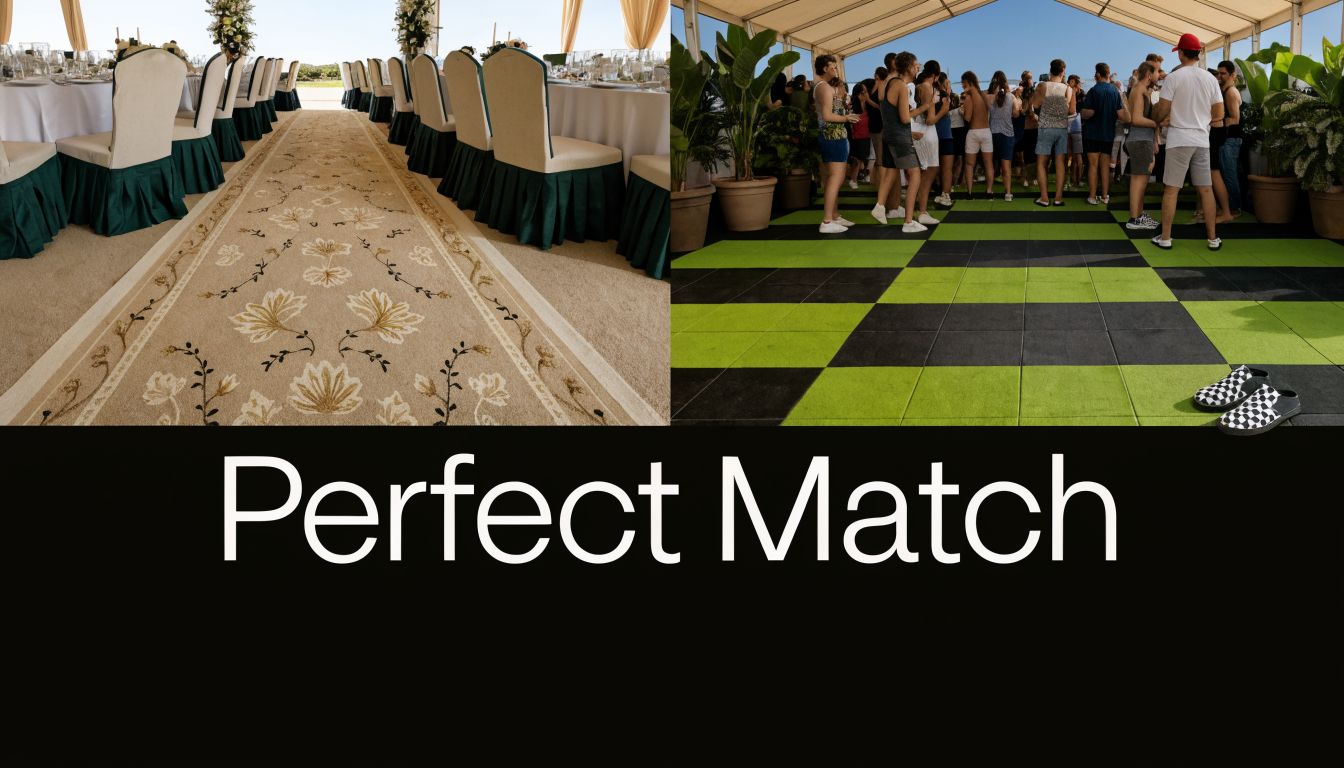
Wedding gardens and family homes
For weddings at private homes across Surrey and South London, comfort and finish usually lead the decision. Guests spend long periods seated, moving between drinks, dining and dancing, and many will be dressed for the occasion rather than for the ground conditions.
A typical recommendation is:
- A level subfloor suited to the garden
- A carpeted main interior for warmth and formality
- A dedicated dance floor insert or separate dance area
- Protected entrance sections where foot traffic is heaviest
This setup works well because it balances appearance with practicality. A formal aisle or dining room atmosphere can still sit comfortably inside a domestic garden if the floor creates enough visual order.
Corporate launches and staff events
Business events in Croydon and nearby commercial venues usually need a more disciplined layout. People stand more, circulate more, and use the space in a less predictable pattern than wedding guests.
That changes the flooring decision. Harder-wearing surfaces often make sense around:
- Reception points
- Bar and catering zones
- Product display areas
- Entrances where outdoor footfall is constant
For a polished front-of-house look, carpet can still be the right call in audience-facing zones. The key is not treating the whole marquee as one identical surface if the event functions in different ways.
One practical aid during planning is seeing how event teams fit and finish these spaces in real settings:
Community festivals and public-facing events
For school functions, council events and community celebrations, the floor has to cope with repeated traffic and less controlled movement. The venue may also include mixed ground conditions from grass to tarmac to temporary access routes.
In those cases, the smartest option is often a combination rather than a single decorative finish.
Entrance routes and service areas usually need a tougher, more forgiving surface than the central guest zone.
That’s especially true when poor weather is a possibility. A beautiful carpeted finish loses its appeal quickly if guests arrive through wet grass and queue at one busy point. Better to harden the critical routes and keep the principal guest areas looking clean.
Three simple event matches
| Event type | Floor approach that often works well | Why |
|---|---|---|
| Formal wedding | Carpeted main floor with defined dance area | Creates comfort and a refined visual finish |
| Corporate event | Mixed surfaces by zone | Supports traffic, branding and practical operations |
| Community function | Durable access routes with stable central event flooring | Handles heavier use and variable ground conditions |
The best flooring choices usually come from asking one plain question early. How will people move through the marquee once the event starts?
Essential Technical and Safety Considerations
A flooring marquee isn’t properly specified until the technical side has been addressed. At this point, safety, legal obligations, and guest comfort all meet. It’s also the point where an under-planned floor becomes expensive, because the fixes tend to appear late.
Load bearing and heavy items
Not every event places the same demands on the floor. A seated dinner with light furniture is one thing. A marquee holding staging, production equipment, large bar units or other concentrated loads is another.
The practical issue is simple. Heavy items don’t just need space. They need support under the exact points where the weight is concentrated.
Ask early if your event includes:
- A stage or performance platform
- A large band setup
- Heavier catering equipment
- Display structures or branded installations
- Any item that can’t tolerate movement or unevenness
The visible floor may look identical across two events, but the substructure beneath it may need to be very different if the load profile changes.
Accessibility is not optional
For public-facing, community and corporate events, flooring has to be considered through an accessibility lens, not just a styling one. Verified guidance notes that UK guidance on accessible events stresses level, stable surfaces but rarely links this explicitly to marquee floor systems. It also states that marquee flooring is not a luxury add-on but a core accessibility measure, necessary for meeting requirements for tactile paving zones, ramp gradients, or wheelchair-turning-circles, which can vary significantly between private lawns and public parks, as discussed in this accessible event flooring discussion.
That matters because many clients assume accessibility begins and ends with a ramp at the entrance. It doesn’t. The internal floor needs to support movement once someone is inside the marquee.
What to check for accessibility
- Entrance transitions: The move from path, lawn or car park into the marquee should feel deliberate, not improvised.
- Level routes through the space: Dining, bar and toilet access should be workable without awkward detours.
- Turning space: Mobility aids need enough room at key points, especially around tables and circulation areas.
- Surface consistency: Floors shouldn’t shift noticeably between one zone and another without good reason.
If you’re creating an event planning pack, a general ABCO Security event risk template can be a useful starting point for thinking through access, hazards and movement, alongside the venue-specific details your marquee supplier will assess.
A good marquee floor doesn’t only help guests who identify as disabled. It helps anyone pushing a buggy, using a walking aid, recovering from injury, or simply unsteady on soft ground.
Thermal comfort underfoot
Guests notice cold floors more than many organisers expect, especially during longer seated events. Verified trade guidance states that internal flooring should extend to within 50mm of marquee walls to permit thermal expansion and air circulation, and that specifying an insulated underlay beneath carpet or thicker carpet overlays, typically 12-15mm pile depth, increases surface temperature by 3-5°C during seated events lasting 4+ hours according to DG Floors marquee flooring guidance.
That’s useful in practical terms, not just technical ones. If you’re planning a winter party, a spring wedding, or an evening reception where guests stay seated for long stretches, underfoot warmth makes the room feel settled much faster.
Heating and flooring should be planned together rather than separately. If you’re looking at both as part of the same package, it helps to review options for marquee heating alongside event structures, because the floor and the heat output need to work as one environment.
Planning Your Marquee Floor Layout and Flow
A good floor isn’t only about materials. It’s also about movement. The layout inside the marquee decides whether guests drift naturally through the event or keep bunching in the same places.
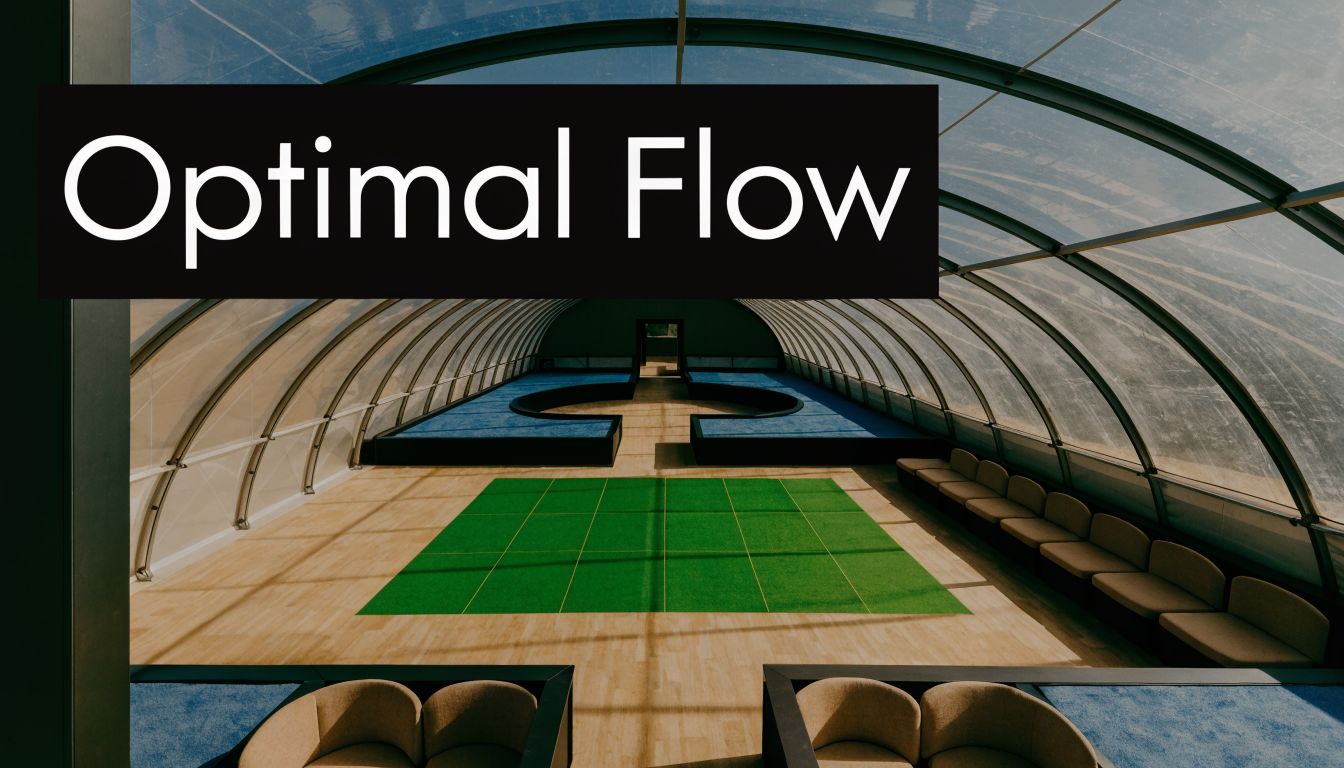
A drawn plan is helpful. Even a simple CAD layout can save a lot of second-guessing because it lets you test where the dining area, dance floor, bar, entrance and service routes sit before anything arrives on site.
Start with the busiest route
The most important line in the marquee is usually not the centre line. It’s the path people use most often. From entrance to drinks area. From dining tables to dance floor. From bar to seating.
If that route cuts awkwardly across chair backs, service stations or decorative features, the marquee feels cramped even when it isn’t.
A useful planning sequence is:
- Mark the entrance and exit points
- Place the main guest destination next, often the bar or reception area
- Position dining so chairs can pull out without blocking walkways
- Set the dance floor where it feels connected, not stranded
- Keep service movement off the main guest route where possible
Zoning the floor properly
Different floor finishes can help define use without putting up physical dividers. A dance floor insert signals where the social centre is. A carpeted dining zone settles the room. A firmer route near catering or access points can subtly guide how people move.
That matters in larger marquees where one open-plan space can otherwise feel vague.
Guests shouldn’t have to work out where to stand, where to queue, or how to get to the next part of the event. The floor plan should do some of that work for them.
Common layout mistakes
Some issues come up again and again at private and corporate events:
- Entrance bottlenecks: Too much furniture too close to the opening.
- Bar congestion: The bar is popular, but it still needs breathing room around it.
- Detached dance floors: If it’s too far from seating and the bar, it loses energy.
- Dead corners: Large empty areas can make the marquee feel underused rather than spacious.
A well-planned flooring marquee layout helps avoid all four. The floor is one of the easiest ways to cue function, especially when the marquee itself is a blank canvas.
The Hiring Process Costs Timelines and Key Questions
Hiring marquee flooring works best when it’s treated as part of the main event build, not a late extra. That matters for cost, programme and design quality.
Pricing is usually driven by area and complexity. A straightforward level site is one thing. A site that needs a more advanced subfloor, careful access planning or multiple floor zones is another. The broad point is that the cost usually follows the engineering demand underneath, not just the finish on top.
Book flooring with the marquee, not after it
This is one of the most useful decisions a client can make. If you leave flooring until late, you limit your options. The supplier may then be working around a fixed marquee footprint, final furniture plan and event date instead of shaping them together.
That’s one reason many clients choose to organise flooring at the same time as the main marquee hire package. It keeps the structural, visual and logistical choices aligned from the start.
For winter and shoulder-season events, don’t leave comfort questions until the final week. Verified guidance notes that insulated underlay beneath carpet or thicker carpet overlays, typically 12-15mm pile depth, can increase surface temperature by 3-5°C during seated events lasting 4+ hours, which is highly relevant for longer functions in London and Surrey, as outlined in the earlier DG Floors reference.
Questions worth asking any supplier
A good supplier should welcome detailed questions. If they don’t, that tells you something.
Ask things like:
- What subfloor system suits my site? You want a reasoned answer, not a default package.
- Will you carry out a proper site visit? Gardens and outdoor venues nearly always look different in person than they do in photos.
- How will the floor handle entrances and changes in level? This matters just as much as the main guest area.
- How are accessibility needs built into the plan? Especially important for public, corporate and mixed-generation events.
- What happens if the ground is wetter than expected on install day? You want a contingency, not improvisation.
- How will the flooring interact with furniture, heating and dance areas? The best answers treat these as connected decisions.
What a professional process looks like
One practical benchmark is a supplier who can combine a site visit with layout planning and clear discussion of ground conditions. Premier Marquee Hire, for example, offers site visits and CAD layouts as part of its wider service information, which is exactly the sort of joined-up process clients should look for when flooring is part of a bigger marquee build.
The buyer’s rule of thumb
Choose the team that asks the most useful questions about your ground, access and guest movement. Not the team that jumps straight to carpet colour.
That’s usually the difference between a floor that merely covers the grass and one that supports the event.
If you’re planning an event in Croydon, South London, Surrey or the surrounding areas and want clear advice on the right flooring marquee setup for your site, Premier Marquee Hire can help you assess the ground, plan the layout and choose a flooring solution that fits the event properly.
Sorry, the comment form is closed at this time.