

02 Jun A Complete Guide to a Marquee to Hire in London (2026)
You've got a date in the diary, a rough guest list, and a dozen tabs open comparing venues, gardens, and hire companies. That's usually the point where people start asking for “a marquee to hire” when what they really need is a workable event plan.
A marquee changes the question. Instead of hunting for a venue that almost fits, you create one that fits properly. That matters in Croydon and across Greater London, where gardens vary wildly, access can be tight, car parks become event spaces, and a site that looks simple at first glance often needs proper thought around flooring, power, neighbours, and weather cover.
For a family party in Purley, the answer might be a compact structure over a patio and lawn. For a wedding in Sanderstead, it could mean a larger dining space with a separate bar and dance area. For a corporate event in Bromley or Sutton, it often means using a clearspan marquee on hard standing so the layout stays clean and practical.
The good news is that the process is far less mysterious than it seems. Once you know how marquee types differ, how capacity is calculated, what a site survey checks, and which extras are useful, decisions become much easier.
Your Event Vision Starts Here
A client in Croydon often starts with a simple brief. Birthday in the garden. Wedding at home. Company event in a yard or car park. Then the real questions arrive. Will it fit, how will people move through it, where will the catering go, and what happens if the weather turns.
That is the right place to start.
A marquee gives you control over the space, but the best results come from planning the event around how the day will run, not from picking a structure because it looks good in a photo. In Greater London, that matters more than many first-time clients expect. A nice flat lawn in the listing photos can turn out to have awkward levels, restricted side access, overhead cables, or neighbours close enough to affect music plans.
Plan the event first, then the marquee
The first job is to get clear on how the space needs to work.
For a wedding reception in Sanderstead, that might mean a dining area, dance floor, bar, catering access, and enough circulation space that guests are not squeezing past tables all evening. For a Mehndi or family celebration in Thornton Heath, it may mean separate seating groups, service space for food, and weather cover between the house and marquee. For a business event in Croydon or Sutton, it often comes down to clean guest flow, branding space, and practical access for deliveries and pack-down.
A few early decisions make the rest of the hire process much easier:
- How guests will spend their time. Mostly seated, mostly standing, or a mix of both.
- What must happen inside the structure. Dining, speeches, dancing, catering service, prayer space, staging, or a bar.
- What can sit outside the marquee. Toilets, generator, smoking area, welcome space, or back-of-house prep.
- What the site will allow. Access width, surface type, slopes, nearby trees, and noise-sensitive boundaries.
Those points affect size, shape, flooring, lighting, heating, and installation method. They also affect cost, which is why a good brief saves money as well as stress.
Croydon sites rarely behave like brochure sites
Local marquee planning is usually about constraints.
In Purley and South Croydon, gardens are often deeper than they are wide, which changes layout options. In central Croydon and parts of Greater London, access is often the bigger issue than footprint. I have seen sites with enough room for a generous marquee, but only if the kit can get through a side passage, avoid tight turns, and be installed without blocking shared access for hours.
Hard standing can be very useful for corporate or school events, but it changes the fixing method and may bring extra ballast or flooring considerations. Lawns look attractive, but soft ground after rain can affect installation, guest comfort, and where support vehicles can stop. None of that rules a site out. It just needs to be handled properly from the start.
What good planning looks like in practice
A well-planned marquee event feels straightforward on the day because the difficult decisions were made earlier.
The guest count has some margin built in. The layout reflects how people will use the space. The install team knows the access route, power plan, and surface conditions before arriving. If the site needs matting, flooring, heating, or quieter generator placement, that is agreed in advance rather than discovered the day before the event.
That is usually the difference between a marquee that merely fits on site and one that works properly once guests arrive.
Choosing Your Marquee Type
Not all marquees solve the same problem. Some are chosen for appearance first. Others are chosen because they make layout, access, and installation far easier. In London and the South East, that difference matters.
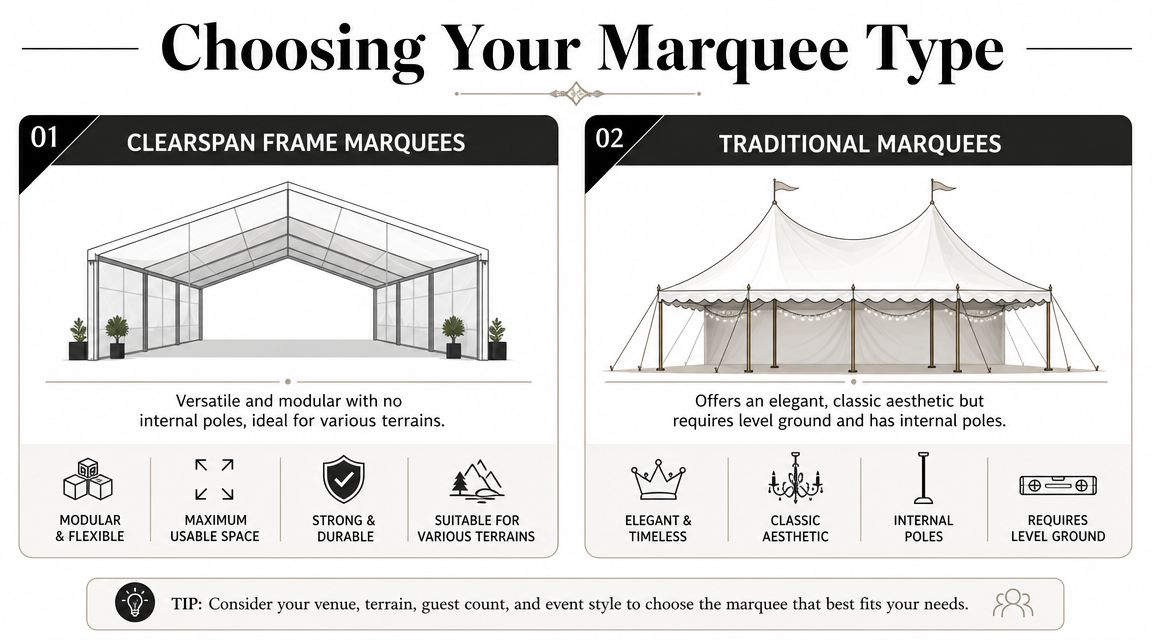
Clearspan frame marquees
For most modern events, clearspan frame marquees are the most practical option. They don't use internal centre poles, so the entire footprint is usable. That gives you much more freedom with dining layouts, stage positions, bars, dance floors, and walkways.
They're also modular. According to Field and Lawn's guide to marquee hiring considerations, clearspan structures are commonly used in widths from 3m to 30m, with lengths extended in bays. In real terms, that means the marquee can be built around your guest numbers and your site, rather than forcing you into a fixed shape.
Traditional pole marquees
Pole marquees have a classic look and can be beautiful for the right setting. They suit open spaces where you want that traditional silhouette and where the central poles won't interfere with the layout.
The trade-off is practical. Internal poles interrupt sightlines and usable floor space. They also need the right ground conditions and enough surrounding room for guy ropes. In a large field, that's manageable. In a suburban garden in Croydon or Wimbledon, it often becomes restrictive very quickly.
Pagodas and smaller linked structures
Pagodas are useful as entrance canopies, bar covers, catering tents, or small satellite spaces. On their own, they're ideal for compact events. Linked together, they can create attractive zones around a main marquee.
They work well when the site can't take one large footprint or when the event benefits from separate areas. A garden party might use one marquee for dining and another for service or drinks. A corporate setup might use pagodas as registration or breakout points.
Which type works best for most clients
If your priority is flexibility, clear circulation, and efficient use of the footprint, a clearspan is usually the strongest answer.
That's especially true when the event includes any of the following:
- A formal dining layout: round tables need clean spacing and sensible aisle widths.
- A stage or DJ area: internal poles create awkward compromises.
- A dance floor: open central space works much better than trying to build around obstructions.
- Hard standing installation: frame systems are typically better suited to varied urban sites.
Clearspan marquees usually win because they let the event layout lead. The structure supports the plan, instead of dictating it.
Planning Your Marquee Capacity and Layout
A client in Croydon might say they have 60 guests and assume the answer is a single marquee size. In practice, 60 guests for drinks and canapés needs a very different layout from 60 guests sitting down for a wedding breakfast, with a bar, DJ, and space for staff to move properly.
Start with the event at its fullest point of use. If everyone will be seated at once, dancing later, and queuing at the bar in between, the marquee has to carry that peak comfortably. Planning only for the guest count usually produces a space that feels tight as soon as tables, chairs, and service equipment go in.
A simple size guide helps at the early stage:
| Marquee Capacity Guide (Approximate) | Standing Reception Capacity | Seated Banquet Capacity |
|---|---|---|
| 3m x 6m | Smaller standing gathering | About 20 seated guests |
| 3m x 12m | Larger standing gathering | About 30 seated guests |
Independent guidance in this marquee size guide gives a useful sense of scale, but real planning in Greater London nearly always comes down to layout efficiency, furniture choice, and how much working room the event needs.
That last point matters more than many clients expect.
Round tables take more room than trestles. A staffed bar needs queue space. A buffet needs people to approach it without blocking the main walkway. If a DJ setup, dance floor, cake table, gift table, or lounge seating is part of the brief, those items should be treated as planned floor area from the start, not squeezed in later.
The cleanest marquee plans usually divide the interior into clear zones:
- Dining space: enough room for chairs to pull back and staff to serve
- Bar area: positioned so queues do not cut across the main route
- Dance floor: large enough to be used properly, not just fitted in on paper
- Soft seating: useful for guests who want somewhere quieter during a long event
- Service access: a practical route for caterers, waiting staff, or equipment movement
In suburban gardens around Croydon, Purley, and Sanderstead, this zoning often decides whether the event feels relaxed or cramped. Two marquees with the same headline capacity can perform very differently if one has proper circulation and the other relies on guests constantly shuffling chairs to let people through.
I usually advise clients to be honest about furniture movement. If the plan involves clearing tables after dinner to create dancing space, that can work well, but only if staff are booked to do it and the schedule allows for it. If the room needs to function for dining and dancing with minimal changeover, the marquee should be sized for both uses from the outset.
Heating can affect layout too, especially for spring and autumn events. Placement of doors, linings, and warm air units needs to support the table plan rather than fight against it, which is why it helps to review marquee and heater hire options for colder-weather events before the footprint is fixed.
For more involved setups, a layout drawing is worth asking for. On an awkward plot, or with a mixed-use event, seeing the tables, dance floor, bar, and access routes on paper usually prevents the expensive mistake of hiring a marquee that is technically large enough but operationally too tight.
London Site and Seasonal Considerations
A marquee that works beautifully on a flat open lawn can become a much more technical job on a London driveway, behind a terraced house, or across a split-level garden. In these situations, local experience matters most.

Access is often the real challenge
In Croydon and nearby boroughs, the biggest constraint often isn't the event itself. It's getting the equipment to the build area safely and efficiently.
A few common examples:
- Terraced properties: side access may be narrow, stepped, or shared
- Patios and hard standings: these need a different fixing approach from open lawns
- Sloping gardens: flooring and levelling become part of the solution, not an optional extra
- Protected lawns: clients often want a clean finish without churned ground or damaged borders
A sensible site survey checks gate widths, route obstructions, overhead cables, surface changes, and whether the team needs to hand-carry equipment through the property. These details affect setup time and the installation method.
British weather needs proper specification
A marquee can absolutely work outside the height of summer, but only if the setup matches the season. Generic “all-weather” language isn't enough.
Current UK weather planning needs to account for both heat and heavy rain. The Met Office was reported as saying recent years have seen record warmth and extreme rainfall, which is why practical planning should include insulated linings, solid flooring, heating, and wet-weather contingencies, as discussed in this weather-focused marquee venue guide.
For winter and shoulder-season events, the useful questions are:
- Will guests be standing or seated for long periods
- Is the ground likely to soften
- How draught-proof are the entrances
- Does the schedule run late into the evening
- Will caterers need protected service access
If you're weighing up heating options, this guide on marquee and heater hire is a helpful next step.
What usually solves the problem
A comfortable cold-weather marquee tends to rely on a combination rather than a single add-on.
- Solid flooring: helps on wet or uneven ground and improves the feel underfoot
- Insulated or lined interior: makes the space feel finished and retains warmth better
- Appropriate heating: chosen for the size and use of the marquee
- Managed entrances: reduce draughts and stop guests walking straight from rain into the main room
- Reliable anchoring plan: essential on exposed or hard-standing sites
This short video gives a useful visual sense of how temporary event structures come together on real sites.
Real-world trade-offs on London sites
On a suburban garden job, a slightly smaller dining layout with a separate catering tent can be the right call if access is tight. On a car park installation, a wider clearspan may be simpler because it avoids awkward internal divisions.
The right answer usually isn't “largest possible”. It's the structure that installs cleanly, protects the site, and still lets the event run comfortably in the conditions you're likely to face.
Bringing Your Marquee to Life with Accessories
The structure gives you the shell. The accessories decide whether the event feels warm, elegant, relaxed, formal, or flat.
That's why accessories shouldn't be treated as afterthoughts. They shape how guests experience the space from the moment they walk in.
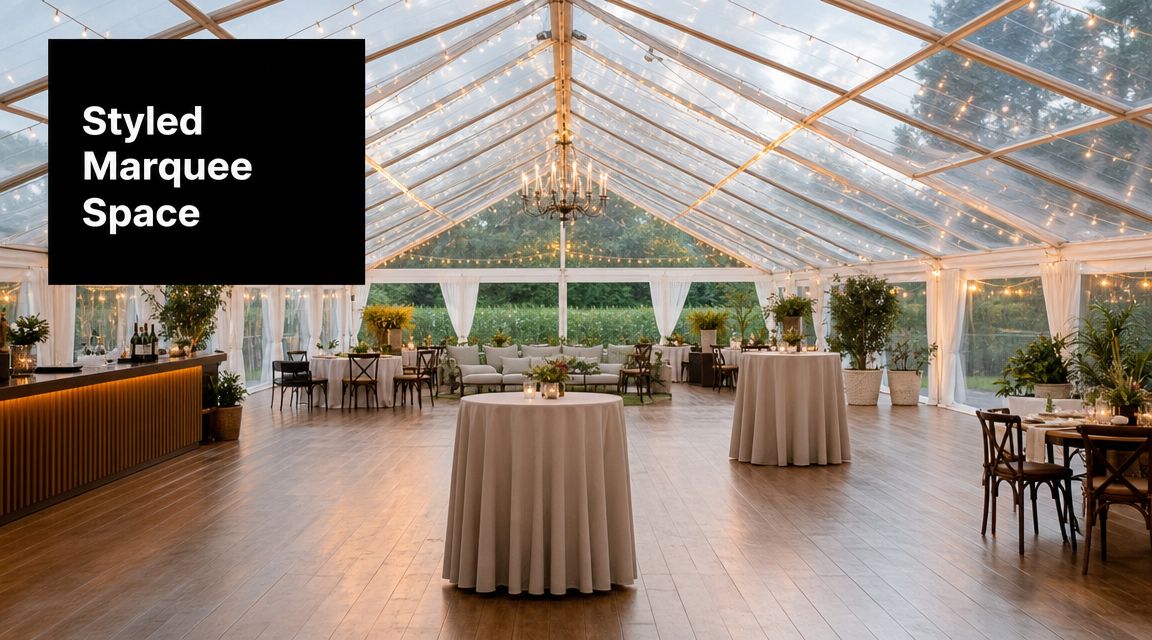
Furniture sets the tone first
Furniture does two jobs at once. It affects appearance, and it controls how people move.
Folding chairs and practical tables are ideal for straightforward parties, school functions, and community events. Chiavari chairs, dressed tables, and more polished seating plans suit weddings and formal receptions far better. Long tables can feel sociable and dramatic. Round tables usually make circulation simpler.
What doesn't work is mixing styles without purpose. A smart marquee with rushed, mismatched furniture instantly feels unfinished.
Lighting changes everything after dark
Lighting is one of the strongest upgrades you can make because it affects mood, visibility, and photography all at once.
Useful layers often include:
- Functional lighting: enough brightness for dining, speeches, and safe movement
- Ambient lighting: fairy lights, festoons, or warm internal effects to soften the space
- Feature lighting: chandeliers, bar lighting, uplighting, or stage emphasis
- External path lighting: especially important in gardens and side-access routes
If you're planning the lighting scheme in detail, this article on lighting for marquees is worth reading.
Good lighting doesn't just help people see. It tells them where to look, where to gather, and when the event shifts from dinner to party.
Bars, dance floors, and the social centre of the event
A mobile bar often becomes the natural anchor point for the room. Place it badly and you create congestion. Place it well and it supports the whole flow of the evening.
The same applies to the dance floor. If it's tucked into a corner with no visual connection to the seating, it can feel disconnected. If it sits naturally between dining and bar space, people use it far more confidently.
For weddings and milestone birthdays, entertainment pieces often finish the room properly. A stage for a band, giant LOVE letters, or a Magic Mirror can all work well if they're given enough space and aren't crammed in at the last moment.
Personal touches people actually keep
Some extras are decorative for the evening. Others become part of the memory afterwards. For guest interaction, a photo station paired with a sign-in setup can work brilliantly, especially if you want something more personal than a standard written book. This complete guide to guest photo books gives practical ideas on making that part of the event more meaningful.
A marquee always starts as a blank canvas. Accessories are what stop it feeling blank.
Understanding Marquee Hire Costs in London
Marquee pricing feels confusing when quotes aren't itemised properly. One company appears cheaper, another looks expensive, and often you're not comparing the same scope.
The clearest way to judge value is to separate the core structure cost from the event-specific extras.
What a professional quote usually includes
A standard marquee hire quote often covers the basics needed to supply the structure itself.
That usually means:
- The marquee frame and roof
- Delivery to site
- Installation and breakdown
- Basic anchoring or fixing method suited to the site
- Hire for the agreed event period
Beyond that, costs typically rise based on what the event needs.
What is often priced separately
Many of the things that make a marquee comfortable or event-ready are optional in the quote because not every client needs the same setup.
These commonly include:
- Flooring
- Carpet or interior lining
- Heating
- Furniture
- Lighting packages
- Bar units
- Dance floors
- Generator or power distribution support
- Extra service tents or covered walkways
That's why a lower headline price can be misleading. If one quote excludes flooring, heating, and lighting, it may not be cheaper once like-for-like items are added.
The main factors that change cost
Price usually moves for sensible reasons, not arbitrary ones.
Look closely at:
| Cost factor | Why it changes the quote |
|---|---|
| Marquee size | Larger footprints require more structure, labour, and often more accessories |
| Site complexity | Tight access, hard standing, slopes, and long carry distances add installation work |
| Event season | Colder or wetter periods may require more flooring and heating |
| Layout requirements | Separate catering areas, bars, and linked structures increase scope |
| Finish level | Functional setup and fully dressed event spaces are very different packages |
A local company can also make a practical difference because travel, logistics, and revisit requirements are usually simpler when the supplier works in your area regularly.
For a broader look at how quotes are structured, this guide to marquee hire prices in London is a useful reference.
What to ask before accepting a quote
Don't just ask for the total. Ask what's missing.
A reliable quote should make it clear:
- Whether flooring is included
- Whether VAT is included
- Whether delivery and collection are included
- Whether setup timings are fixed
- Whether weather-related adjustments could change the scope
The cheapest quote is only useful if it covers the specific event you're trying to run.
Your Marquee Booking Timeline and Checklist
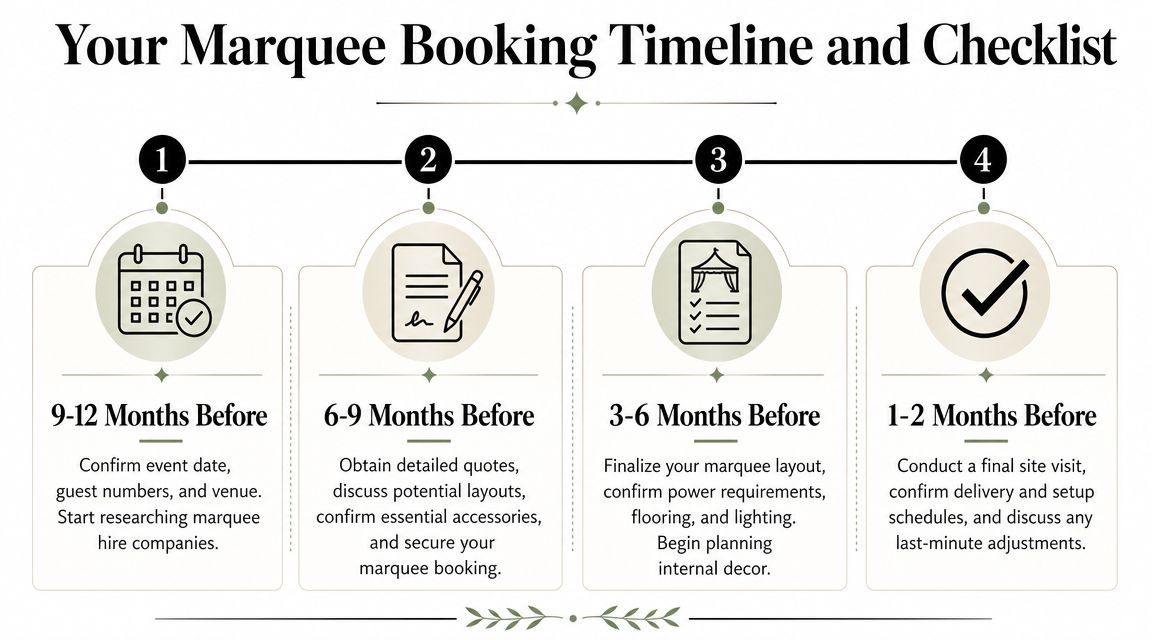
The smoothest bookings start earlier than is commonly expected. Not because every event needs months of stress, but because the good dates go first and site decisions take longer when the event has multiple moving parts.
For weddings and large summer events, it's sensible to start early. For private parties and straightforward garden hires, the timeline can be shorter, but leaving everything late reduces your options.
A workable booking rhythm
A practical way to approach it is:
Early planning stage
Fix the date, rough guest count, and whether the event is mainly standing, seated, or mixed.Quote and site stage
Get the site looked at properly. This is the point where access, surface, marquee type, and likely layout become clearer.Layout and services stage
Confirm furniture, lighting, flooring, heating, bar setup, and any catering or power needs.Final confirmation stage
Check timings, contact details, last access instructions, and any late changes to numbers or layout.
If you want a broader planning framework to sit alongside the marquee booking itself, this efficient event planning guide is a helpful resource.
Questions to ask any marquee supplier
These questions quickly tell you whether you're dealing with a careful operator or someone pricing loosely.
Insurance and responsibility
Ask what cover they hold and what happens if site conditions are different from the original brief.Site survey process
Ask whether they'll visit in person, what they check, and whether they assess access as well as footprint.Fixing method
Ask how they secure the structure on grass, patios, or car parks.Wet-weather plan
Ask what they recommend if rain is forecast and whether flooring or entrance protection should change.Power and heating
Ask who is responsible for calculating requirements if you're adding caterers, lighting, or heaters.Setup and breakdown timings
Ask when they need access, how long installation usually takes, and what the collection window is.
A good supplier doesn't rush these answers. If they're careful before the booking, they're usually careful on site as well.
Your own pre-booking checklist
Before you confirm, make sure you can answer these yourself:
| Check | Why it matters |
|---|---|
| Do you know your realistic guest range | A marquee sized for guesses often ends up wrong |
| Have you identified the exact build area | The usable site is often smaller than the garden as a whole |
| Have you considered neighbours and parking | This affects finish times, music, and guest arrival plans |
| Do you know what must be inside the marquee | Catering, bars, and entertainment all change the footprint |
Good marquee planning isn't about being over-cautious. It's about removing avoidable surprises.
Frequently Asked Questions for London Marquee Hire
Some of the most important marquee questions aren't about style or size. They're about what happens when real life gets involved. Councils, neighbours, narrow access, wet ground, and setup-day problems are usually what make clients uneasy.
Do I need planning permission for a marquee in my garden
Sometimes no. Sometimes you need to ask more questions before assuming it's fine.
A key issue with home and garden marquee hire in the UK is the interaction between temporary structures, neighbour impact, local councils, Environmental Health, and event permissions. That's especially relevant in denser London areas where noise-sensitive neighbours are close by, as noted in this discussion of planning permission and neighbour impact for domestic marquees.
In practical terms, the marquee itself may not be the only issue. Late music, guest parking, lighting spill, generators, and the overall scale of the event can matter just as much. If you're hosting at home in Croydon, Sutton, Bromley, or another built-up area, it's sensible to think beyond “can the structure go up” and ask “can the event run without causing complaints”.
What happens during a site survey
A proper site survey checks more than measurements.
Expect the survey to look at:
- Access route: gates, steps, side passages, and carrying distance
- Ground conditions: lawn, patio, gravel, or mixed surfaces
- Level changes: slopes, retaining edges, and soft spots
- Power position: what's nearby and what may need extra planning
- Surrounding constraints: trees, fences, garages, neighbouring properties
The survey should also test whether your preferred layout makes sense on the actual site, not just on paper.
What if the weather turns bad before setup day
A professional team plans for that before the forecast becomes a problem. The questions are usually about ground protection, install timing, flooring, and whether entrances need more weather protection.
What doesn't help is pretending weather won't matter because the marquee has a roof. Heavy rain affects access, lawns, and guest comfort. Wind affects installation sequencing and how exposed side openings should be treated. The answer is preparation, not panic.
Can a marquee go on a driveway or car park
Often yes, but it needs the right fixing method and a realistic plan for the surface underneath. Hard standing can be excellent for clean access and stable guest movement, especially for corporate events. It just needs to be assessed correctly.
Is a home marquee party only about the structure
No. This is one of the biggest misconceptions.
At home, the event only works smoothly if you think about:
- Neighbour communication
- Music finish time
- Toilet arrangements
- Guest arrival and parking
- Catering access
- Waste and breakdown timing
That wider planning is often what separates a relaxed event from a stressful one.
If you're at the stage of checking dates, comparing layouts, or trying to work out what will fit on your site, Premier Marquee Hire is a Croydon-based option for marquee hire, site visits, and layout planning across London and the surrounding counties. A quote request or site survey is usually the easiest place to start.
Sorry, the comment form is closed at this time.