

07 Jun Chiavari Limewash Chair: London Marquee Events 2026
You've got the marquee sorted, the guest list is moving, and now the furniture decisions start multiplying. Round tables or trestles. White folding chairs or something smarter. Cushioned banqueting seats or a chair that enhances the room instead of just filling it.
That's usually the point where people realise seating isn't a side detail. In a marquee, chairs are everywhere. They shape the first impression, the photographs, the room flow, and the pace of setup on the day. If you're planning a wedding in Croydon, a corporate reception in Greater London, or a lively Mehndi celebration in a garden or open venue, the wrong chair can make a polished setup feel heavy very quickly.
A Chiavari Limewash Chair tends to solve more problems than people expect. It looks formal without feeling stiff, works with soft wedding styling and brighter celebration décor, and it's practical enough for real event logistics. That balance is why it keeps turning up in marquees across London.
The Secret to Timeless Event Style
A marquee can look immaculate on paper and still feel unfinished once it's built. The flooring is down, the lining is crisp, the lighting is ready, but the room only starts to feel like an event once the seating goes in. That's where most clients either calm down or start second-guessing every decision.
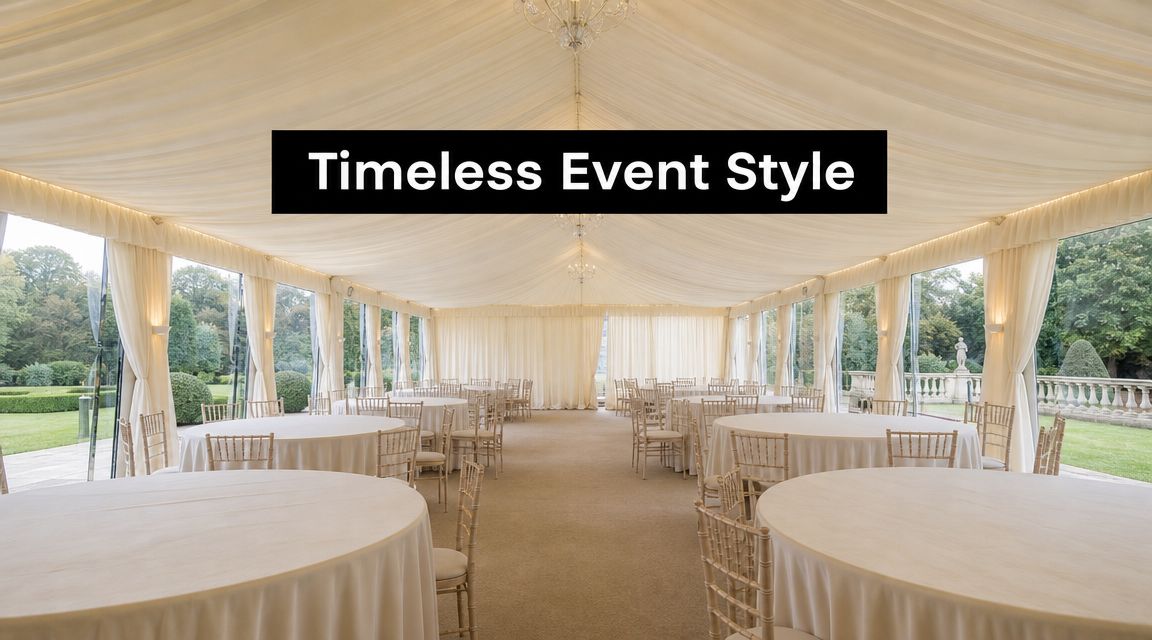
In practice, chairs do more than provide a seat. They decide whether a marquee feels open or crowded. They affect how easily guests move between tables. They influence whether the room photographs as refined or just functional. For clients in Croydon and the surrounding boroughs, that matters because marquee spaces often need to do several jobs in one event. Ceremony first, meal later, then dancing once the layout shifts.
Why this chair changes the room
A Chiavari Limewash Chair gives you that dressed look immediately. It has enough detail to feel special, but it doesn't dominate the space. That's a big difference from bulkier banquet seating, which can make a clear marquee feel visually packed before your florals, linens, or lighting have any chance to stand out.
The limewash finish helps even more. It softens the look of the chair, especially under warm festoon lighting, chandeliers, or daylight through marquee walls. In a garden setting in South Croydon or a more formal venue setup in Sutton or Bromley, that finish tends to settle into the room rather than fight it.
A good chair should support the event design, not become a separate design problem.
When clients feel overwhelmed
Individuals don't typically spend their days comparing chairs for a living. They're trying to organise timings, suppliers, family requests, weather plans, and a budget all at once. So the useful question isn't “What's the trendiest chair?” It's “What will still look right when the marquee is fully dressed and the day gets busy?”
That's where Chiavari seating earns its place. It's one of the few options that looks established, works across very different event styles, and still makes sense operationally once delivery, setup, and turnaround enter the picture.
What Exactly Is a Chiavari Limewash Chair?
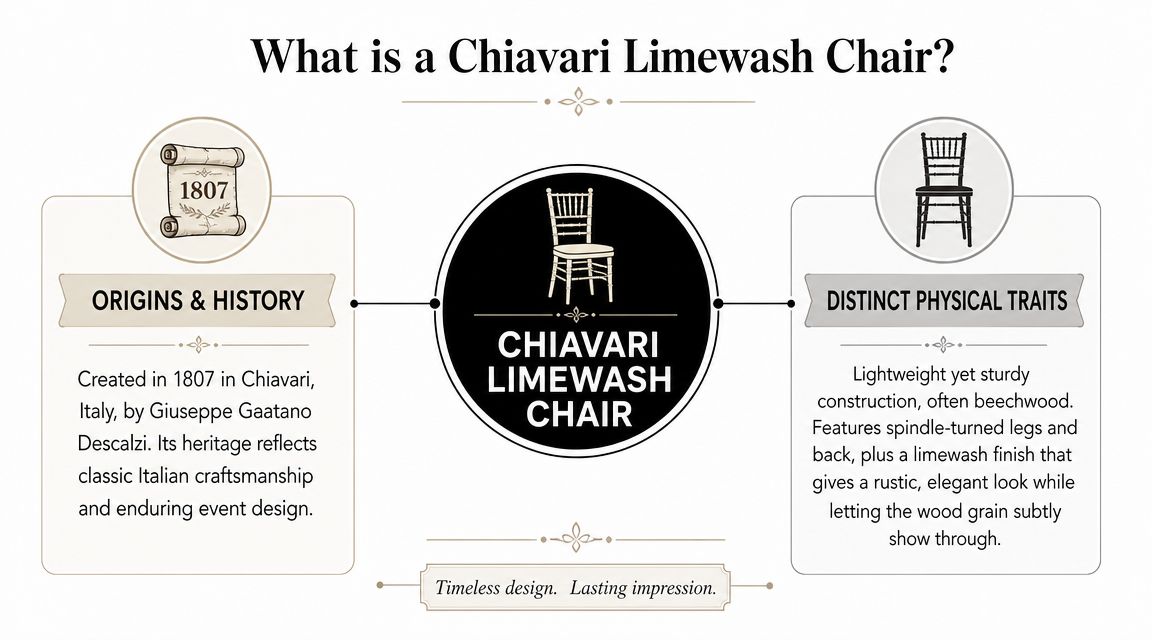
The reason this chair still feels current is that it was never designed as a fad piece. The Chiavari chair was created in 1807 in the Italian town of Chiavari by Giuseppe Gaetano Descalzi, and the design became known as the Chiavarina. Its history is outlined in this Chiavari chair reference. That heritage matters because it explains why the chair still reads as formal and recognisable more than 200 years later.
In the UK events world, that long design life is one reason it became such a reliable choice for weddings, banquets, and premium hospitality. It doesn't need reinvention. It already carries the right visual language for special occasions.
The features that define it
A proper limewash Chiavari chair usually has a few recognisable characteristics:
- Six-spindle curved backrest that gives the chair its classic outline and keeps it visually light
- Wood-frame construction, often described in trade listings as commercial-grade beech wood or a similar wood frame
- Removable or ivory seat pad, which helps with comfort and styling flexibility
- A pale limewash finish that works as a neutral rather than a hard white
The curved back and spindle structure aren't just decorative. UK technical listings describe that shape as central to the chair's balance between stiffness and low visual weight, which is part of why the style has remained so popular in repeated hire use across formal events.
What limewash actually means in event styling
Clients often perceive limewash as 'off-white'. It's more useful than that. Limewash has a softened, neutral character that sits comfortably with white linen, warm timber tables, pastel florals, richer jewel tones, and most marquee linings.
That's why it works well for events that don't want a metallic finish. Gold can look too traditional in the wrong room. Silver can feel colder than expected. Black is sharp, but it changes the mood entirely. Limewash stays flexible.
If you're comparing options and want a closer look at seating styles in a hire context, this guide on Chiavari chair hire is a useful next step.
| Element | What it means for your event |
|---|---|
| Historic Italian design | Feels established and formal |
| Spindle back | Elegant shape without visual bulk |
| Wood frame | Better suited to classic marquee styling |
| Limewash finish | Neutral base for varied décor schemes |
Why Choose Limewash Chairs for Your Marquee Event
The strongest reason to choose this chair isn't just that it looks elegant. It's that it solves the usual marquee tension between appearance and logistics. You want the room to feel elevated, but you also need a layout that can be delivered, placed, adjusted, and cleared without turning the day into a furniture exercise.
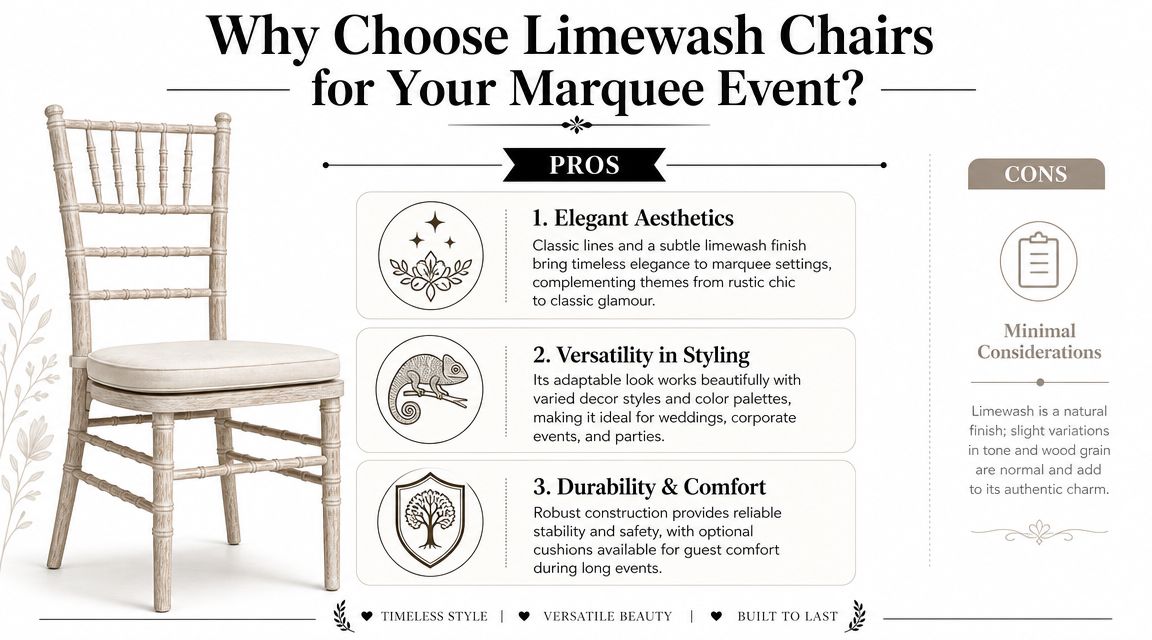
One practical advantage is size and handling. A typical limewash Chiavari chair is listed at around 40 cm wide and weighs roughly 3.4 to 4.5 kg in UK hire-market specifications, which makes it easier to move and better suited to dense but tidy layouts in marquees, as shown in this limewash Chiavari chair specification.
It keeps a marquee feeling open
Bulkier chairs can reduce the sense of space very quickly. That matters in marquees because the room often has multiple visual layers already. Linings, poles, bars, dance floors, top tables, cake displays, and catering routes all compete for space.
A Chiavari frame stays slim. Guests still feel properly seated, but the room doesn't become chair-heavy. That's a simple point, yet it makes a visible difference when you're trying to keep a wedding breakfast elegant or a corporate dinner polished.
It works across more than one look
The chair's shape is formal, but the finish is forgiving. That combination is rare. It can sit under chandeliers and soft draping just as easily as it can beside branded stage backdrops, coloured napkins, or vivid floral schemes.
Here's a quick visual overview before we get into styling examples:
The operational case is just as strong
For larger marquee events, logistics matter as much as styling. Chairs that are awkward to handle slow down changeovers, especially when a team needs to reset dining areas, add extra ceremony rows, or clear part of the room for evening use.
Practical rule: If a chair looks lovely but causes friction in transport, stacking, or floor handling, it won't feel like a good choice on event day.
What works well with limewash Chiavari chairs:
- Fast placement because the chair is relatively light to carry
- Clean row planning because the frame is compact
- Flexible restyling when layouts change between ceremony and reception
What doesn't work so well:
- Over-accessorising the chair with heavy covers or bulky styling that hides the frame
- Using it where a casual look is the goal, because it still reads as occasion seating
Styling Ideas for Weddings Corporate Events and Mehndi Parties
A limewash Chiavari chair works best when you let it act as the base layer. It isn't shouting for attention, which means the rest of your styling has room to do its job. That's why it adapts so well across very different event briefs.
The UK market has increasingly treated the limewash finish as a flexible neutral. It supports the traditional white wedding look and also suits multi-purpose hire stock because it works across weddings, corporate functions, and mixed cultural celebrations, as discussed in this UK event styling guide on limewash Chiavari chairs.
Wedding marquees that feel soft, not flat
For weddings, the risk with neutral styling is that the marquee can drift into plainness. Limewash helps avoid that because the chair brings texture and shape even when the palette is light.
Pair it with:
- White or ivory linen for a clean base
- Soft floral runners or centrepieces rather than dense arrangements at every table
- Warm lighting such as chandeliers, uplighting, or candle-style lamps
- Subtle chair pad choices that don't break the palette
If you're organising guest placement at the same time, a well-planned wedding seating chart helps you avoid last-minute table reshuffles that can upset the look of the room.
Corporate events that still feel polished
For corporate marquees in London, clients often want the room to look refined without becoming too wedding-like. Limewash can still work well if the rest of the scheme is sharper.
Use the chair with dark table linen, minimal florals, branded menus, or selective colour accents through napkins and staging. The result feels considered rather than cold. In spaces where people are networking before sitting down, that lighter chair profile also stops the room looking too packed from the outset.
Mehndi parties where colour does the talking
For Mehndi celebrations, the neutral base is a real asset. Bright textiles, marigold tones, coloured glassware, patterned table settings, and statement backdrops all sit more comfortably against limewash than against stronger metallic finishes.
That's especially helpful in marquees, where décor often carries a lot of the atmosphere. You want colour to pop, but you don't want the furniture competing with it. Limewash gives those brighter details somewhere to land.
For broader ideas on dressing the full marquee, this guide to marquee decoration ideas is useful when you're planning chairs alongside draping, lighting, and tablescaping.
Keep one visual anchor per table. If the chairs are elegant and the linens are strong, let the centrepieces complement rather than compete.
Practical Hire Guidance for Your London Event
By the time clients get to furniture decisions, they usually want direct answers. How many chairs do we need? Will they fit comfortably? Are they easy to handle in a marquee? What should we expect on price?
That's where practical hire planning matters more than Pinterest boards.
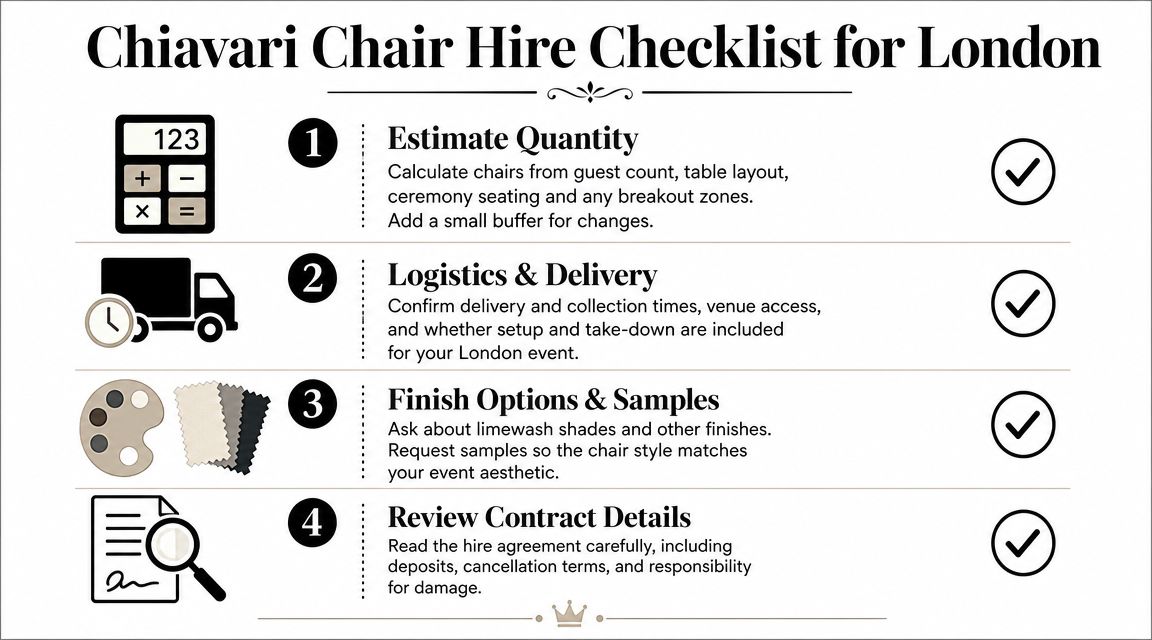
Start with quantity, then layout
The first mistake is counting only dining seats. Many London marquee events need chairs for more than one zone. Ceremony rows, dining tables, signing areas, lounges, and breakout spaces all affect the final number.
A practical approach is to list each use area separately:
- Dining area with final table plan
- Ceremony seating if that happens before the meal
- Top table or stage positions
- Spare chairs for late layout changes
If your event includes live presentations, hybrid content, or a stage-led format, it's also worth reviewing expert advice for UK event production so seating, screens, and audience sightlines work together.
Know what the hire market is telling you
UK hire listings show limewash Chiavari chairs at around £3.80 per chair ex VAT for events, which places them as a mainstream premium option in the market. Trade listings also note stackability of 8 to 10 high, which is one of the details that makes them practical for delivery, storage, and fast turnaround in large-capacity setups, as outlined in this UK limewash Chiavari hire listing.
That matters in London because access is often a significant challenge. Narrow gates, timed load-ins, temporary flooring, and quick evening clear-downs all favour chairs that move efficiently.
Protect the floor and the schedule
Temporary marquee flooring, dance floors, and venue surfaces need care. A chair can be elegant and still be a nuisance if it marks floors, catches on joins, or slows the team down during reset.
What usually works best:
| Planning point | Why it matters |
|---|---|
| Confirm delivery access early | London venues often have restricted loading windows |
| Check flooring type | Marquee flooring and indoor venue floors need different handling care |
| Match chairs to table plan | Prevents cramped aisles and awkward service routes |
| Ask about setup support | Saves time if the room needs a precise layout |
For clients who want help visualising capacity and table flow, chair hire guidance is useful, especially when you're balancing ceremony seating with dining and evening use. Some providers, including Premier Marquee Hire, also offer site visits and CAD layouts, which can be helpful when a Croydon garden or London venue has awkward access, uneven ground, or a tight footprint.
The right chair count isn't just about guest numbers. It's about how the room needs to behave from setup through to clear-down.
Book Your Chairs with Premier Marquee Hire
By this stage, the appeal of the chair is usually clear. A Chiavari Limewash Chair gives you a formal look without visual heaviness, a neutral finish that adapts across different event styles, and practical handling that suits marquee work rather than fighting it.
That mix is what makes it such a sensible choice for London events. Weddings need elegance. Corporate functions need order and flexibility. Mehndi parties need a neutral base that lets colour, fabric, and lighting stand out. This chair handles all three without needing to be disguised or over-styled.
What makes booking easier
Most clients don't need dozens of furniture options. They need one option that works, then a clear plan for quantities, delivery, and layout. The simplest route is usually:
- Confirm your event format so you know whether you need ceremony, dining, or mixed-use seating
- Lock in your guest count as accurately as you can
- Check access and flooring details
- Review the room plan before the event day
If you're local to Croydon or planning across Greater London, it helps to work with a team that understands garden access, venue restrictions, and how quickly weather can change the practical side of a marquee setup. That's often the difference between a smooth furniture install and a stressful one.
A calm approach works best
No one enjoys feeling pushed into a booking, especially when they're still deciding table plans, décor, and timings. A proper quote should be straightforward. A site survey should answer real questions. And if the chair is right for the event, it should be obvious from the layout and the brief, not from sales language.
The best furniture decisions are usually the ones that remove friction. That's exactly where the limewash Chiavari earns its place. It looks right, handles well, and fits the way marquee events run.
If you're planning a wedding, corporate function, or celebration and want practical advice on chair quantities, layout, and marquee setup, contact Premier Marquee Hire for a no-pressure quotation and site survey.
Sorry, the comment form is closed at this time.