


08 Jun Hire Heated Marquee for Your 2026 Event
If you're planning an event in London for the colder months, the worry usually arrives early. Will guests be warm enough? Will the garden become damp and unusable? Will the marquee feel elegant and welcoming, or like a temporary shelter everyone wants to leave as soon as dinner finishes?
That's where a properly heated marquee changes the whole picture. Many considering hire a heated marquee initially focus on the heater itself. In practice, the result depends on a complete setup: the right marquee size, the right heat source, solid flooring, sensible access, safe power, and a layout that doesn't leak warmth every time someone walks in.
In Croydon and across Greater London, that matters more than many hosts expect. A back garden in Purley has different access issues from a venue car park in Bromley, and a corporate function in Sutton needs a different internal plan from a wedding reception in Wimbledon. Good winter marquee hire isn't about adding one piece of equipment at the end. It's about designing the whole event to work in real UK conditions.
Why a Heated Marquee is Your Best Bet for Autumn and Winter Events
Autumn and winter events can be brilliant. Guests arrive wrapped up, the lighting feels softer, the atmosphere is naturally more intimate, and the marquee becomes a warm focal point rather than just an outdoor cover. When it's done properly, stepping inside feels like entering a different environment altogether.
When it's done badly, the opposite happens. People keep coats on. The edges of the marquee feel draughty. The floor stays cold underfoot. Conversations shorten because nobody settles. Hosts often assume the answer is “more heat”, but that usually misses the core issue.
Comfort comes from control
A heated marquee works because it gives you control over the event environment. You're no longer hoping the weather holds. You're creating a dedicated space for dining, speeches, dancing, presentations, or family celebrations without handing the experience over to the forecast.
That's why heated marquees work so well for:
- Home celebrations in Croydon, South Croydon and Purley where indoor space isn't large enough
- Winter weddings that need both atmosphere and weather protection
- Corporate events in Bromley or Sutton where guest comfort reflects on the organiser
- Community and faith events where reliable shelter matters for longer guest dwell times
A warm marquee doesn't just protect the event from bad weather. It changes how long guests stay, how relaxed they feel, and how usable the space becomes.
The difference is especially noticeable when the marquee is treated as a full venue rather than a shell. Flooring, linings, entrance design and heating all need to work together. If you're comparing options, it helps to look at a dedicated marquee and heater hire guide so you can see what a proper setup should include.
It suits London events better than people think
A lot of London clients assume a marquee is mainly for summer. In reality, cooler-season events often benefit more from one because the structure creates a clear, enclosed venue with its own mood. Warm lighting, lined walls, carpeted flooring and clean ducted heat can make the space feel more deliberate than an improvised indoor room.
For planners, that reliability is the advantage. You're not gambling on a mild day. You're building an event that can still feel polished on a cold evening in Croydon or a damp afternoon in Beckenham.
Planning Your Marquee Size and Layout for Optimal Warmth
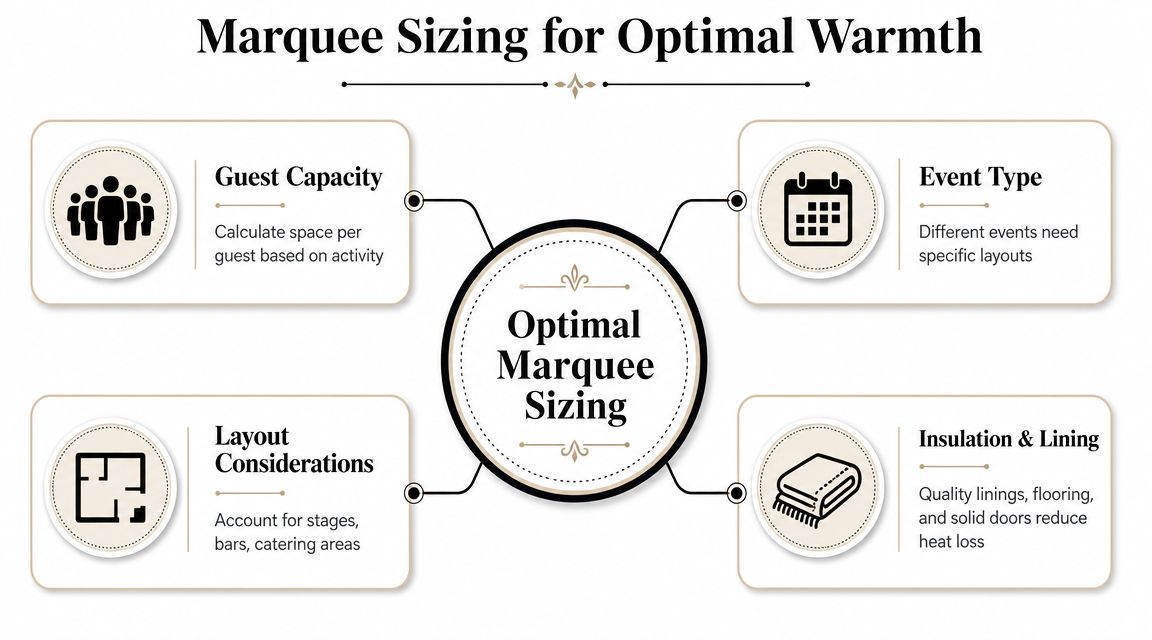
Before any heater is chosen, the space has to be planned properly. Heat loss starts with poor sizing. If the marquee is too large for the event, you pay to warm empty air. If it's too small, guest comfort drops because circulation, seating and service all become cramped.
A better starting point is to think about how the event will function. Not just how many people are attending, but what they'll be doing once they're inside.
Start with use, not just guest count
A wedding layout usually needs more from the footprint than a straightforward seated dinner. You may need room for a top table, dance floor, bar, gift table, DJ area and circulation space between tables. A corporate event, by contrast, might work better with cabaret seating, theatre rows, or open networking zones.
Many planners often overestimate one area and forget another. The marquee might technically fit the guest list, but if the entrance sits beside the bar queue or the dance floor pushes diners into the colder perimeter, the room won't feel balanced.
Useful questions to settle early:
- Will guests mostly sit, stand, or move between zones?
- Do you need separate catering or service space?
- Will coats, buggies, or accessibility needs affect circulation?
- Is there a stage, screen, dance floor, bar, or buffet to accommodate?
For a broader planning reference, a practical marquee hire sizes explained guide can help you compare event types and likely footprints.
Layout choices affect warmth
The warmest marquee isn't always the smallest one. It's the one laid out sensibly. Entrance placement matters. In exposed gardens, turning the main access away from prevailing wind can make a surprising difference to how the space feels throughout the event.
Internal zoning matters too. A few examples from real planning decisions:
| Event type | Layout priority | Warmth impact |
|---|---|---|
| Wedding reception | Keep dining and dancing connected without blocking access | Guests stay in the main heated zone longer |
| Corporate presentation | Seat audience away from door traffic | Fewer temperature fluctuations during arrivals |
| Garden party | Create a tighter social core around tables or lounge furniture | Prevents the event feeling sparse and chilly |
| Community function | Leave clear circulation around exits and service points | Safer movement without crowding colder edges |
Planning rule: warmth follows layout. If people constantly move through badly placed doorways and service routes, the marquee will feel colder no matter how powerful the heater is.
Good design creates cosy zones
Not every part of the marquee needs to work equally hard. Dining areas should feel settled. Bars can handle more movement. Waiting space near entrances should be practical rather than premium. That lets you concentrate comfort where guests spend the most time.
This is one of the main reasons detailed layout drawings help. They let you test guest flow, furniture placement, heater duct routes and access before installation day. That avoids the common problem of trying to solve warmth issues after the structure is already standing.
Choosing the Right Heating and Insulation Options
If you only remember one technical point, make it this: professional marquee heating is normally external, ducted, and sized to the structure. That's the standard because it works better and it's safer for enclosed event use.
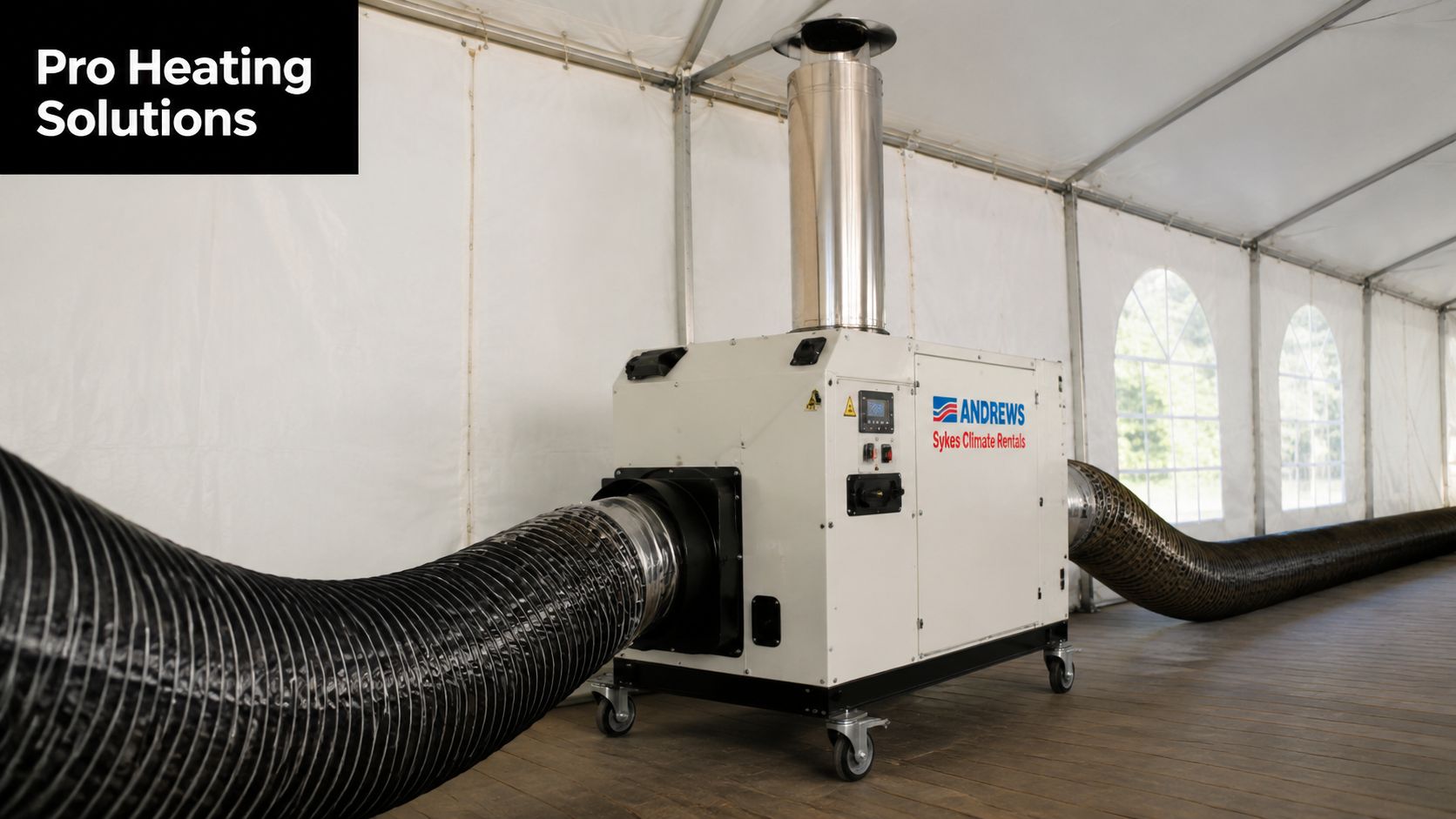
UK hire guidance states that the most technically sound option for marquee events is indirect-fired oil heating positioned outside the marquee and ducted in, because that keeps combustion gases out of the occupied space. The same guidance also notes that heating should be engineered around marquee size, season and forecast, with indirect blowers described as the most efficient option for marquees in this use case, as set out in this UK marquee heating advice.
Why indirect heating is the professional choice
Indirect-fired units heat air and send it into the marquee through ducting, while the actual combustion happens outside. That gives you clean warm air in the event space without introducing the risks associated with unsuitable indoor combustion equipment.
For clients, the practical benefits are clear:
- Safer occupied space because the heater itself stays outside
- More usable floor area inside the marquee
- Less visual intrusion around guests and furniture
- Better control over duct placement and temperature management
What doesn't work well is treating winter marquee heating like patio heating or trying to solve a large enclosed space with improvised indoor units. Those options may create local warmth, but they don't produce even, venue-wide comfort.
Heating demand rises quickly with size
Marquee heating load climbs fast as the structure gets bigger. One practical UK sizing rule says that to raise a marquee's temperature by 20°C, you need about 1 kW for every 5 cubic metres of space, according to this marquee heating size guide.
That same guide gives useful examples:
- A 4 m × 4 m marquee with an average height of 2.5 m equals 40 cubic metres and needs about 8 kW
- A 6 m × 12 m marquee at 2.5 m height equals 180 cubic metres and needs about 36 kW
- A 9 m × 12 m marquee at 3.05 m height equals 329.4 cubic metres and needs about 66 kW
Those figures explain why guessing rarely works. A structure that looks only a bit larger on plan can need a very different heating setup once height and internal volume are factored in.
Bigger marquees don't just need “a bit more heat”. They often need a completely different heating specification.
A short visual explainer helps if you want to see how commercial heater setups work in temporary structures:
Insulation starts with linings and flooring
Heaters create warmth. Linings and flooring help keep it there.
Some quotes can look cheaper than they really are. A bare marquee shell with heat added later often feels colder than clients expect because warmth escapes faster and the ground transmits cold upward. Full internal linings soften the space visually, but they also contribute to comfort by reducing the harsher feel of an unlined temporary structure.
Solid flooring with carpet matters just as much. Guests notice the ground temperature immediately, especially at weddings and longer evening events where people are seated for hours. If the floor feels cold and damp, the marquee will never feel fully comfortable, even if the air temperature is reasonable.
Don't solve every problem with more heater capacity
If a marquee loses heat through weak entrances, poor flooring, or underplanned layout, adding more heating often increases cost without properly fixing comfort. Layered solutions usually perform better:
- lined interior
- solid floor with carpet
- sensible entrance arrangement
- well-routed ducting
- realistic occupancy planning
That's how a heated marquee feels consistent from arrival through to the end of the event.
Critical Power and Safety Requirements for Heated Events
Most clients start by asking what the marquee will look like. The more important questions are often less visible. Can delivery vehicles reach the setup point? Where will the heater sit? What power source is available? How will cables run safely? Are exits clear once tables are in place?
Those details decide whether the event runs smoothly or becomes stressful on the day.
The hidden risks that catch planners out
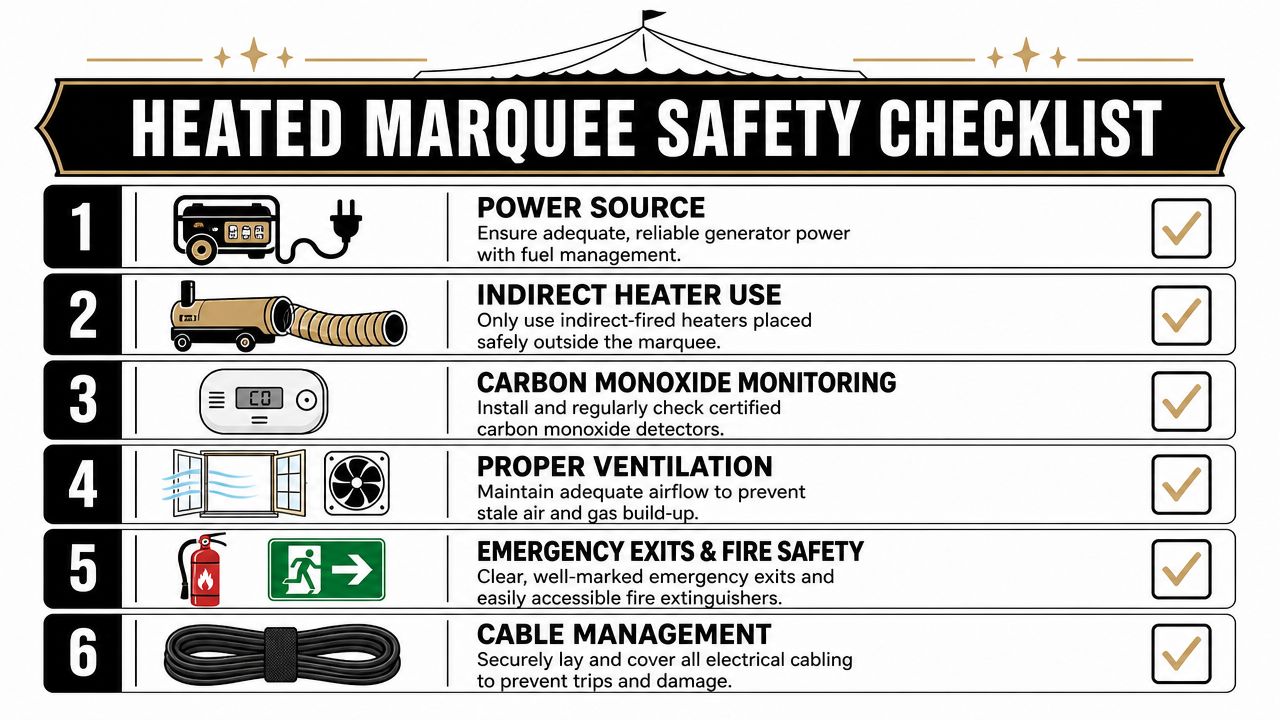
Most marquee content online concentrates on style and broad hire options. It rarely explains the practical issues that determine whether an event can proceed at all, such as fire safety, emergency exits, access for delivery vehicles, noise and generator placement. Those hidden risks are where careful professional planning matters most, especially with heated structures.
In London, this comes up constantly. A house in Dulwich may have narrow side access. A school site in Croydon may have restricted delivery hours. A venue in Beckenham may be fine with the marquee itself but have strict rules about generator position, cable runs or late-night noise.
Power needs proper planning
Heating is only one part of the electrical picture. The event may also involve lighting, catering equipment, sound, bar refrigeration and service areas. If the available supply is weak or badly located, planners can end up relying on long cable runs or unsuitable connections.
A proper site assessment looks at:
- Available power source and whether it can support the full event load
- Cable route so it stays protected from weather, footfall and vehicles
- Generator location if additional supply is needed
- Fuel access and runtime planning so service isn't interrupted mid-event
- Noise management for homes, venues and community spaces
The marquee itself is often not the biggest planning risk. Power, access and sign-off usually create the real pressure points.
Safety and permissions aren't box-ticking
For heated marquees, fire safety isn't optional and it isn't something to improvise on install day. Exit routes have to stay usable once furniture, bars and décor are in place. Heater placement has to remain clear of the structure and service traffic. Cables need proper protection. If the event is at a private home, venue, school or community site, you may also need approval from the landowner or site manager before equipment positions are finalised.
A simple planning habit helps here. Before confirming suppliers, it's worth using a structured checklist or download event risk assessment guide so key operational points are captured early.
What a useful site visit should uncover
A meaningful pre-event visit should answer practical questions, not just measure the lawn. It should identify whether the access route can handle flooring and heater delivery, whether the setup area is level enough, whether nearby neighbours could be affected by generator placement, and whether emergency egress still works once the event is dressed.
That process reassures clients for a reason. It moves the discussion from “Can we fit a marquee here?” to “Can we run this event safely, comfortably and without last-minute surprises?”
Understanding Your Quote and the Booking Process
Most stress around marquee hire comes from uncertainty, not from the marquee itself. People worry about hidden extras, missing equipment, fuel arrangements, and what happens between paying a deposit and event day. A clear quote should remove that uncertainty.
What an all-in quote often includes
In UK event hire, marquee bookings are often sold as a bundled service, not just a shell rental. One UK example shows a 100-guest wedding package at £3,500 including VAT, with delivery, installation, removal, hard floor, carpet, full lining, chairs, tables, lighting, and bar included, over a standard 3-day hire period, as shown in this UK marquee package pricing example.
That matters because it reflects how real events are usually delivered. Clients rarely hire only the structure. They need transport, labour, flooring, interior fit-out, and a schedule that allows proper installation and removal.
The same source also notes that standard hire often runs across several days, which makes sense operationally. Setup, testing, styling and removal all take time, especially when heating and flooring are part of the specification.
Read the quote by function
Instead of reading line items as costs, read them by purpose.
- Delivery and installation means the logistics of getting equipment to site and building it safely
- Flooring and carpet deal with comfort underfoot and event finish
- Linings improve appearance and help the space feel more enclosed
- Furniture and lighting turn the marquee into a usable venue
- Heating and fuel planning support comfort throughout the event window
If one quote looks much lower than another, check what has been left out. A cheap starting price can become expensive if you later add flooring, linings, access adaptations, or proper heating support.
The booking process should feel straightforward
A well-run booking process usually follows a sensible order:
- Initial enquiry with date, location, guest numbers and event type
- Site visit to confirm access, ground conditions, power and layout constraints
- Quote and layout proposal so the scope is visible before commitment
- Revisions if needed for guest flow, furniture, catering or heating arrangement
- Booking confirmation once the specification is agreed
- Final pre-event checks covering timings, access and on-site responsibilities
Good marquee planning removes surprises before install day. That's the point of the process.
For London clients, local knowledge helps here. Traffic restrictions, narrow residential access, controlled parking and venue rules can all affect timing and setup method, so the quote should reflect the actual job rather than an idealised version of it.
Essential Accessories That Complete a Winter Marquee
A winter marquee feels finished when guests stop noticing the weather outside. That result rarely comes from the heater alone.
The pieces that make warmth feel real
Solid flooring changes everything. It lifts guests off cold, damp ground and gives the event a stable, indoor feel. Add carpet and the marquee immediately feels warmer, quieter and more comfortable for seated events.
Full linings do double duty. They improve the visual finish and soften the internal environment so the marquee doesn't feel hollow or exposed. In colder months, that contributes to comfort far more than many first-time organisers expect.
Entrance treatment matters too. A zipped opening may be workable in summer, but winter events benefit from better-managed access points, whether that means more substantial door arrangements or weighted entrance design that reduces heat loss during arrivals and service.
Atmosphere also affects perceived comfort
Lighting changes how warm a space feels. Softer, warmer schemes make guests settle faster than harsh white lighting, especially for evening receptions and private parties. If you're planning the look as well as the logistics, this guide to lighting for marquees is a useful place to start.
The best winter setups treat comfort as a package: warm air, warm feet, softer surfaces, controlled access, and lighting that supports the mood rather than fighting it.
Heated Marquee Hire FAQs and Planner Checklist
Before booking, keep the process simple and practical.
Planner checklist
- Confirm the guest count so the marquee isn't oversized or cramped
- Book a site visit to check access, ground conditions and equipment positions
- Discuss heating and power together because one affects the other
- Review the internal layout for dining, dancing, catering and exits
- Check quote inclusions carefully so flooring, linings and setup aren't assumed
- Confirm timings early for installation, collection and site access windows
Common questions
How much fuel will I need for my event
That depends on the marquee size, weather conditions, event duration and heating specification. The right approach is to plan fuel runtime as part of the heating setup rather than treat it as an afterthought. For longer events, fuel management should be agreed before the day.
Can a heated marquee go on a patio or hard standing
Often, yes, but it depends on access, fixing method, surface condition and surrounding clearances. Hard surfaces can work very well, but they need checking in advance so flooring, anchoring and cable routing are handled correctly.
Will the marquee stay warm if guests keep going in and out
It can, if the entrance layout is planned properly and the heating is sized for real event use rather than ideal conditions. Frequent door traffic is one reason layout and access planning matter as much as heater choice.
What if bad weather is forecast
Bad weather is exactly why winter marquee planning needs to be thorough. The important thing isn't pretending the weather won't be poor. It's making sure the structure, heating, flooring, access routes and operational plan have all been prepared for it.
If you're looking to hire a heated marquee in Croydon, London or the surrounding areas, Premier Marquee Hire can help you plan it properly from the start. Ask for a quote or site visit and get clear advice on sizing, heating, access, layout and everything else that makes a winter event run smoothly.
Sorry, the comment form is closed at this time.