

19 Jun What Is a Gobo? a Guide to Event Lighting & Branding
A gobo is a stencil for light, used to project patterns, logos, or text onto a surface to personalise an event space. In event lighting, it's a precisely etched disc made from glass or steel, and high-quality glass versions can project detailed, multi-coloured artwork at up to 600 DPI.
If you're planning a wedding or corporate event in a marquee, you've probably reached the stage where the structure, tables and lighting are coming together, but the space still needs something that feels like yours. That's where gobos make a real difference.
In a marquee in Croydon, Purley, Bromley or further across London and the South East, a gobo can turn a plain wall lining, dance floor or entrance area into a branded or personalised feature. It might be a couple's monogram, a company logo, a decorative pattern across the ceiling, or simple directional signage that helps guests find their way without adding bulky printed boards.
What Is a Gobo and How Can It Elevate Your Event
A lot of clients first hear the word and assume it's a niche bit of theatre jargon. In practice, it's much simpler than that. A gobo sits inside a lighting fixture and shapes the beam into a chosen design, so instead of getting a plain circle of light, you get a name, pattern, logo or motif projected onto a surface.
The term has been used in UK stage and event lighting since the 1930s, when it described something used to “go between” a light source and a subject to shape the light, long before people mainly associated gobos with branding and logos in event spaces. That history is noted in this lighting industry explanation of where the term gobo came from.
For marquee events, that matters because the tool was never just about corporate branding. It was always about control. In a temporary structure, that's useful. You can add identity and atmosphere without bringing in large scenic pieces or printed panels.
Where clients usually notice the difference
A wedding client in Sutton might want initials on the dance floor for the first dance. A business hosting an awards evening in a marquee might want a clean logo on the entrance wall so guests arrive to something that feels organised and on brand. At trade and promotional events, the same thinking often overlaps with wider visual planning such as exhibition booth design, where light, graphics and layout all need to work together.
For company functions, gobos also pair neatly with broader marquee hire for corporate events because they help temporary venues feel intentional rather than improvised.
A good gobo doesn't just decorate a marquee. It gives the space a point of focus.
Why they work so well in marquees
Marquees are blank canvases. That's one of their strengths, but it can also make them feel visually flat if every element is functional and nothing is personal. A projected design solves that quickly.
Instead of filling the room with extra props, you can use one well-positioned projector to create a focal point on a wall, ceiling liner or floor. It's compact, flexible, and when it's set properly, it looks far more polished than many people expect.
Gobo 101 How Light Projection Actually Works
The easiest way to think about a gobo projector is as a modern version of a slide projector. A light source shines through a shaped disc, then a lens focuses that shaped light onto a wall, floor or ceiling. If the disc contains your initials, that's what appears in light.
A gobo is technically a precisely etched disc, usually made from glass or steel, placed in the optical path of a fixture. High-quality glass gobos can produce complex, multi-coloured projections at up to 600 DPI, which is described in this gobo guide from Advanced Staging.
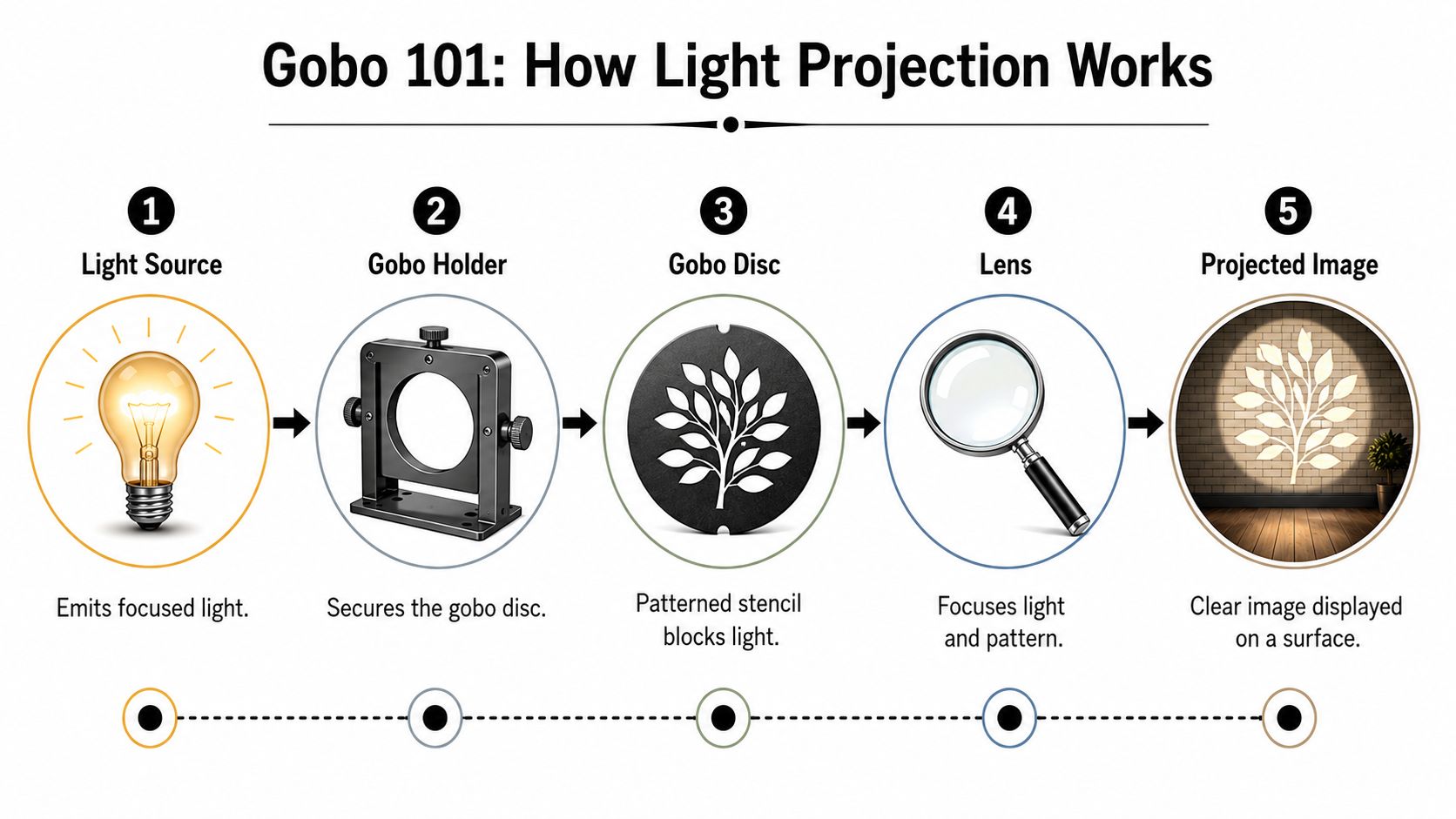
The five parts that matter
Light source
The fixture creates the beam. Without a strong, controlled beam, the image won't have enough punch to read clearly in a marquee.Gobo holder
This keeps the disc in the correct position inside the fixture. Tiny alignment errors can soften or skew the image.Gobo disc
This is the actual design. The etched or open areas let light through, while the rest blocks it.Lens
The lens focuses the image so it appears crisp rather than fuzzy.Projection surface
The final result depends heavily on what you're projecting onto. A smooth white wall lining behaves very differently from pleated drape or textured flooring.
Why the artwork orientation matters
Clients often ask why a supplied design sometimes needs to be flipped before it goes into the unit. The reason is mechanical. The fixture and lens invert the image during projection, so the inserted artwork has to account for that if the final result is to read correctly on the surface.
That's particularly important for text, logos and monograms. Decorative breakup patterns can be more forgiving, but if the projection includes names or corporate branding, orientation has to be checked carefully before the event.
Practical rule: If the design includes words, always test orientation before guests arrive. It's a small detail that saves an awkward correction later.
What a gobo is not
This catches people out. In event lighting, a gobo usually means the disc inside the light. In photography and film, the word can also mean any object placed between a light source and a subject to shape or block light. As a result, not everyone asking “what is a gobo” is looking for a logo projector. Some are looking for general light-shaping tools.
For marquee events, though, most clients mean the projected result. They want to know how to get that clean logo on a wall or that elegant monogram on a dance floor.
Choosing Your Style Steel vs Glass Gobos
Once you know what a gobo does, the next question is usually which type you need. In most event work, the practical choice is between steel and glass. Both can work well, but they solve different problems.
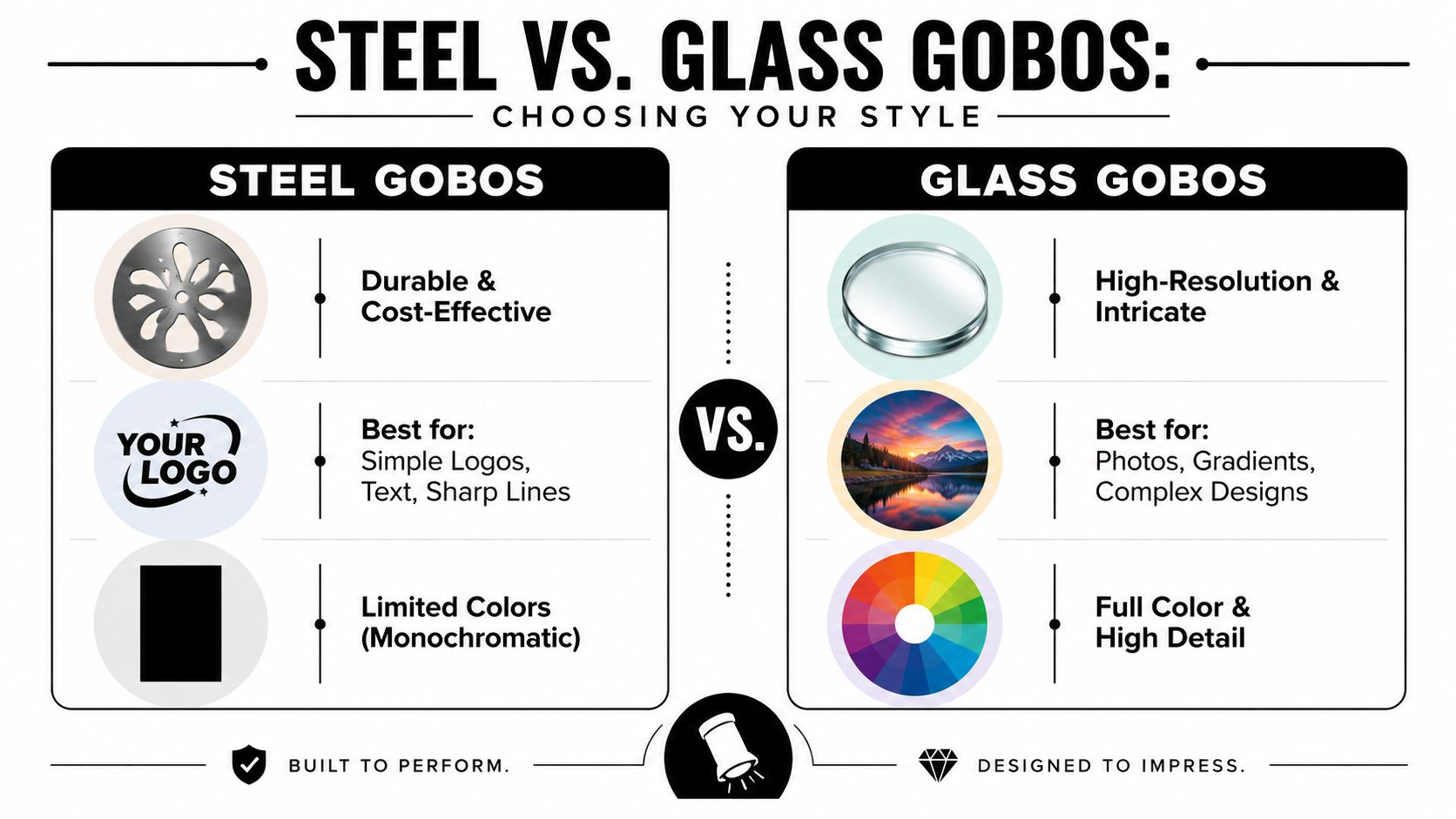
The short version
| Type | Best for | Main strength | Main limitation |
|---|---|---|---|
| Steel | Text, bold logos, simple shapes | Durable, sharp, high contrast | Limited to simpler monochrome designs |
| Glass | Detailed logos, colour, intricate artwork | High detail, colour, finer finish | Needs the right fixture and more care with heat |
When steel is the better choice
Steel gobos are the workhorses. They're laser-etched from polished stainless steel and are ideal when the design is bold and uncomplicated. If a client wants crisp text, a straightforward company mark, or a clear silhouette effect, steel is often the sensible answer.
They're also the stronger option in hotter, more powerful fixtures. In larger event lighting setups, steel gobos can tolerate the heat from 1000W to 2000W lamps, which makes them suitable where output and heat resilience matter most.
For practical marquee use, steel suits:
- Simple corporate logos with strong shapes
- Directional arrows or signage
- Bold initials without fine decorative detail
- Outdoor or higher-output applications where fixture heat is a consideration
When glass is worth it
Glass gobos are what you choose when the design needs finesse. If the artwork includes fine linework, multiple colours, detailed floral shapes or a more premium finish, glass gives you much more freedom. The available resolution can reach 600 DPI, which is why it's the standard choice for intricate wedding monograms and polished brand artwork.
That extra detail shows up clearly in marquee settings. Fine patterns for a Mehndi celebration, layered logo artwork for a product launch, or delicate script projected onto a wall all need the precision glass can provide.
If the design looks elegant on screen because of detail, gradients or colour, it usually needs a glass gobo to look elegant in the marquee too.
What works and what doesn't
A common mistake is trying to force a complex design into a steel gobo. The result often loses the detail that made the artwork attractive in the first place. Fine script, tiny internal shapes and colour transitions don't translate well into a basic metal stencil.
On the other hand, ordering a glass gobo for a very simple one-line text mark can be overkill. If the job is just to put clean lettering on a wall, a steel gobo may do it perfectly well.
A sensible choice usually comes down to this:
- Choose steel when you want strength, simplicity and sharp contrast.
- Choose glass when image quality and design complexity matter more than keeping the artwork minimal.
Transforming Your Marquee Inspiring Gobo Ideas
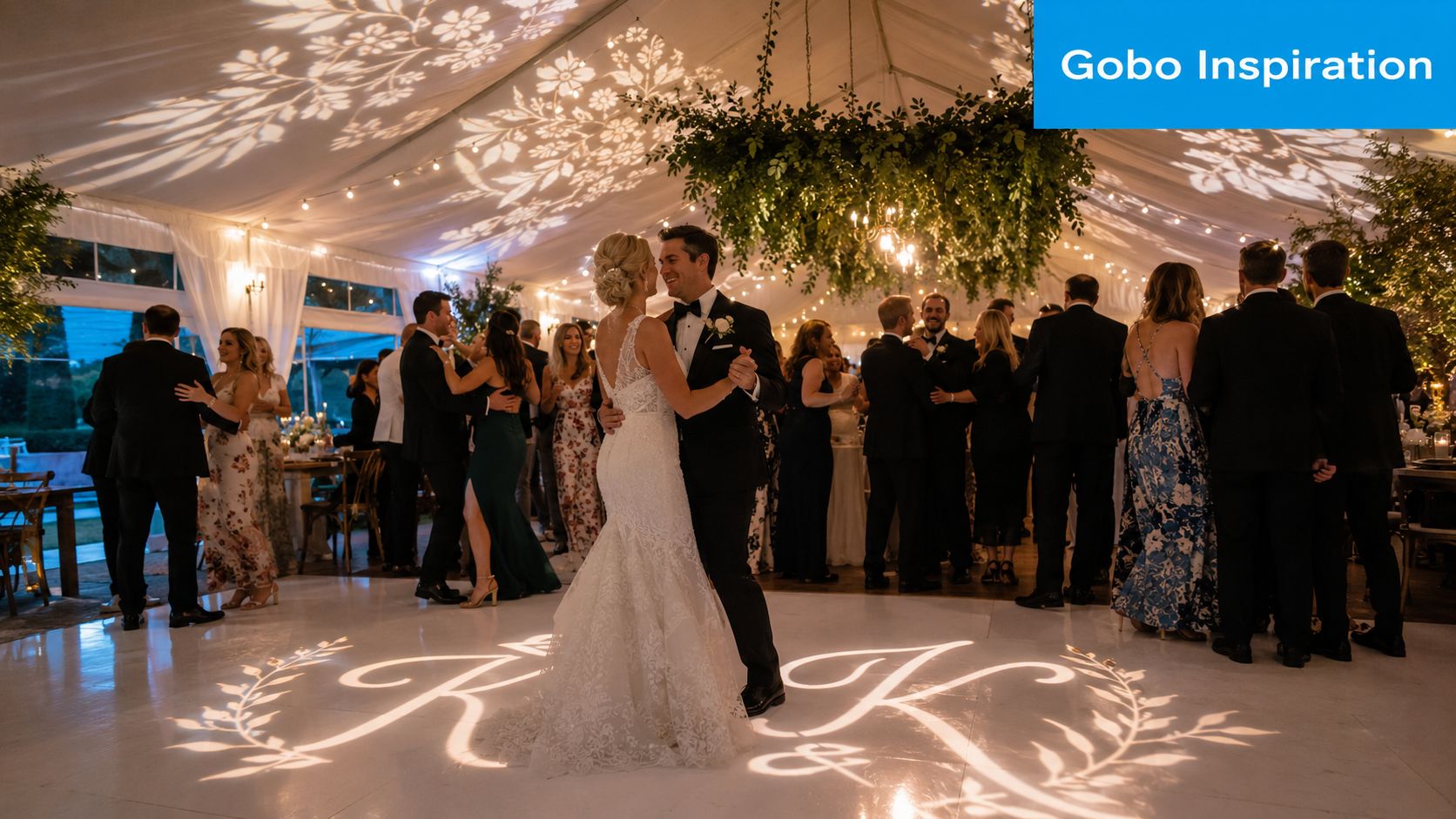
The best way to understand gobo lighting is to see what it does in a real event space. In a marquee, small lighting decisions carry a lot of weight because the structure starts as a fairly neutral shell. A good projection gives the room identity without filling it with extra décor.
Gobos developed from simple metal stencils into digitally controlled projection tools, and that shift is what made them so useful in modern event production. Today they're used to project company logos, event names, textures and signage in branded environments, including marquees, as described in Apollo's history of the gobo.
Weddings that feel more personal
For weddings around Croydon, Bromley and Purley, the most popular use is still the dance floor monogram. It works because it gives one key moment a visual signature. During the first dance, the floor becomes part of the styling rather than just a practical surface.
Another strong option is a soft patterned wash on the marquee lining. Instead of projecting one logo-sized image, the fixture throws a repeating pattern across the ceiling or upper walls. That works especially well when the marquee needs atmosphere before the dance floor fills up.
Good wedding uses include:
- A monogram on the dance floor
- The couple's names on an entrance wall
- Floral or lace-style patterns on ceiling liners
- Cultural motifs for pre-wedding functions and Mehndi events
For broader ideas on combining these effects with festoon, uplighting and interior ambience, it also helps to look at marquees with lights.
Corporate events that need cleaner branding
Corporate clients usually want something more restrained. A product launch in a Croydon marquee might use a logo on the entrance wall and a subtle texture on the roof liner so the room feels branded without looking busy. For an awards night, one fixture can carry the event title while another adds a patterned backdrop behind the stage area.
That's where programmable lighting has made gobos more useful. You're not limited to one static decorative trick. You can build a coherent look across the whole structure.
Here's a quick visual example of the effect in action:
Practical ideas beyond logos
Some of the most effective gobo uses aren't glamorous at all. They're functional. At community events, school functions and festivals, projections can help with wayfinding and zone marking. A clear illuminated sign on a marquee wall is often tidier than adding another freestanding board.
I've also seen decorative texture do more for a room than a name projection. A simple leafy breakup pattern across the roof at a summer party can make a plain marquee feel layered and considered.
Not every gobo needs to say something. Sometimes the strongest result is texture, atmosphere and depth.
Technical Tips for Gobos in Marquees
A gobo in a marquee lives or dies on setup. In a hotel ballroom, the walls stay put, the ambient light is predictable, and there are usually fixed rigging points. In a marquee in Croydon, Surrey or anywhere across the South East, you are dealing with temporary walls, changing daylight, soft ground, cable runs, and guests moving through a space that was built for one day only. Get the practical side right and the result looks polished. Get it wrong and even a good design can look faint, stretched or poorly placed.
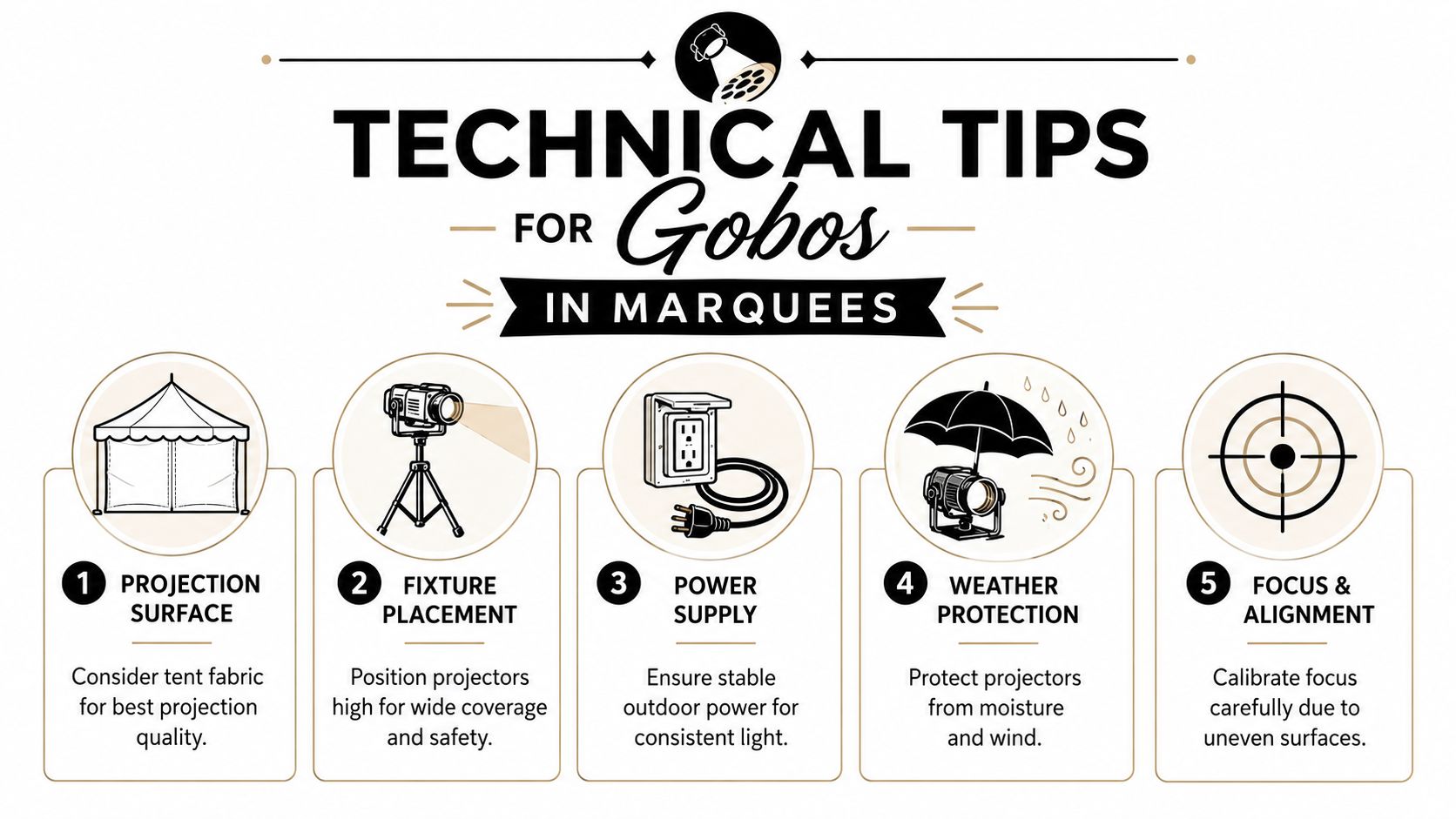
Start with the projection surface
The surface matters more in a marquee than many clients expect. A smooth ivory lining panel or solid internal wall section will usually give a cleaner result than pleated drape, clear PVC, or anything with folds and seams. If the projection is meant to show a name, monogram or company logo, I always look for the flattest, palest area available first.
Placement matters just as much. A lovely projection near the entrance can disappear once the sidewalls are open, the bar is busy, or guests keep passing in front of it. For weddings, the end wall opposite the entrance often works well if the layout allows it. For corporate events, a stage backdrop, reveal curtain, or branded wall panel is often the safer choice.
Floor projection can look excellent too, especially for first dances or entrance moments. It just needs the right floor finish and fixture angle. On a glossy black-and-white dance floor, for example, reflections can wash out the detail.
Position the fixture for real event use
A projector that works in a warehouse test does not always work in a marquee once tables, florals, catering kit and guests are in place. The beam needs a clear path from fixture to surface, and the unit needs to be mounted where nobody will knock it, trip over cabling, or stand in the light.
Higher mounting points usually solve several problems at once. They keep the beam above head height, reduce shadows from guests, and often improve the shape of the image. If the fixture sits too far off-axis, the logo can stretch into a trapezium instead of staying clean and square. Some fixtures can correct for that, but good positioning is better than relying on correction later.
In temporary structures, practical rigging options are part of the conversation from the start.
Daylight changes everything
A marquee that looks fairly dim during installation can become bright once afternoon sun hits the roof and sidewalls. That drop in contrast catches people out all the time. White roof linings glow in daylight, and clear wall panels can flood a projection area with ambient light even before the event properly starts.
If the gobo needs to be visible before sunset, keep the artwork bold. Short text, thicker lines and simple shapes read better than fine script. If the event starts in daylight and runs into the evening, it can also make sense to treat the gobo as a softer branding or decor feature early on, then let it become stronger after dark.
This is one reason broader lighting for marquees planning matters. The gobo is only one part of the room. Wash lights, festoons, uplighters and practical lighting levels all affect how well that projection will read.
Plan power and cable routes early
Marquees rarely have power exactly where you want it. The projector position that gives the best image may be nowhere near the dimmer rack, distro point or generator feed. That is normal, but it needs planning before the fit-up starts.
I prefer to decide three things early. Where the fixture wants to live. How the cable will get there safely. Whether that circuit is shared with anything else that could cause problems. In marquee work, tidy cable routing is not just about appearance. It protects the guest experience, the crew, and the equipment.
If the event is on a generator, allow for proper testing under live conditions. A fixture that powers up happily during install still needs checking once the rest of the event load is online.
Match the fixture and gobo properly
The gobo design, the fixture, and the throw distance all have to suit each other. A delicate glass gobo with fine detail can look superb, but only if the projector has the optics and output to carry that detail to the chosen surface. A simple steel gobo often performs better for bold names or directional signage because it stays readable and does not ask as much of the fixture.
Heat also matters. Some fixtures run hotter than others, and not every gobo type is suitable for every unit. That is a technical check worth doing before anything is ordered, not on the day the marquee goes up.
Keep it readable from where guests will stand
Clients often approve a design on a screen at close range. Guests will see it from across the marquee, while chatting, eating, dancing or finding their table. Readability has to be judged in that real setting.
Check these points before sign-off:
- Keep wording short. Initials, surnames, event titles and logos usually project better than long lines of text.
- Use strong contrast. Pale surfaces and darker surroundings help the image stand out.
- Allow enough throw distance. Too close and the image is small. Too far and focus becomes more critical.
- Avoid awkward viewing angles. A design can be technically sharp but still hard to read if it is tucked behind furniture or viewed from the side.
- Consider weather exposure. If a unit is near an entrance, open wall, or external rig point, use equipment suited to those conditions.
Test it in the actual marquee
A final on-site test is the part that saves disappointment. Linings can shift slightly during install. Furniture plans change. A bar or DJ booth may end up exactly where you hoped to project. Ten minutes of checking focus, brightness and sightlines in the finished marquee is far better than discovering the problem when guests are already inside.
That is the reality of marquee work. The structure is temporary, so the lighting plan has to be flexible and practical from the start.
Ordering a Custom Gobo Timeline and Costs
Ordering a custom gobo is usually more straightforward than clients expect. The important part is giving yourself enough time for design approval, production and testing, especially if the event artwork is still being finalised alongside invitations, signage and printed materials.
The usual process
Most custom orders follow a simple path:
Choose the use case
Decide whether the gobo is for a dance floor monogram, a wall logo, decorative texture, or signage.Submit the artwork
Clean artwork helps. Simple vector-style logo files are usually easiest for production. If the design is detailed, it's worth checking early whether it needs glass rather than steel.Review the proof
Orientation, spacing, and legibility are checked. It's the stage that prevents awkward surprises later.Match it to the fixture
The gobo has to fit the actual projector or lighting fixture being used. The disc dimensions used in event lighting vary, and standard sizing can range from 13.8mm to 100mm, so fixture compatibility matters.
What affects cost
Price usually depends on complexity rather than just the idea itself. A simple steel text gobo is a different job from a detailed, multi-coloured glass monogram. The more intricate the design, the more likely it is that glass and a more exact production process will be needed.
The main cost drivers are usually:
- Material choice, steel or glass
- Whether the design includes colour
- How fine the detail is
- How quickly the gobo is needed
- Whether testing and setup are included with the event lighting package
What to do early
If you're planning a marquee wedding or company event, don't leave the artwork discussion until the last week. Even when the design seems simple, the details still need checking against the fixture, projection distance and target surface.
A clean result usually comes from three early decisions:
- choose where the image will go
- decide whether it needs to be decorative or readable
- confirm whether the artwork is simple enough for steel or detailed enough to justify glass
That saves time, avoids rushed design compromises and gives the installer a much better chance of delivering the look you want.
If you're planning a wedding, corporate function or community event and want to explore gobo lighting in a marquee, Premier Marquee Hire can help you talk through the practical side. A quick conversation about the marquee layout, projection surface and artwork usually makes it clear what will work well, what won't, and how to build the effect into the event without overcomplicating the setup.
Sorry, the comment form is closed at this time.