

28 Apr Long Term Marquee Hire Prices Explained (2026 UK Guide)
If you're looking at a marquee for longer than a weekend, you're usually solving a very specific problem. You need usable space quickly, you need it to look right, and you need the numbers to make sense over several weeks or months, not just for one Saturday.
That might mean a restaurant terrace extension in London, a school overflow area in Surrey, a festival structure in Croydon, or a family setup for a run of pre-wedding events rather than one big day. The difficulty is that most online guides talk about weekend marquee hire. They don't explain long term marquee hire prices in a way that helps you budget properly.
Planning Your Extended Event with a Marquee
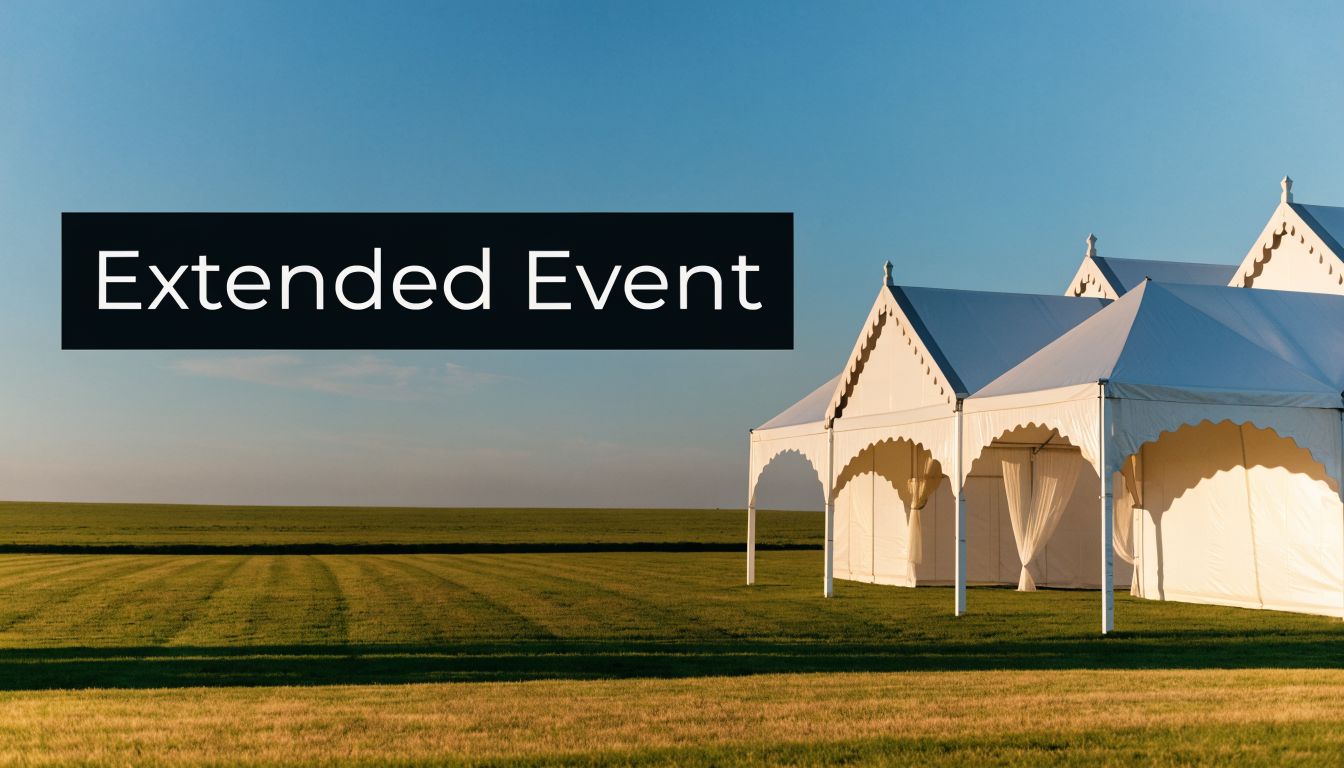
A long-term hire usually means a marquee staying in place well beyond a standard event booking. In practice, that can be a couple of weeks, several months, or a near season-long installation, depending on the site and use.
That changes the pricing logic straight away. A short-term hire is built around a fast install, a single event, and a quick collection. A long-term hire is closer to creating a temporary building. It needs to work day after day, cope with changing weather, remain safe, and still be practical for the people using it.
Why long-term pricing isn't a simple price list
In this part of the trade, fixed lists only tell you so much. The marquee itself is only one part of the cost. The quote also reflects how easy the site is, how long the structure stays up, what flooring is needed, whether the space needs heating, and how much access there is for vehicles and crew.
That approach fits what the wider UK market is doing. The industry recorded average growth of 3.3% in the latest reported year, showing a maturing market where efficiency and customized quoting matter more than broad headline prices, according to Plimsoll's UK marquee and tent hire market report.
In Croydon and across Greater London, that's especially true because sites vary so much. A flat sports ground is one job. A tight residential garden with restricted access is another. The structure may be the same width on paper, but the labour and logistics won't be.
Practical rule: The longer the marquee is staying up, the less useful a generic weekend price becomes.
What people usually want to know first
Most clients aren't really asking, "What's the hire rate?" They're asking three better questions:
- Can this work on my site without turning into a complicated build?
- Will the weekly cost come down enough to justify a longer hire?
- What extras are essential as opposed to nice to have?
Those are the right questions. A long-term marquee can be very cost-effective, but only if the quote reflects real use. A simple weather cover for daytime storage is a different job from an all-season guest space with hard flooring, lighting, furniture, and heating.
The useful way to think about it is this. You're not hiring a tent for one occasion. You're commissioning a temporary venue that needs to perform reliably for the whole period.
The Key Factors That Determine Your Marquee Hire Cost
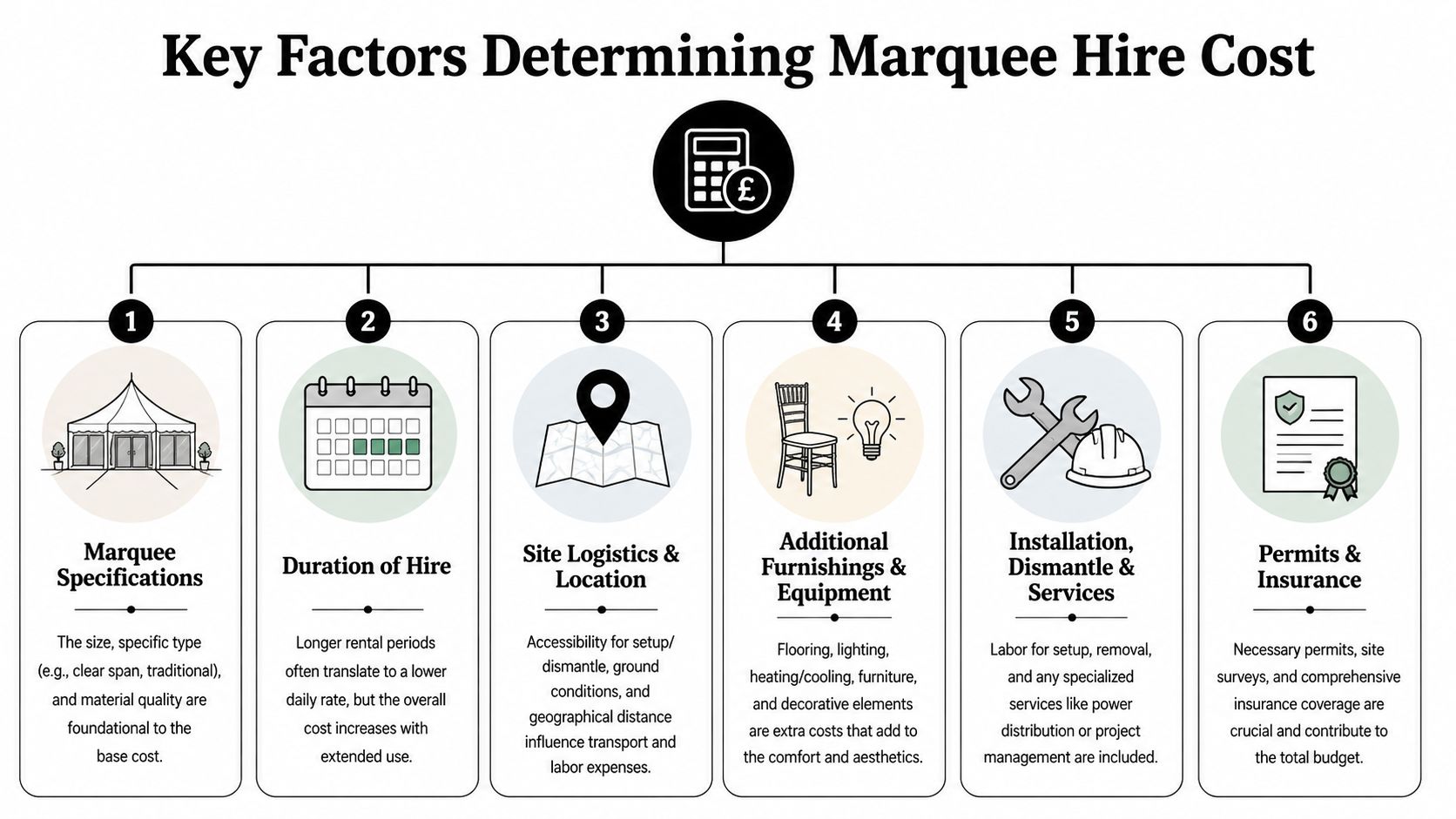
Long term marquee hire prices are built from layers. The easiest way to understand them is to think of the job as a temporary building project rather than a single rental item.
The frame and roof create the shell. Then the site, flooring, services, furniture, weather protection, and labour shape the final cost. That is why one marquee of the same footprint can produce two very different quotes.
The structure itself
Size comes first. Wider spans, longer runs, and higher-spec frames all increase the base cost because they use more material and take more crew time to install properly.
Style matters as well. A straightforward working marquee for storage or sheltered circulation is one thing. A clearspan structure with linings, doors, window walls, and a cleaner finish for guests is another. If you're using the space for dining, hospitality, worship, trading, or front-of-house use, the specification usually rises quickly.
A good rule is that the marquee should be sized around how the space will function, not the headline guest count. Standing receptions, seated dining, staging, bars, catering zones, and walkways all change the footprint.
Duration changes the shape of the quote
Long-term hire presents a more attractive option. Setup, transport, and initial labour are front-loaded costs. Once the marquee is safely installed, those fixed costs are spread across a longer period.
Industry reporting from 2023 notes that firms are moving away from fixed lists and towards custom quoting based on the cost of each booking, including access, installation complexity, and transport, which is why a site visit matters so much for extended hire projects, as outlined in this 2023 tent rental industry report.
That doesn't mean every long hire is cheap. It means the quote becomes more rational. If a structure stays in place and performs for weeks or months, the weekly rate can look much better than repeating short hires.
A quick visual overview helps if you're comparing options before a site visit:
Site access and ground conditions
Many budgets fail here. People focus on marquee size and forget the site can add a lot of labour.
A few common cost drivers are easy to miss:
- Restricted access: If the crew can't get close with vehicles, more equipment must be carried in by hand.
- Slopes and uneven ground: These often require more time and more flooring work.
- Delicate surfaces: Existing paving, gardens, and venue grounds need protection and careful loading.
- Urban constraints: Tight roads, parking limits, and timed access windows can slow installation.
A flat open lawn in Purley is usually simpler than a compact back garden in a built-up part of South London. The marquee may look identical once complete, but the install won't feel identical to the team doing it.
The site often decides whether a job is straightforward, fiddly, or genuinely complex.
Flooring and ground preparation
For long hires, flooring is rarely an afterthought. It becomes part of the structure's day-to-day usability. If guests, staff, or stock are using the marquee regularly, stable flooring usually saves money and hassle later.
The right floor depends on how the space will be used. Matting may be enough for lighter use. Hard flooring is often the better answer for dining, repeated footfall, or sites that may soften after rain. If you're weighing up options, this guide to marquee flooring choices is worth reading before you finalise the specification.
Weather protection and comfort
A long-term structure has to cope with more than one weather window. A weekend booking might get lucky. A month-long hire can't rely on luck.
Typical additions include:
- Heating: Important for winter use, evening occupancy, and guest comfort.
- Sidewalls and doors: Help with wind, rain, and heat retention.
- Linings: Improve appearance and soften the interior feel.
- Lighting: Essential for safe, practical evening use.
- Ventilation or cooling measures: Important if the marquee is occupied during warmer spells.
These aren't just decorative extras. In longer hires, they often determine whether the marquee remains pleasant and usable after the first few days.
Furniture, power, servicing, and risk
Furniture and fit-out can change the total as much as the shell in some jobs. Banqueting chairs, Chiavari seating, tables, staging, bars, and catering support all need to be planned around the hire period, not just the opening day.
Then there are the less visible parts of the quote:
| Cost driver | Why it affects price |
|---|---|
| Ongoing access | The team may need access for checks, adjustments, or maintenance |
| Power distribution | Lighting, heating, catering, and entertainment need safe supply |
| Insurance and liability | Longer occupation means clearer responsibilities in the contract |
| Dismantle planning | Removal can be simple or difficult depending on timing and access |
Long-term jobs succeed when the practical details are priced accurately at the start. The cheapest-looking quote often becomes the most expensive one if it leaves out the things the site and schedule require.
Long Term Marquee Hire Prices Real World Examples
The theory can be understood quickly enough. What helps more is seeing how different hires behave in real use.
The figures below are estimated weekly cost ranges, not fixed tariffs. They are there to show how long term marquee hire prices are usually shaped in the London and South East market. The final figure always depends on specification, access, duration, and whether the space is mainly functional, guest-facing, or both.
Short-term comparisons also matter. For context, a 120-guest seated wedding reception on a short hire can cost upwards of £3,000 to £4,000 for a weekend, while longer hires can bring the weekly cost down because the upfront install and delivery costs are spread over the full term, as noted in Bark's marquee hire cost overview.
Sample long-term price ranges
| Scenario | Marquee Size | Duration | Key Features | Estimated Weekly Cost Range |
|---|---|---|---|---|
| Restaurant terrace extension | 6m x 15m | Several months | Solid flooring, lighting, doors, weather protection | Bespoke quote |
| Community arts festival hub | 12m x 24m | Several weeks | Clearspan structure, staging area, lighting, harder wearing flooring, public access layout | Bespoke quote |
| Family pre-wedding event space | 9m x 18m | Around two months | Guest seating, lighting, flooring, linings, heating if needed | Bespoke quote |
Example one. Restaurant terrace extension in Wimbledon
A restaurant wants extra covered capacity for an extended trading period. The marquee isn't there for one celebration. It's there to operate like part of the business.
The first decision is usually structural. A clean-sided frame or clearspan style works well because it gives open internal space and a more commercial feel. Then the quote is shaped by practical details. Can vans get close to the install point, or does everything need to travel through a narrow service route? Does the site need hard flooring because staff will be carrying trays and stock in all weather? Are doors needed at both ends for service flow?
This kind of job often benefits from long-term economics because the structure stays put. The initial install is meaningful, but it isn't being repeated every few days. That tends to make the weekly figure far more attractive than trying to recreate the same setup through repeated short hires.
What doesn't work here is under-specifying the floor. If the marquee is acting like trading space, soft or uneven ground becomes a daily operational problem. The cheapest floor on day one can become the most frustrating choice by week three.
For commercial use, the best value quote usually isn't the leanest quote. It's the one that supports daily operation without constant patching and workarounds.
Example two. Community arts festival in Croydon
This client needs a larger public-facing marquee for a multi-week programme. The marquee may host performances, workshops, ticketing, waiting areas, or sheltered gathering space depending on the day.
The brief sounds simple until the public-use details appear. You have to think about entrances, circulation, power routes, lighting levels, furniture layout, the likely wear on the floor, and how the structure behaves if the weather turns halfway through the programme.
A larger footprint increases the base hire, but the biggest pricing swings usually come from usage rather than just span. Public access generally needs a tidier finish, better internal flow, and stronger planning around ground protection. If the marquee is on open grass and traffic is high, flooring quality becomes central rather than optional.
A client in this position usually gets the best outcome by deciding early what the marquee is mainly for:
- Performance space: Prioritise clear floor area, lighting, and staging compatibility.
- Exhibition or workshop use: Focus on access points, internal zoning, and steady flooring.
- Hospitality hub: Spend more on comfort, furniture, and lighting quality.
Trying to make one structure do everything without prioritising often pushes the cost up unnecessarily. A better route is to identify the marquee's main role, then add only the supporting features that matter.
Example three. Family event marquee in Sutton
A long family booking often sits somewhere between hospitality and home use. The marquee may be used for a sequence of celebrations, visiting relatives, dining, prayers, a Mehndi event, or overflow space across several dates.
Clients can make smart savings through one continuous hire rather than repeated installs. The structure goes up once, the family uses it flexibly over the agreed term, and the cost per event becomes easier to justify.
The pricing usually turns on four decisions:
How formal the interior needs to feel
A practical white interior costs less than a more dressed finish with linings and upgraded furniture.Whether the ground needs hard flooring
For longer use, particularly with mixed weather, this often becomes worth doing properly.How many evenings the space will be used
That affects lighting and, in colder months, heating.Whether the marquee is one large room or zoned
Dining, lounge areas, and service zones can all be built in, but each choice affects cost.
This type of hire often works very well because the family gets flexibility. Dates can move within the hire period, the space is already there, and there isn't the stress of multiple setup windows.
What these examples have in common
They all show the same underlying point. The best long-term quote is the one that matches the job's real use.
If the marquee is there to trade from, host the public, or support repeated family events, the specification needs to suit that use. Cutting out practical essentials may reduce the headline figure, but it usually creates inconvenience later. Long-term value comes from getting the shell, floor, comfort features, and access planning right from the start.
How to Accurately Budget for Your Long Term Marquee Hire
If you want a realistic budget before asking for quotes, start with use, not size. The biggest mistakes happen when people pick a marquee by rough guest count and only later realise they also need room for catering, circulation, furniture, storage, or a stage.
A better method is to build the budget in layers. That gives you a working estimate, and it also makes supplier quotes easier to compare.
Step one and define the job properly
Write down what the marquee needs to do every day, not just on the busiest day. A space used for dining has different demands from a sheltered walkway, community hub, or trading area.
Ask yourself:
- Primary use: Dining, standing event space, hospitality, worship, exhibition, storage, or mixed use
- Occupancy pattern: Daily use, occasional use, weekends only, or all-day operation
- Season: Summer convenience is different from winter resilience
- Finish level: Practical, polished, or fully event styled
That one page of notes usually saves a lot of wasted quoting.
Step two and split essentials from extras
Once the use is clear, sort every item into one of two groups.
| Essentials | Extras |
|---|---|
| Structure | Interior lining upgrades |
| Safe access | Decorative lighting effects |
| Suitable flooring | Premium seating styles |
| Practical lighting | Styling features |
| Weather protection | Non-essential dressings |
Clients often regain control of the budget through strategic cuts. If money needs to be trimmed, start with presentation extras before touching structural or comfort items that affect daily use.
For a broader benchmark on shorter bookings versus more customised projects, it helps to compare your thinking with this guide on prices for marquee hire.
Step three and think in cost per day or cost per guest
Long-term hires become easier to judge when you divide the total by the way you'll use the space.
Two simple checks help:
- Cost per day: Useful for restaurants, schools, community organisations, and business use.
- Cost per guest or user session: Useful for family events, worship gatherings, and hospitality periods.
If a marquee serves repeated events or regular occupancy, the value often looks much better once you stop treating it as one big spend and start treating it as infrastructure.
A marquee that seems expensive as one invoice can look very sensible when spread across the days, events, or guests it supports.
Step four and budget for the awkward parts early
The awkward parts are usually where late cost increases come from. Build them into your first estimate:
- Access issues: Narrow routes, timed loading, stairs, or long carries
- Ground condition: Soft lawn, slope, mixed surfaces, or delicate paving
- Power planning: Heating, catering equipment, sound, and lighting all need safe supply
- Servicing needs: Long-term occupancy may require planned checks and access
Clients who budget accurately for these items usually avoid unpleasant surprises later. The cheapest provisional estimate often belongs to the least complete brief.
Smart Strategies to Reduce Your Marquee Hire Costs
The best savings don't come from stripping the job back until it no longer works. They come from choosing a setup that reduces wasted labour, repeat transport, and unnecessary specification.
Long term marquee hire prices reward sensible planning. If you make decisions that simplify the install and improve the hire period, the numbers usually move in your favour.
Use one continuous hire instead of repeated bookings
This is the biggest lever. Specialist long-term calculators show that weekly marquee hire costs can fall to 20% to 40% of the initial short-term rate because delivery, setup labour, and materials are spread over a longer period. That's why longer hires often produce the strongest value once the marquee remains in place for more than a month, according to the long-term marquee cost calculator at marqueehire.co.uk.
That logic is simple. Putting a marquee up once and keeping it in service is more efficient than building, removing, and rebuilding the same structure several times.
Spend where it prevents repeat cost
Some upgrades save money indirectly because they stop avoidable problems. Hard flooring is a good example on long hires. It can reduce wear, improve comfort, and make the space more dependable in changing weather.
Heating is another one. If the marquee has to remain usable through colder periods, under-budgeting on warmth can make the space unpleasant and force last-minute fixes. If winter use is part of the plan, it's worth comparing proper marquee heater hire options before the specification is locked in.
Keep the layout simple
Complex layouts can look impressive on paper, but they often add cost through extra lining, partitioning, door positions, furniture density, and longer install times.
Three ways to keep the quote tighter without making the space feel cheap:
- Choose one main room: Multi-zone builds are useful only when you really need separation.
- Standardise furniture where possible: Mixed styles and changing layouts increase handling time.
- Reduce unnecessary access points: Extra doors and openings can add complexity.
Book around real need, not best-case optimism
Clients often over-order because they're planning for every possibility. A better approach is to define the critical use case and build for that.
If the marquee only needs to feel premium on a few key dates, keep the base structure practical and add selected styling where it matters most. If the site is already sheltered and accessible, don't pay for solutions to problems that aren't there.
The smart saving is not "go cheaper". It's "pay only for what the site and schedule genuinely require".
Your Contract and Site Inspection Checklist
Long-term hires need a better paper trail than weekend bookings. That's not red tape for the sake of it. It's what keeps the project clear when a structure is staying on site for an extended period.
Many online guides still focus on simple event pricing and skip the realities of longer contracts. In practice, a detailed agreement and proper survey matter because extended hires must account for weather changes, maintenance access, and difficult urban logistics, as highlighted in County Marquees' pricing guide.
What your contract should spell out
A good long-term marquee contract should be easy to read and hard to misunderstand.
Check for these points before you sign:
- Hire period: Start date, end date, and what happens if collection moves.
- What's included: Structure, flooring, lighting, furniture, heating, linings, and any servicing.
- Payment schedule: Deposit, stage payments if any, and final balance timing.
- Damage responsibility: Who is liable for accidental damage, vandalism, or misuse.
- Access rights: Whether the installation team can return for checks, adjustments, or maintenance.
- Weather procedures: What happens if severe conditions affect safe use.
- Cancellation and change terms: Important if your event dates are still evolving.
If any of that is vague, ask for it in writing before you commit. Long hires run more smoothly when both sides know exactly where they stand.
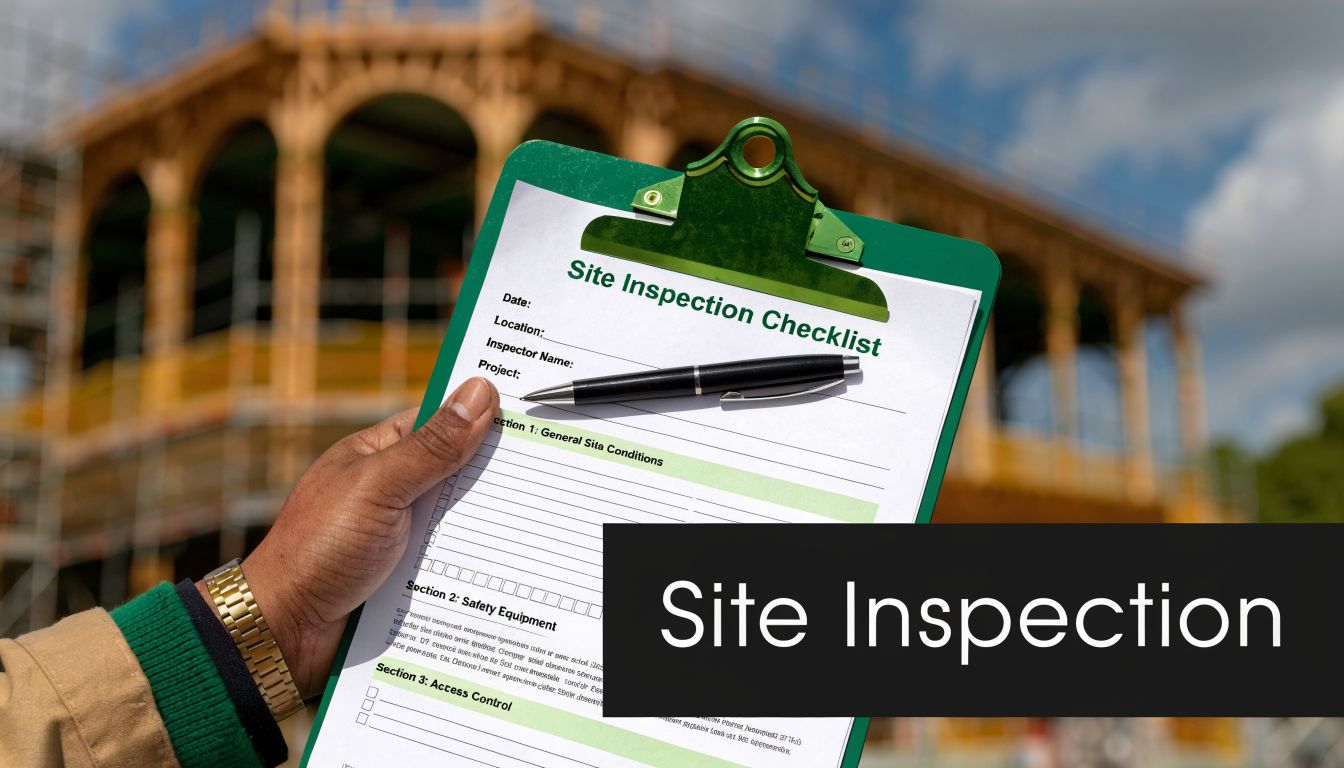
What happens on a professional site visit
A proper site inspection isn't a formality. It answers the questions that pricing alone can't.
The survey usually covers:
| Site check | Why it matters |
|---|---|
| Vehicle access | Determines how easily equipment and flooring can be delivered |
| Ground type and level | Affects anchoring, stability, and flooring needs |
| Available footprint | Confirms what size and shape will actually fit |
| Overhead or nearby obstacles | Trees, cables, gutters, and boundaries can all limit layout |
| Surface protection needs | Important on paving, lawns, and managed venue grounds |
| Power and support areas | Helps position lighting, heating, catering, and service zones |
A sensible handover process
Long-term jobs benefit from a clear handover once the marquee is complete. Walk the structure with the hire company and make sure you understand:
- How doors and walls operate
- Which parts clients or staff shouldn't adjust
- Who to call if weather or damage becomes an issue
- When routine checks may be needed
That short handover often prevents the small mistakes that turn into repair calls later. It also gives the client confidence that the structure is meant to be lived with, not just admired on installation day.
Frequently Asked Questions About Long Term Hires
Do I need planning permission for a long-term marquee
Sometimes you might, especially if the marquee is staying up for an extended period or being used in a way that changes how the site functions. The right answer depends on the land, the duration, and the type of event or operation. For commercial sites, schools, religious venues, and public-facing events, it's sensible to raise the question early with the local authority rather than assume.
Who handles maintenance during the hire
That should be set out clearly in the contract. In most cases, the hire company remains responsible for the structure itself and any agreed maintenance access, while the client is responsible for day-to-day care and avoiding misuse. Long-term hires work best when everyone knows who deals with routine checks, minor adjustments, and urgent call-outs.
Can the marquee layout be changed during the hire
Sometimes yes, but only if the requested change is practical and safe. Swapping tables, chairs, or internal layout is often straightforward. Altering the structure, adding bays, moving doors, or changing flooring usually needs a formal review because those changes affect labour, stock, and site logistics.
What happens if the marquee is damaged while it's on site
That depends on the cause and the terms agreed in the contract. Weather issues, accidental damage, and third-party damage need to be handled differently, which is why insurance and liability wording matters. Report any issue quickly so the structure can be checked before a small problem becomes a larger one.
Is long-term hire better than buying
For many clients, yes. Hiring avoids storage, transport, maintenance, installation labour, and the need to manage the structure after use. Buying only starts to make sense for organisations with repeated use, suitable storage, and the ability to manage setup and care properly.
What's the best way to manage the paperwork
Keep everything central from the first quote onwards. For businesses and event organisers dealing with approvals and supplier paperwork, tools that support affordable eSignatures for small businesses can make it easier to organise marquee contracts, venue permissions, and supplier sign-off without chasing printed forms.
How early should I book
Earlier is better for longer projects because there are more moving parts. A long-term hire often needs a site visit, a more detailed quote, and a practical installation window. If your dates are important or the marquee is required in a busy season, don't leave the enquiry until the last minute.
Ready to Plan Your Event Get Your Free Site Visit and Quote
A long-term marquee isn't just a larger version of a weekend hire. It's a customized temporary space that has to work properly over time. Once you look at the actual cost drivers, the pricing becomes much easier to understand. In many cases, a well-planned long hire gives better value than people expect, especially when the structure stays in place and supports repeated use.
The next step is simple. Get the site looked at properly, talk through how the space will be used, and ask for a quote that reflects the actual job rather than a guessed package.
If you're planning a long-term installation in Croydon, London, Surrey, Middlesex, or Kent, Premier Marquee Hire can arrange a free, no-obligation site visit and provide a detailed quotation with layout guidance to help you budget with confidence.
Sorry, the comment form is closed at this time.