

01 May What Is a Marquee? Your Complete Guide to Event Tents
You’re often asking this question at the point where a venue problem appears.
The guest list has grown. The garden in Purley suddenly needs to host a full birthday party. A wedding reception in Wimbledon has more relatives than the house can comfortably take. A school in Croydon needs covered space for speeches, catering and seating, but the hall isn’t right for the event. That’s usually when “what is a marquee?” stops being a dictionary question and becomes a practical one.
In simple terms, a marquee is a large temporary tent structure used for outdoor events. In UK usage, the Cambridge Dictionary defines it as “a large tent used for eating and drinking in at events held mainly outside that involve a lot of people” via the Cambridge English Dictionary definition of marquee.
That definition is correct, but it’s only the starting point. In practice, a marquee is a temporary venue. It gives you weather cover, usable event space, and the freedom to shape the layout around your event instead of forcing your event into a room that doesn’t quite work.
Your Flexible Event Space Solution in London
London events rarely happen on perfect, empty, level ground. More often, you’re dealing with a narrow side access in South Croydon, a patio and lawn split in Dulwich, a formal garden in Bromley, or a venue that needs extra reception space for one day only. That’s where a marquee earns its place.
A good marquee isn’t just canvas overhead. It becomes the dining room, dance floor, ceremony space, bar area, breakout room or covered walkway. It can sit in a suburban garden, on a school field, beside an office building or within a larger venue that needs extra capacity.
What makes marquees so useful is their flexibility. You’re not tied to one standard room shape, one fixed capacity or one existing interior. The space can be built around the numbers you’re expecting and the way you want guests to move through the event.
Why people choose a marquee instead of a fixed venue
For many London and South East events, the appeal comes down to control.
- More room where you need it: If the house or venue is slightly too small, a marquee creates the missing space without moving the whole event elsewhere.
- Better flow: You can separate dining, drinks and dancing instead of cramming everything into one room.
- A setting that feels personal: Garden parties, home weddings and family celebrations feel more connected to the host when the event stays on site.
- Useful in awkward spaces: Urban gardens and mixed surfaces often need a solution that can adapt rather than a venue that expects ideal conditions.
Practical rule: If the location is right but the space isn’t, a marquee usually solves the problem better than changing venue altogether.
For clients across Croydon and the surrounding boroughs, that’s the answer to what is a marquee. It’s a bespoke event space, built for a short period, planned around your site, and dressed to suit anything from a relaxed garden gathering to a formal corporate function.
The Four Main Types of Marquees Explained
Choosing the right marquee usually starts with a real site constraint. A narrow side access in Croydon, a paved office courtyard in central London, or a wide lawn in Surrey will each point you towards a different structure.
The style matters, but the site decides what will work well on the day. That is why we look at access, ground conditions, surrounding space and event format before we recommend any marquee.
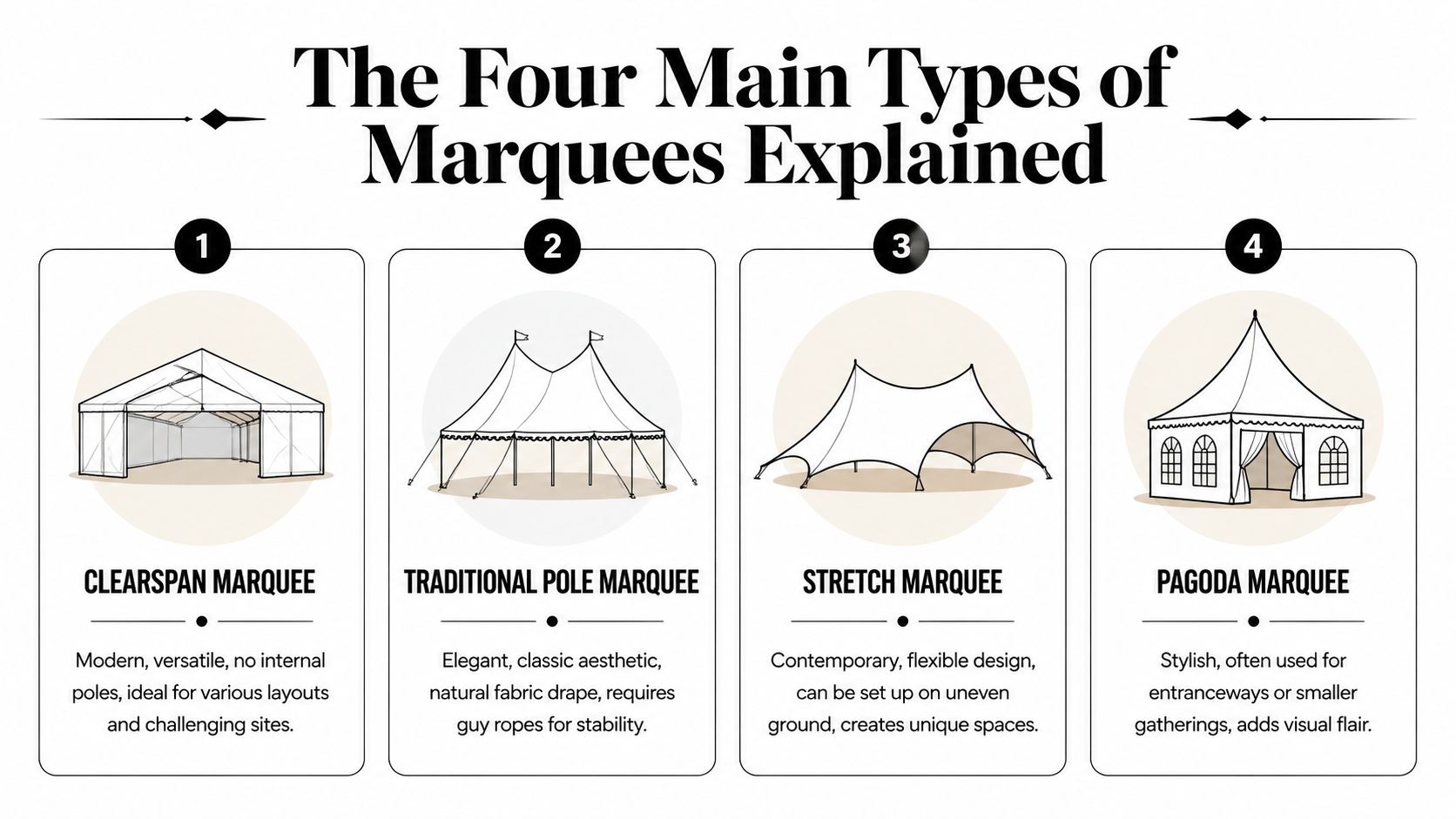
Clearspan marquees
A clearspan marquee is the most widely used option for London events because it gives you a fully usable interior without centre poles. That makes layout planning much simpler for dining, dance floors, staging, bars and catering runs.
It is usually the safest recommendation for patios, driveways, school grounds and compact gardens where every part of the footprint needs to earn its keep. For corporate work, it also gives a cleaner, more structured finish that suits branding, lighting rigs and formal layouts.
Best for: weddings, corporate events, school functions, covered dining, production-heavy events, and sites with limited room.
Trade-off: The finish is neat and practical, but some clients prefer a softer, more traditional look for summer receptions.
Traditional pole marquees
A traditional pole marquee has the classic curved roofline many people want for a wedding or garden party. On the right setting, it looks beautiful. The shape feels softer and more relaxed than a framed structure, and it photographs especially well on open lawns.
The catch is space. Pole marquees need guy ropes and support points, so the usable area extends beyond the fabric itself. They also suit grass far better than hardstanding.
On a large private lawn in Surrey or Kent, that is rarely a problem. In a tighter garden in Dulwich, Beckenham or South Croydon, it can limit furniture layout and guest circulation.
Best for: elegant weddings, summer parties, private lawns, and events where appearance leads the brief.
Trade-off: Strong visual appeal, but less efficient on restricted or awkward urban sites.
Stretch tents
A stretch tent gives a more contemporary, relaxed feel. The shape is fluid rather than formal, which works well for drinks receptions, hospitality events, courtyard parties and informal wedding celebrations.
They can be very effective on uneven ground or irregular spaces where a standard rectangular layout feels too rigid. We sometimes recommend them for venue terraces and garden settings where the brief is more about atmosphere than a fully enclosed room.
They are not always the best fit for heavily dressed formal dinners or events that need tight environmental control. If you want straight table lines, full lining, and a predictable enclosed interior, a framed marquee is often easier to plan.
Best for: modern parties, outdoor hospitality, relaxed receptions, and characterful sites.
Trade-off: Distinctive and flexible in shape, but less suited to highly formal interior layouts.
Pagoda marquees
A pagoda marquee is usually used as a smaller feature structure rather than the main event space. The high peaked roof gives it plenty of presence, which is why it works so well for entrances, bars, catering tents, registration points and breakout areas.
In London gardens and urban venues, pagodas can solve a practical problem. Instead of forcing one large marquee into an awkward footprint, it is often better to split the event into smaller linked spaces.
We use them regularly for welcome areas at weddings, side kitchens for caterers, and bar tents at private parties where the main structure needs to stay focused on dining and dancing.
Best for: entrances, bars, food service, reception points, and linked extra rooms.
Trade-off: Useful and attractive, but usually too small to carry the whole event on its own.
Which type works best
The best choice comes down to how your event needs to function on your specific site.
| Type | Works best for | Main advantage | Main limitation |
|---|---|---|---|
| Clearspan | Weddings, corporate events, mixed-use layouts | No internal poles, efficient use of space | More modern appearance |
| Traditional pole | Large lawn weddings, classic garden parties | Elegant silhouette and softer feel | Needs more surrounding space |
| Stretch tent | Contemporary parties, relaxed hospitality | Flexible shape and distinctive look | Less controlled interior layout |
| Pagoda | Entrances, bars, smaller areas | Stylish and compact | Usually not the main event space |
If you want to compare styles in a practical way, it helps to look through a real hire range with examples of marquee options for different event types and sites.
How Marquee Sizes and Modular Configurations Work
A family in South Croydon might have a long garden but very little width. A company booking a summer event in Bromley might have plenty of open space, but need room for dining, a stage, a bar and staff access. Both need a marquee that fits the site properly, not a standard box dropped into place.
That is why marquee sizing starts with layout and footprint, not just guest numbers.
Width first, then length
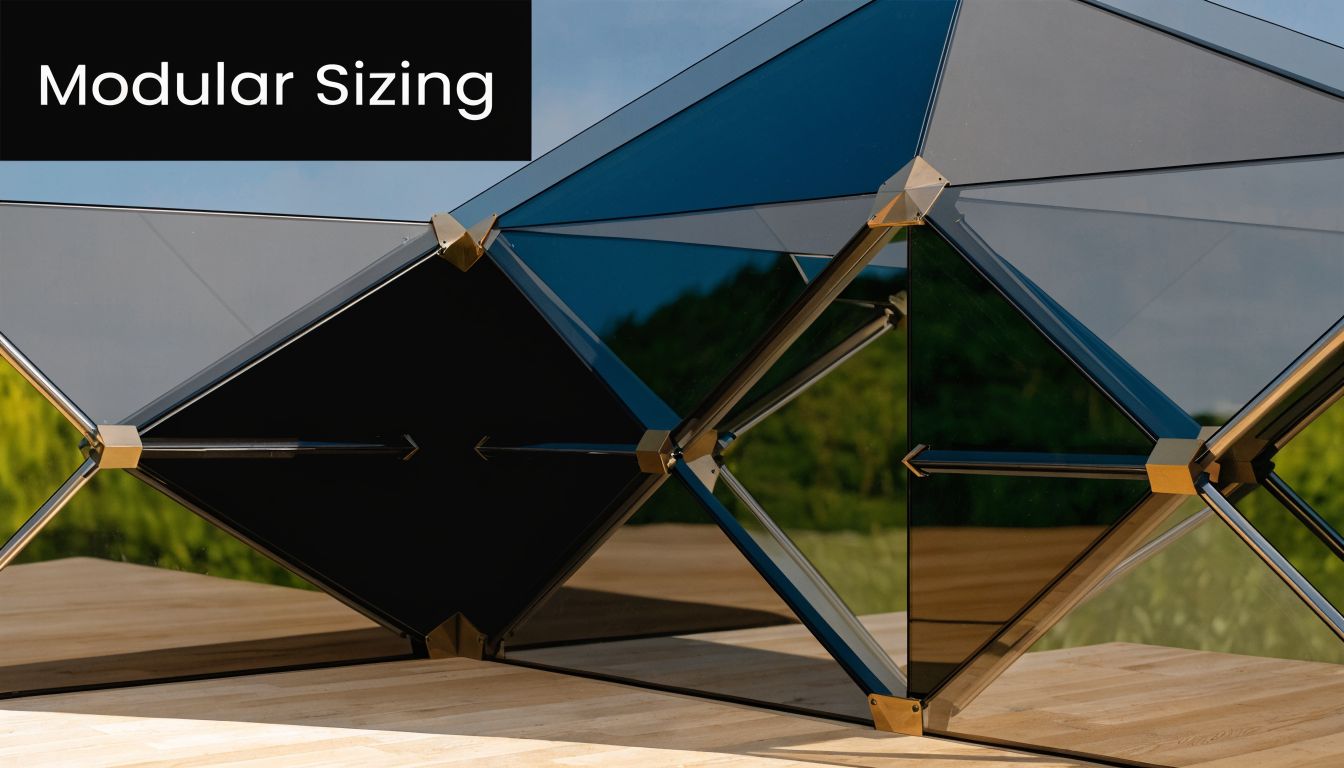
Most framed marquees are built by span first, then extended in bays. In practical terms, that usually means choosing a width such as 3m, 6m, 9m, 12m or 15m, then adding length in 3m sections until the structure suits the event.
That modular system is one of the biggest advantages of a modern marquee. It gives far more control than a fixed venue room, which is particularly useful across London and the South East where sites vary so much. A narrow driveway in Beckenham, a terrace lawn in Purley, and a school field in Croydon all call for different proportions.
Clients usually find this reassuring once they see it on paper. The shape can be adjusted to the ground available, instead of forcing the event into dimensions that do not work.
What affects the size you need
Guest count is the starting point, but it is never the full answer. Sixty guests for a standing drinks party need a very different amount of space than sixty guests seated at round tables with a dance floor and DJ.
The layout changes again if you want any of the following:
- Round tables or trestle tables
- A dance floor
- A stage, band area or DJ setup
- A bar
- Buffet service or indoor catering prep
- Separate areas for arrivals, dining and evening use
I see this regularly on London garden events. On paper, the numbers look fine. Once you allow proper walkways, chair clearance, serving space and somewhere for people to gather without blocking the room, the required footprint often grows.
How we size a marquee in practice
A good sizing plan usually follows three checks.
Start with the event format
A formal dinner, an all-day wedding reception, and an open-house party each need a different balance of seating and circulation space.Place the fixed items first
Tables, chairs, staging, bars, catering equipment and dance floors all take space before a single guest arrives.Test how people will move
Guests need to reach seats, toilets, exits and the bar comfortably. Staff need clear service routes. If movement feels pinched on the plan, it will feel worse once the marquee is full.
The best layouts feel easy to use from the moment guests walk in.
Real-world configuration examples
A long rectangular marquee often works well in suburban gardens where width is limited but depth is available. That is common in parts of Croydon, Sutton and Bromley. Dining can sit in one section, with a dance floor or lounge area added in the next bay.
A wider format usually suits events that need several functions under one roof at the same time. Corporate hospitality on a larger site, for example, may need reception space, dining tables, presentation area and catering support without splitting guests between separate structures.
There are trade-offs. A narrower marquee can be more efficient on an awkward plot, but the layout has to be tighter and more carefully planned. A wider marquee gives more freedom inside, but only if the site can take it without crowding fences, planting, parking or access points.
That is why the right size is never just a headcount calculation. It comes from three things together. Guest numbers, event function and the shape of the site.
Common Uses for Marquees in London and the South East
The reason marquee hire stays so popular is simple. These structures can adapt to very different events without feeling like the same venue repeated every time.
A marquee for a wedding in Kent shouldn’t feel like a product launch in Bromley. A Mehndi in Sutton shouldn’t feel like a council event in Croydon. The structure may be temporary, but the atmosphere needs to feel right for the occasion.
Weddings
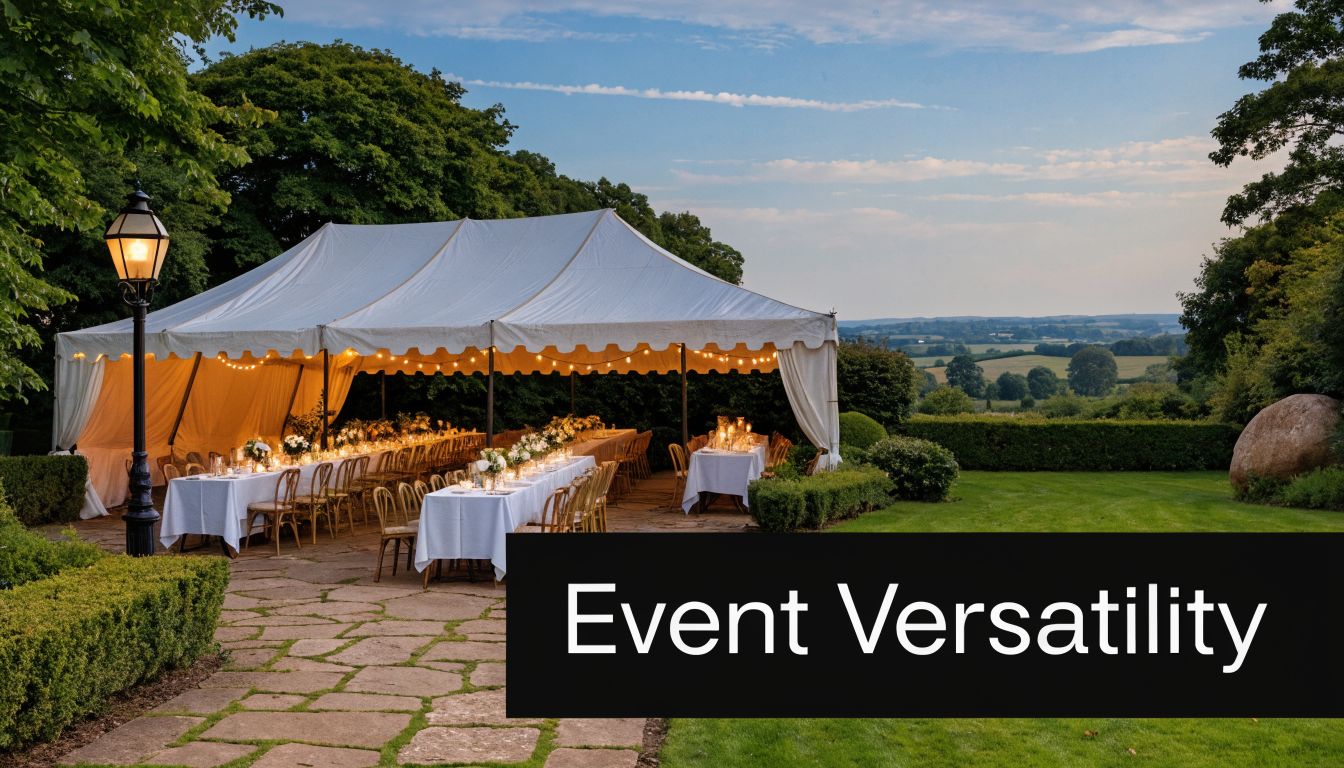
For weddings, marquees work best when couples want the freedom to create their own venue rather than inherit someone else’s package. That might mean a reception in a family garden, a dining space beside a country venue, or an evening structure added to a ceremony location that needs more capacity.
A clearspan layout is often the practical winner because it gives uninterrupted room for round tables, top table placement, speeches and dancing. If the site has a broad lawn and a more traditional look is important, a pole marquee can be the one that gives the day its character.
What matters most is balance. Wedding layouts need enough room for the formal parts of the day, but they also need warmth. Too tight feels stressful. Too cavernous loses atmosphere.
Mehndi and pre-wedding celebrations
These events often need something different from a standard wedding reception setup. Family movement, music, colour, catering, and a stronger sense of social flow all become more important.
In a Sutton or South Croydon garden, for example, a marquee can create one central covered space for seating and celebration, with adjacent areas for food service and arrivals. The structure becomes a gathering point rather than just a dining hall.
When families are hosting at home, marquees also help protect the comfort of the house itself. Guests have room to celebrate properly without every part of the home becoming event space.
A marquee works particularly well for pre-wedding functions because it keeps the event personal while still giving you proper scale.
Corporate events
Corporate clients usually need clean layout logic more than decoration first. Registration, branding, presentations, hospitality, breakout areas and catering all need to function smoothly.
A sleek marquee on a business site in Bromley or a school campus in South London can solve a problem a permanent room can’t. It creates extra capacity exactly where the event is happening.
This is especially useful for:
- Product launches: where brand presentation and guest circulation matter
- Staff events: where dining, speeches and entertainment need one managed space
- Exhibitions and showcases: where open floor area is more important than fixed-room character
Later in the planning cycle, visual details can soften the look. But the structure has to work operationally first.
A short video helps show how marquee spaces can be adapted for different event styles:
Festivals and community events
Community events need flexibility of a different kind. Instead of one room doing one job, you may need several covered spaces serving different purposes. Entrance cover, stage support, food zones, first aid, seating and activity tents may all need to work together.
In Croydon parks, school grounds and community spaces, marquees can form a temporary event village. That’s where linked structures and smaller additional units come into their own.
Religious and cultural gatherings
Churches, temples, mosques and community groups often use marquees when attendance exceeds indoor capacity or when outdoor celebration is central to the event. In those settings, the value of a marquee is not just shelter. It’s respectful flexibility.
The structure can be arranged around serving areas, family seating, ceremonial space and practical access in a way many fixed venues can’t match.
Expert Planning From Site Visit to Final Layout
A successful marquee event is won long before installation day. The structure itself matters, but the planning behind it matters just as much.
The first question isn’t usually “which marquee looks nicest?” It’s “what will work on this site?” That’s why a proper site visit is one of the most valuable parts of the whole process.
What a site visit should uncover
A good site visit looks beyond the patch of ground where the marquee might stand. It checks the access route, nearby walls and fences, trees, overhead obstacles, power options, and whether the crew can install safely without damaging the surrounding area.
In London and the South East, access is often the main issue. A generous lawn at the back doesn’t help if every item has to pass through a narrow side gate or a restricted driveway.
Ground conditions also affect the recommendation. Grass, paving, mixed surfaces and slight slopes all need different planning. Some sites are easy. Others need a more careful design, or a different structure entirely.
Layout planning before the event
Once the site is workable, the next step is turning it into a usable event room. That means deciding where tables go, how guests enter, where catering operates from, and how people move between the key parts of the event.
Layout drawings can be extremely helpful. They stop people booking space in the abstract. You can see whether the bar is too close to the dining area, whether speeches have a clear focal point, and whether the dance floor is in the right place.
A practical event layout usually balances four things:
- Arrival and welcome: guests need a clear, easy first impression
- Main function: dining, celebration, presentation or worship
- Service routes: staff, catering and furniture access must stay workable
- Exit and late-evening flow: the event should still function well when guests disperse
The smoothest marquee events feel effortless to guests because the planning has already solved the awkward parts.
A structure with a long track record
Marquees may feel modern in their current form, but they’re not a new idea. The term has military origins, coming from the 17th-century French word “marquise”. These large tents were used by French soldiers for planning and strategy before moving into civilian life as structures for grand gatherings across Europe, as outlined in this history of the term marquee.
That history matters because it explains the basic strength of the concept. A marquee has always been about creating usable, organised space where permanent buildings aren’t available or don’t fit the moment.
If you’re exploring practical options across the capital and surrounding areas, a dedicated marquee hire London service is usually the best place to begin because it starts with the site, not just the brochure image.
Transforming Your Marquee into a Complete Venue
A marquee on its own is only the shell. Useful, yes, but unfinished.
The difference between “a covered area” and “a venue people remember” comes from the details inside it. Flooring changes how the space feels underfoot. Lighting changes mood. Furniture changes how long guests stay comfortable. Heating can turn a chilly evening into a relaxed one.
Setting the scene
Linings, drapes and lighting do most of the visual heavy lifting. They soften the frame, shape the atmosphere and make the interior feel intentional rather than temporary.
For formal events, clean interior linings and warm lighting usually create the best result. For parties and mixed-use celebrations, a combination of practical lighting and decorative features tends to work better. You want enough light for safe movement, food service and speeches, but not a flat, over-bright room.
If you’re planning paths, entrance features or exterior illumination as part of the wider event setup, specialist support like Electricians London 247 outdoor lighting can be a useful reference point for thinking through safe outdoor lighting around the marquee itself.
Guest comfort makes the event
Clients sometimes focus heavily on the roofline and overlook what guests experience. In reality, comfort is what people remember for hours.
That usually comes down to a handful of essentials:
- Flooring: good flooring changes everything. It stabilises the surface, improves appearance and makes furniture work properly. A helpful starting point is this guide to flooring for marquee events.
- Furniture: the right chair and table choice affects both comfort and style. Formal dining needs different seating from a casual drinks party.
- Heating or ventilation: the marquee should suit the season, not fight it.
- Layout space: even the best furniture won’t rescue an overcrowded plan.
A marquee feels premium when guests stop noticing they’re in a temporary structure and simply enjoy the event.
The features that lift the room
Some additions are practical. Others create impact. The best events usually include both.
A dance floor gives the evening a centre of gravity. A mobile bar makes the room social. Statement features such as photo areas or illuminated decor give guests somewhere to gather and interact. For family celebrations, those extras often become part of the memory of the day.
There’s also a long tradition behind that instinct to dress and personalise the space. The commercial marquee hire trade took shape in the Victorian era, when wealthy Britons used marquees for garden parties, and demand grew again after World War II as communities used them for social events. Advances in materials later made them more widely accessible, according to this history of marquee hire in Britain.
That’s still the appeal now. A marquee isn’t just shelter. It’s a blank canvas that lets you build the event around your guests rather than settling for a room that was designed for somebody else.
Frequently Asked Questions About Marquee Hire
A lot of clients reach this point with the same concern. The marquee sounds like a good idea, but they want to know how it works in real life on a driveway in Purley, a school field in Bromley, or a garden in South London with tight side access and unpredictable weather.
Those are the right questions to ask. In our line of work around Croydon and across London, the practical details are usually what decide whether an event feels easy on the day or becomes harder than it needed to be.
Are marquees suitable for winter events in the UK
Yes, if they are planned properly for winter from the start.
A winter marquee needs more than cover overhead. It needs the right combination of enclosed sides, suitable flooring, sensible entrance points, and heating that matches how the space will be used. A seated Christmas party, for example, needs a different setup from a daytime fundraiser where guests are coming and going.
This matters a lot in London and the South East because conditions vary so much from site to site. A sheltered garden in Sanderstead behaves very differently from an exposed open space on the edge of Surrey. The structure, heating plan and guest flow should reflect that.
What happens if it’s very windy or raining heavily
Weather planning is part of the job. It should never be an afterthought.
Heavy rain usually causes more trouble around the marquee than inside it. Key pressure points are guest entrances, walkways, catering access, toilet access, and the condition of the ground as the day goes on. If those areas are planned well, wet weather is far easier to handle.
Wind is more site-specific. A properly installed commercial marquee is built for outdoor events, but the recommendation has to suit the setting. Courtyards, roof terraces, exposed lawns and awkward urban plots all need careful assessment before anything is confirmed.
How is power supplied for lighting and catering
Power depends on the venue, the distance to the supply, and what the event needs to run.
Some smaller private events can use an existing supply from the house or venue, provided it is suitable and tested against the expected load. Larger events often need a more dedicated setup, especially if you are running catering equipment, bar refrigeration, band or DJ equipment, heaters, and feature lighting at the same time.
The safest approach is to plan power early. In practice, that means looking at the full event rather than treating each item in isolation.
A sensible power check usually covers:
- Lighting: ambient lighting, task lighting and decorative features all draw differently
- Catering equipment: ovens, hot cupboards, fridges and prep areas can put serious demand on the supply
- Entertainment: DJs and live bands need stable, reliable power
- Cable routes: cables need to be safe, protected and practical for the site
Do I need planning permission for a marquee
Often you do not, but there is no one answer that covers every booking.
The structure itself is only part of the picture. Licensing, alcohol sales, amplified music, public attendance, event duration, access arrangements and local restrictions can all affect what is required. In residential parts of Croydon, for instance, neighbour considerations and finish times can matter just as much as the marquee.
That is why any responsible hire company should look at the event as a whole before giving you a definite answer.
How far in advance should I enquire
As early as you can, especially for weddings, summer Saturdays and bank holiday weekends.
The marquee may be available, but the wider package also depends on crew availability, flooring, furniture, lighting and any extras you want included. Early enquiry gives you more choice and usually leads to a better layout because there is time to solve site issues properly instead of forcing a rushed plan.
If the date is fixed, ask early. If the date is still flexible, ask early anyway.
What usually affects the overall cost
There is no single standard price because no two marquee jobs are identical.
A garden party for 40 guests on a flat lawn in Croydon is a very different job from a wedding reception on mixed ground in Kent with formal dining, a dance floor, luxury toilets and generator power. The marquee is only one part of the cost. Access, setup time, interior finish and event use all change the quote.
The main cost factors are usually:
| Factor | Why it changes the price |
|---|---|
| Marquee size | Larger structures require more material, transport and labour |
| Site conditions | Difficult access, uneven ground or mixed surfaces make installation more complex |
| Event season | Popular dates reduce availability and flexibility |
| Interior fit-out | Flooring, lighting, linings, heating and furniture all add to the final cost |
| Event use | Dining, dancing, staging and catering create different equipment and layout needs |
The more accurate the brief, the more accurate the quote. Guest numbers, site photos, postcode, timings and a clear list of priorities make a big difference.
What’s the booking process usually like
The clearest booking processes are also the calmest.
You enquire with the basics. Date, location, guest numbers and event type. From there, the supplier can usually tell you very quickly whether the job sounds straightforward, whether a site visit is needed, and what decisions will affect price most.
The part clients often appreciate most is knowing what locks your date in. Ask about deposits, payment stages, what can still change after booking, and the latest point for confirming final numbers or extras. That is where the process becomes real, and where good communication saves stress later.
If you’re planning an event and want straightforward advice on the right structure, layout and setup, Premier Marquee Hire can help with practical guidance, site visits and customized quotes across Croydon, London and the surrounding counties.
Sorry, the comment form is closed at this time.