

02 May Traditional Pole Marquee: Your Complete 2026 Hire Guide
You’re probably at the stage where the idea looks lovely in your head, but the practical questions are starting to pile up. Will a traditional pole marquee fit in the garden? Is the ground suitable? What happens if the weather turns? And will it feel elegant, or just complicated?
That’s exactly where good advice matters. A traditional pole marquee can create one of the most beautiful event settings you’ll get in a London or Surrey garden, but it only works well when the space, layout and logistics are thought through properly. In places like Croydon, Purley, Bromley and Sutton, the difference between a smooth setup and a stressful one often comes down to access, lawn shape, and how much room you really have around the edges.
Your Guide to Classic English Event Styling
A traditional pole marquee suits the sort of celebration many people already have in mind before they’ve learned the technical name for it. Soft rooflines. Timber poles. Fairy lights, florals, long tables, a bar at one end, and guests drifting between the lawn and the dance floor.
That look feels effortless when it’s done well. It isn’t accidental.
In London and the surrounding boroughs, first-time planners often focus on guest numbers first and the garden second. With a pole marquee, the garden matters just as much. You need the right surface, enough perimeter for ropes and stakes, and a layout that still works once tables, flooring, lighting and access routes are in place.
The appeal is easy to understand. A traditional pole marquee has warmth that a more rigid structure doesn’t always give you. It feels part of the garden rather than dropped into it.
A pole marquee tends to work best when you want the setting itself to feel like part of the event, not just weather cover.
For weddings, family celebrations, pre-wedding functions and some corporate hospitality, that character is often the whole point. In a Surrey garden with mature trees, or a Croydon lawn where you want an occasion to feel more personal than a hired hall, it’s often the structure people remember first.
What Makes a Traditional Pole Marquee Special
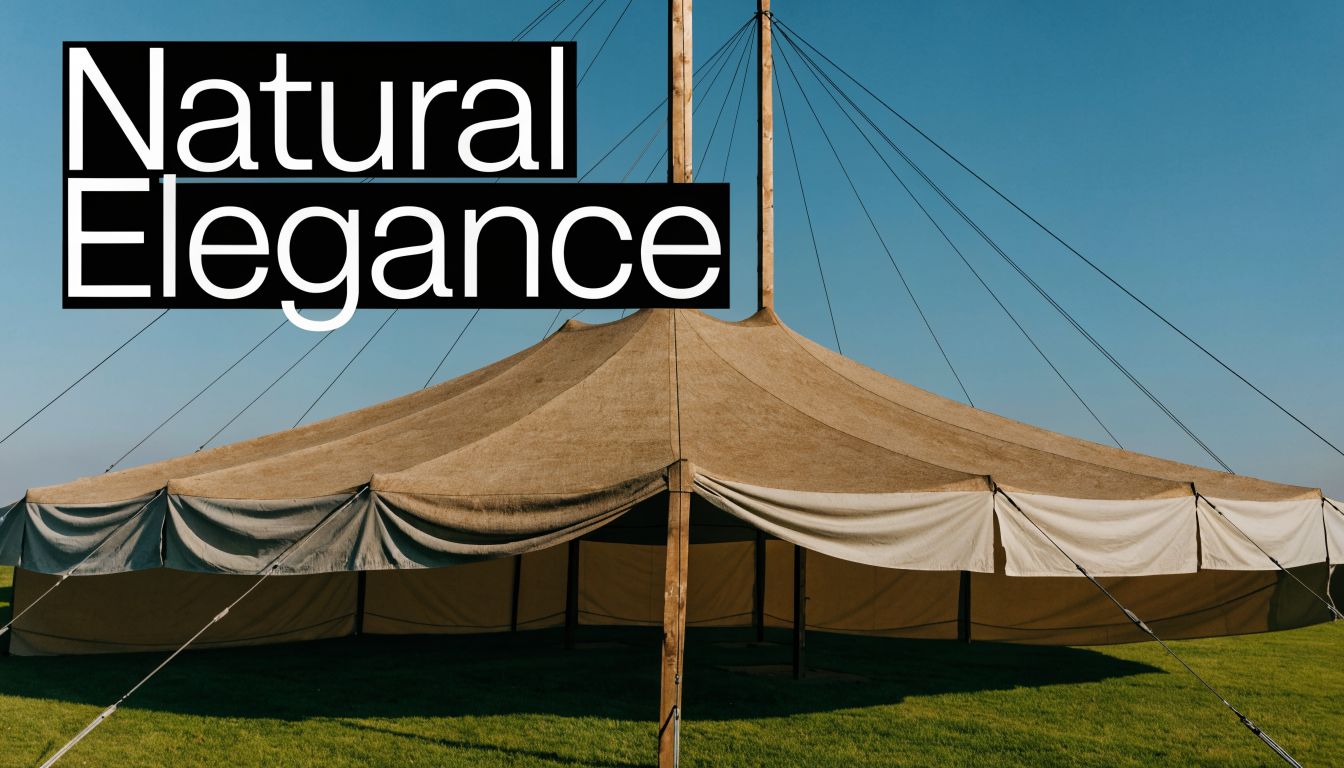
The shape often draws immediate attention. A traditional pole marquee gets its profile from central king poles, side poles and outer guy ropes that tension the roof into that classic sweeping form. It’s not boxy, and it isn’t meant to be.
The structure that creates the look
Those visible elements all do a job.
- King poles carry the main height and give the marquee its signature peaks.
- Side poles support the perimeter and help keep the walls and roofline in shape.
- Guy ropes and stakes create the tension that stabilises the whole structure on soft ground.
That’s why a traditional pole marquee feels different from a frame marquee. The engineering is part of the aesthetic. You see the ropes, the poles and the rise of the roof, and together they create the classic English event look people associate with garden weddings and summer celebrations.
Why it still feels timeless
This isn’t a recent trend. Traditional pole marquees, defined by king poles and guy ropes, became a UK staple in the 18th and 19th centuries, and their evolution from canvas to PVC has kept them in use for British events like village fetes and country weddings for over 200 years, with common capacities of 40 to 350 guests according to the history of event marquees in the UK.
That long history matters because the design has lasted for a reason. It works visually, and it creates an atmosphere that newer structures often imitate but don’t quite reproduce.
Practical rule: If the event brief includes words like romantic, rustic, English garden, country wedding or relaxed summer party, a traditional pole marquee is usually on the shortlist for good reason.
Materials and character
Older versions used canvas. Modern versions often use PVC because it handles British conditions more reliably. Even so, the best traditional pole marquee setups still keep the visual language people want. Timber poles, elegant curves, and interiors that suit linings, chandeliers, bunting or floral dressing.
That combination of craftsmanship and function is why people choose them repeatedly for weddings, private parties and festivals. They don’t just shelter an event. They shape the mood of it.
Pole Marquee vs Frame Marquee Making the Right Choice
Most clients narrow it down to two options fairly quickly. They either want a traditional pole marquee for atmosphere, or a frame marquee for flexibility. Neither is automatically right. The venue decides a lot.
The clearest difference is the site
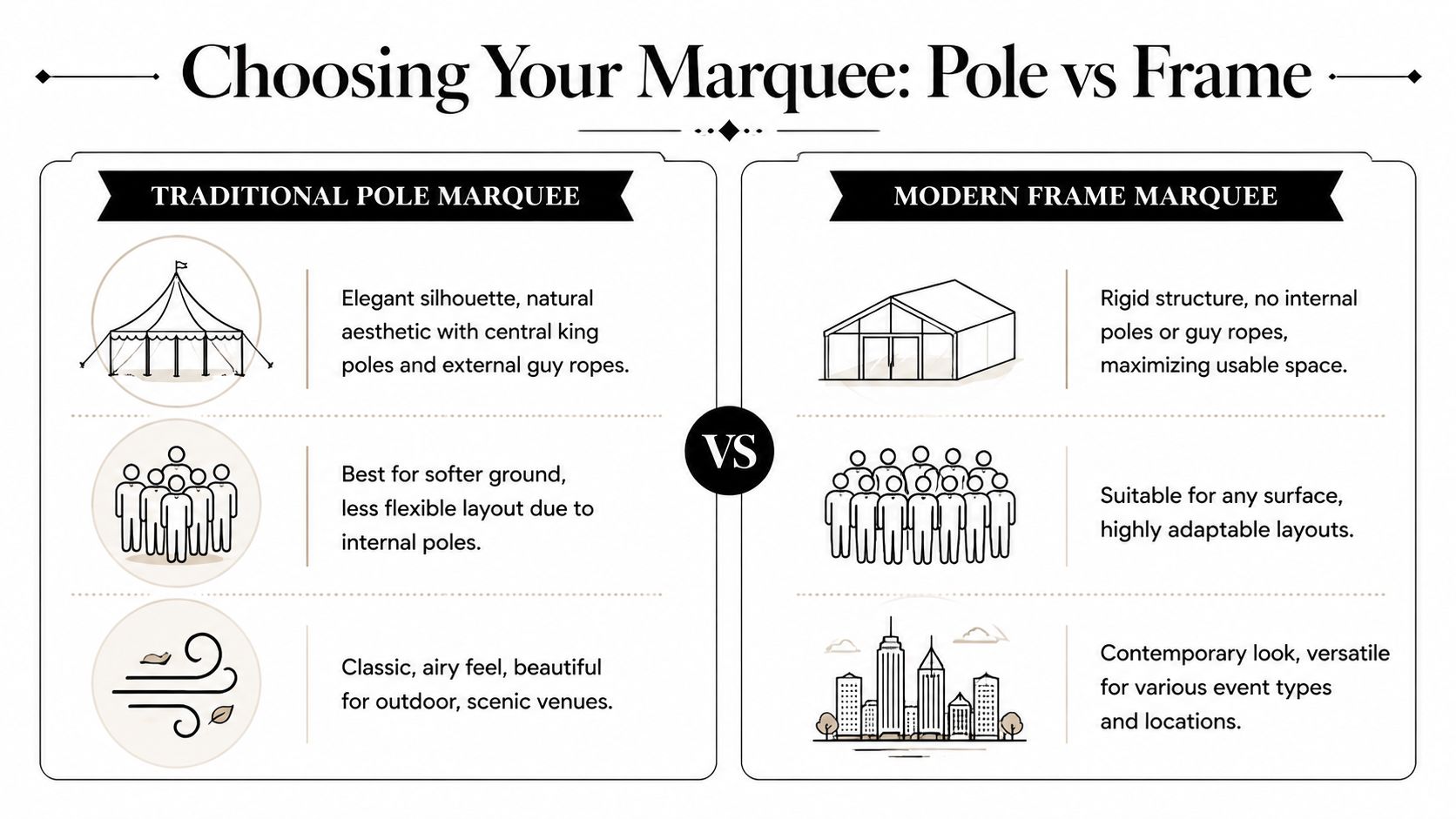
A pole marquee needs soft ground because it relies on stakes and guy ropes. A frame marquee can go into places a pole structure cannot, including many hard-surface sites and tighter urban footprints. If you’re planning a party on a lawn in Sanderstead or Caterham, a pole marquee may be a strong fit. If the event is partly on paving, a drive, or a constrained courtyard in London, a frame structure is often the practical answer.
The interior feels different too
A frame marquee gives you more uninterrupted usable space because there are no central poles. That’s useful for corporate layouts, presentations, precise table plans and events where every square metre matters.
A pole marquee trades some of that flexibility for character. The central poles become part of the design, and a good planner works with them rather than fighting them.
Here’s the simplest way to compare them:
| Consideration | Traditional pole marquee | Frame marquee |
|---|---|---|
| Look and feel | Classic, soft, romantic | Clean, modern, structured |
| Ground type | Best on grass or soft ground | More adaptable across surfaces |
| Internal layout | Some layout constraints from poles | More open-plan freedom |
| Perimeter space | Needs room for guy ropes | More compact footprint |
| Best fit | Weddings, garden parties, heritage-style events | Corporate events, winter use, tight sites |
When a pole marquee is the better choice
A traditional pole marquee usually wins when the event is meant to feel atmospheric from the first glance. That includes:
- Garden weddings: Especially where the view across the lawn matters as much as the dining setup.
- Private celebrations: Anniversaries, milestone birthdays and family gatherings where the setting should feel warm rather than corporate.
- Cultural events with decorative styling: Airy interiors and visible poles can work beautifully with draping, florals and festoon lighting.
When a frame marquee makes more sense
Sometimes clients prefer the look of a pole marquee but the site says no. That’s common in built-up parts of Croydon, Wimbledon or Dulwich where gardens have patios, retaining walls, narrow access, or awkward boundaries.
A frame marquee is often better when:
- You need every bit of internal floor area
- The site surface isn’t suitable for staking
- The event has production needs, such as staging, partitions or a more controlled service layout
- The weather risk is a bigger concern than the visual style
If your priorities are maximum layout freedom and fewer site restrictions, the frame marquee usually wins. If your priority is atmosphere and the lawn is right for it, a pole marquee often gives the more memorable result.
What usually works in London and Surrey gardens
In practice, many home events in Surrey lean naturally toward traditional pole marquees because the gardens are greener, broader and better suited to staking. In denser London plots, the choice often comes down to whether the ropes can be accommodated without swallowing too much of the usable garden.
That’s the key trade-off. A pole marquee often looks better. A frame marquee often fits more easily. The right answer isn’t about fashion. It’s about the site, the season and how you want guests to use the space.
Sizing and Capacity Planning Your Space
Size errors usually happen in one of two ways. People either choose purely by guest count and forget the bar, dance floor and circulation, or they fall in love with a marquee shape and only later realise the garden can’t comfortably hold it.
The fix is to think in zones, not just numbers.
Start with how the event will function
A dining-only event can fit differently from a full wedding reception. The moment you add a bar, dance floor, DJ area, gift table, cake table, lounge furniture or ceremony seating, the required space shifts.
That’s why marquee sizing needs real planning. Guests don’t stand still. They queue, mingle, move chairs, gather at the bar and drift toward the dance floor. A marquee that works on paper can still feel cramped if the layout hasn’t been thought through properly.
A useful benchmark for weddings
One of the most practical reference sizes is the 12m x 18m traditional pole marquee. For UK weddings, it typically accommodates 150 to 250 guests, and it gives enough width for separate dining, bar and dance floor zones. It also needs an additional 2m perimeter for guy ropes, which means a total lawn area of roughly 16m x 22m, as outlined in this 12m x 18m wedding marquee guide.
That’s why this size is often described as an all-rounder. It’s large enough to create proper separation between the main parts of the event without immediately pushing into very large-site territory.
Think in event zones
A practical layout conversation usually includes some version of these areas:
- Arrival and entrance space so guests aren’t bottlenecked the moment they walk in
- Dining area that allows chairs to move and staff to serve comfortably
- Bar position with room for a queue that doesn’t block walkways
- Dance floor or entertainment zone that feels deliberate rather than squeezed into leftover space
If one of those is especially important, the marquee should be sized around that priority.
A marquee should feel comfortably occupied, not tightly packed. Good flow is what makes an event feel calm.
Smaller functions and Mehndi celebrations
Not every event needs a full wedding footprint. Pole marquees are also being chosen more often for compact pre-wedding celebrations in London. The rise of Mehndi and related functions in South Asian communities has driven a 25% increase in pole marquee hires, with airy canvas styling proving popular for 40 to 100 guests in urban gardens across places such as Croydon and Middlesex, according to Field and Lawn’s comparison of traditional and clearspan structures.
That makes practical sense. These events often benefit from a space that feels open, festive and decorative without becoming formal.
A simple sizing mindset
If you’re planning your own event, these questions give a better starting point than guest count alone:
- Will guests be seated, standing, or both?
- Does the marquee need to hold dancing as well as dining?
- Will guests spend much of the event inside if the weather turns?
- Are you planning one main marquee or linked spaces for different functions?
Those answers shape the right size far more accurately than a quick capacity chart.
Site Requirements for London and Surrey Gardens
A traditional pole marquee can look perfect on paper and still fail at the garden gate.
That happens a lot in London and Surrey. A client measures the lawn, sees enough room for the main rectangle, and assumes the site works. Then we visit and find a narrow side return in South Croydon, a raised patio in Wallington, heavy clay in Purley after rain, or flower beds exactly where the staking needs to go. Pole marquees are more dependent on the garden than frame structures, so the site check is not a formality. It decides whether the plan is practical.
Soft ground and staking space
Traditional pole marquees need stakes and guy ropes to hold their shape. The canopy is tensioned from the outside, so the usable lawn must extend beyond the marquee itself. Traditional marquee manufacturing guidance from Crockers Marquee Manufacturing shows the basic requirement clearly. Side poles sit at regular intervals, king poles create the height, and the ropes need clear perimeter space beyond the main footprint.
That outer margin is where many garden plans come unstuck.
A lawn may look large enough for the marquee body but still be too tight once you allow for ropes, staking angles, pathways, and safe clearance from fences or planting. In a suburban garden, even one mature tree or a line of railway sleepers can rule out the layout you had in mind.
What usually works well
The best sites tend to share the same basics:
- Grass or another stakeable soft surface
- A reasonably level area
- Enough width and depth for the marquee plus its guy ropes
- Clear access for the installation team and equipment
- No hidden obstacles such as soakaways, irrigation lines, or shallow service runs
Open lawns in Caterham, Kenley, Purley and wider Surrey villages often suit pole marquees well because they give you breathing room around the structure. Smaller London gardens can still work, but they need more careful planning. Rear access, shared driveways, garden walls, sheds, and tight boundaries all matter before a single pole goes up.
Clay soil changes the job
Croydon, much of Surrey, and parts of South London sit on clay-heavy ground. In practice, clay can be helpful because it often holds stakes firmly. It can also be awkward. After a long dry spell it sets hard and slows the build. After sustained rain it becomes greasy, soft on the surface, and messy underfoot.
That combination affects more than installation. It can influence flooring choices, guest comfort, and how quickly a garden recovers afterwards.
This is why a proper site visit matters in this part of the world. Two houses on the same road can have completely different ground conditions because of drainage, shade, slope, or previous landscaping work.
Garden shape matters as much as size
Square footage alone does not answer the question.
A lot of London and Surrey gardens taper towards the back, step down in levels, or mix lawn with paving in a way that leaves no clean line for perimeter staking. I see this often in Croydon and Bromley gardens where the central lawn looks generous, but the sides pinch in near fences and outbuildings. A pole marquee needs a layout the structure can tension properly. It cannot just squeeze around obstacles because the canvas and ropes work as one system.
The lawn has to suit the marquee shape, not just the guest list.
Access can decide the whole project
Even if the footprint works, the build still has to be possible. Side passages, garden steps, sharp turns, low arches, and parking restrictions can all affect what can be carried in and how long the installation takes.
This catches first-time planners by surprise. The question is not only, "Will it fit when finished?" The question is also, "Can the crew get the poles, canvas, flooring, lighting and furniture into place safely?"
If you are still comparing garden structure options, this guide to an outdoor party tent for garden events is a useful starting point before booking a survey.
Weather in London and Surrey
Pole marquees are at their easiest in late spring and summer, especially on established lawns that have had time to firm up. They can still work outside peak season, but the site has to do more of the heavy lifting. Wet clay, shaded gardens, and exposed plots on higher ground all need a more cautious approach.
In practical terms, autumn and winter bookings usually mean closer attention to flooring, heating, delivery timing, and how guests will move between the house and marquee without churning up the garden. The right answer is site-specific. A sheltered Surrey lawn with good access can be more workable in October than an exposed hilltop garden in July.
What a sensible site check should confirm
Before you commit, these are the questions worth answering:
| Site question | Why it matters |
|---|---|
| Is the ground suitable for staking? | The structure depends on secure anchoring |
| Is there enough clear perimeter around the marquee footprint? | Guy ropes and safe working space need room |
| Is the site level enough for proper tension and a tidy finish? | Uneven ground affects both appearance and setup |
| Can the crew and equipment reach the build area easily? | A good lawn can still be impractical if access is poor |
| How will the garden cope if the weather turns wet? | Flooring, matting and access routes may need upgrading |
A traditional pole marquee rewards an honest site assessment. Get that part right early, and the rest of the planning becomes much easier.
Styling and Accessorising Your Pole Marquee
Once the structure is right, a traditional pole marquee comes into its own. The interior doesn’t need much to feel special, but it rewards thoughtful styling more than almost any other event structure.
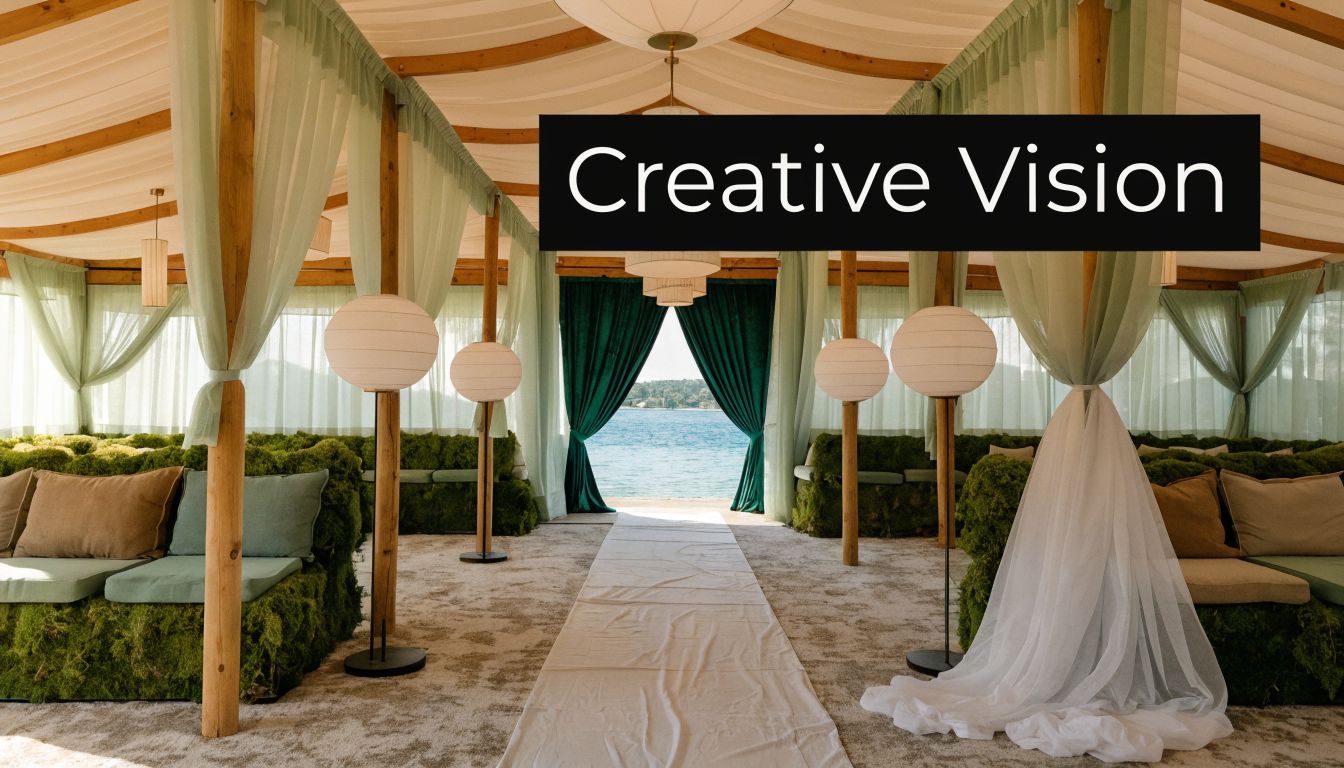
Use the structure as part of the design
The poles and ridge lines aren’t obstacles. They’re natural styling points.
In a wedding setup, they can carry draped fabric, suspended florals, lanterns or festoons. For a Mehndi, they often suit colourful textiles, layered lighting and decorative details that make the space feel celebratory from the first step inside. That’s one reason pole marquees have seen increased demand for these events in compact London gardens.
A strong traditional marquee interior often starts with three visual anchors:
- Ceiling treatment that softens the space and draws the eye upward
- Pole styling with florals, foliage, wrapped fabric or lighting
- A focal point such as the top table, stage, dance floor or bar
Flooring changes the feel immediately
People often think of flowers and lighting first, but the floor changes the room faster than anything else. If the event is casual, matting can keep the atmosphere relaxed. If it’s a formal wedding or evening party, a boarded floor with a defined dance floor usually gives a neater finish and more confidence underfoot.
This is also where weather planning becomes practical. A beautiful marquee on damp grass won’t feel elegant for long if the underfoot finish hasn’t been chosen properly.
Draping and lighting do most of the heavy lifting
For many events, the best styling decision is restraint. A traditional pole marquee already has shape and softness. It doesn’t need to be overloaded.
If you want a fuller ceiling treatment, these examples of ceiling drapes for marquees show how fabric can change the mood from simple garden setup to a more dressed reception space.
After that, lighting usually carries the atmosphere into the evening.
Soft warm lighting suits the shape of a pole marquee far better than harsh brightness. You want glow, not glare.
A useful visual reference sits below.
Furniture and finishing pieces
Furniture should match the style of the structure. Chiavari chairs, long banquet tables, round dining tables, mobile bars and feature pieces such as giant LOVE letters all tend to sit comfortably in a traditional setting if the layout has breathing room.
This is also where one supplier can simplify things. For example, Premier Marquee Hire offers marquees in multiple widths and lengths, along with furniture, mobile bars, lighting and event accessories, which can make layout coordination easier when one team is working from the same plan.
What tends to work best
In London and Surrey gardens, the most successful pole marquee interiors usually share a few traits:
- A clear central layout rather than too many competing decorative zones
- Decor that follows the structure instead of hiding it
- Lighting that shifts the room into evening use
- Accessories chosen for the event type, not just because they looked good in another venue
The marquee already provides the character. Styling should sharpen it, not fight it.
Understanding Your Quotation and Key Cost Factors
A traditional pole marquee quote often surprises first-time clients because it covers far more than the canvas itself. In a London or Surrey garden, the price usually reflects the structure, the site conditions, and the practical items that make the space usable in real weather.
That matters most when two gardens look similar on paper but build very differently on site. A flat lawn in Purley with wide side access is one job. A narrower garden in Wimbledon with clay ground, steps, and limited delivery access is another.
What usually shapes the quote
The biggest cost factors are usually straightforward:
- Marquee size and layout
- Flooring type
- Linings and interior finish
- Lighting
- Furniture numbers
- Delivery, access, and labour time
- Seasonal items such as heating
Size affects more than cover. A larger pole marquee needs more material, a bigger installation team, more transport space, and often a longer build window. If the garden has awkward access or soft ground, labour can rise even when the marquee itself is not especially large.
Why two similar marquees can price differently
The detail sits in the brief and the site.
A simple summer party on a sound lawn is usually the cleanest version of the job. A wedding with boarded flooring, linings, dining furniture, lighting, a bar area, and heating costs more because each part adds handling, installation time, and coordination.
Ground conditions in this area make a real difference too. London and Surrey gardens often sit on heavy clay, which can be firm in a dry spell and awkward after rain. That can affect flooring recommendations, vehicle access, and the time needed to build safely without damaging the lawn more than necessary.
Season also changes the quotation. Pole marquees can still work outside peak summer months, but cooler weather usually means more thought about flooring underfoot, heating output, and how guests move between the house and marquee without trailing mud back inside.
How to read a quote sensibly
The clearest way to review a quotation is to separate the structure from the extras and from the site-specific costs.
| Quote area | What to check |
|---|---|
| Main marquee | Size, shape, and whether it suits your guest numbers and layout |
| Flooring | Basic ground cover or a boarded floor for a firmer, more formal finish |
| Interior items | Linings, lighting, tables, chairs, bar units, and other hired pieces |
| Site-related costs | Access restrictions, distance from unload point, and any build complications |
| Seasonal items | Heating and other weather-related additions |
If you want a clearer benchmark before comparing suppliers, this guide to prices for marquee hire gives a useful breakdown of how costs are commonly structured.
A good quote should show three things clearly. What is included as standard, what is optional, and what has been specified because your garden or event date calls for it.
That is usually a better sign than the lowest headline figure. A shorter quote can hide the items that later become rushed add-ons, and that is where budgets often start slipping.
Your Booking Checklist and Final Questions Answered
Once you’ve chosen the traditional pole marquee route, the booking process becomes much easier if you keep decisions in the right order. Guest numbers and site suitability come first. Decorative extras come later.
Booking Checklist
| Step | Action | Premier Marquee Hire Helps By… |
|---|---|---|
| 1 | Confirm your estimated guest count | advising on suitable marquee size and layout direction |
| 2 | Identify the event type and priorities | discussing whether the space needs dining, dancing, bar service or ceremony use |
| 3 | Arrange a site survey | checking lawn suitability, access and perimeter space for ropes and stakes |
| 4 | Review a draft layout | helping you visualise table plans, walkways and focal areas |
| 5 | Choose flooring and weather options | matching the setup to the season and comfort level you want |
| 6 | Finalise furniture, lighting and styling items | aligning accessories with the marquee structure and event style |
| 7 | Confirm timings and access arrangements | reducing surprises during installation and collection |
Questions clients usually ask near the end
What happens during a site survey
The survey checks whether the garden works for a traditional pole marquee in practical terms. That includes the ground surface, levels, access route, available footprint and the extra perimeter needed for ropes and stakes.
How long does installation take
Installation time depends on marquee size, access and how much else is included, such as flooring, lighting and furniture. A straightforward lawn setup is very different from a tight-access urban garden with a full dressed interior.
Can a traditional pole marquee work for a smaller home event
Yes, if the lawn shape and perimeter allow for it. Smaller celebrations can suit this style very well because the structure itself contributes so much character, especially for garden parties and pre-wedding functions.
What about power
Power needs depend on what’s going inside. Basic lighting needs less than heating, catering equipment, entertainment or bar service. This should be discussed as part of the layout and equipment planning rather than left until the week of the event.
When should you book
Earlier is better, especially for peak wedding months and weekends. It gives more time to assess the site properly and make layout decisions without rushing.
The most important thing is to decide from the site outward. If the lawn is right, the rest becomes far more straightforward. If the site has limits, it’s better to know that early and plan around them properly.
If you’re planning an event in Croydon, London, Surrey or the surrounding counties, Premier Marquee Hire can help you assess whether a traditional pole marquee is the right fit for your space, talk through layout options, and arrange a site visit before you commit.
Sorry, the comment form is closed at this time.