

05 May Marquee with Flooring: The Complete Event Planning Guide
You’ve probably already thought about the marquee size, the guest list, the tables, the caterer and what happens if the weather turns. Then the awkward question appears. What are people going to stand, sit and dance on?
That’s where a lot of London and Surrey garden events start to wobble. A lawn can look fine in photos and still be soft underfoot, slightly sloped, patchy near the borders or damp by late afternoon. In Croydon, Bromley, Purley and the surrounding boroughs, that’s normal. It’s also fixable.
A marquee with flooring isn’t just a nicer version of a garden setup. It’s what turns outdoor space into a proper event venue. If you’re planning a wedding, Mehndi, private party or corporate function, the floor is what makes the whole space feel settled, safe and usable from the moment guests arrive.
The Foundation of a Flawless Event
Most clients start with the roof. They want to know how the marquee looks, how it handles rain, and whether it will feel warm enough in the evening. All sensible questions. But the ground causes just as many problems as the weather.
A smart garden in Croydon can still leave you with muddy entrances, chairs that don’t sit square, and guests picking their route across the lawn to avoid sinking heels. Once catering equipment, bar units and dining tables go in, every small issue in the ground becomes more obvious. What looked manageable the day before starts to feel improvised.
That’s why flooring should be treated as part of the structure, not as a decorative extra. A good floor gives the event a proper base. It creates a cleaner entrance, a steadier dining area and a more comfortable room overall, especially when the weather is mixed.
For clients planning corporate launches or branded events, the same principle applies. If you’re interested in the wider event side of presentation and flow, PSW Events has a useful piece on mastering product launches that shows how much the guest experience depends on practical setup choices, not just styling.
A professional site survey normally answers this quickly. You look at access, the slope, the lawn condition, nearby hard standing and how the marquee footprint will work on the day. If you’re still at that early planning stage, this guide to marquee hire options in Croydon and beyond gives a helpful overview of how the full setup comes together.
A marquee can hide an awkward garden. It can’t fix awkward ground unless the floor is designed for it.
The best events feel effortless to guests. Flooring is one of the reasons they do.
Why Marquee Flooring is a Non-Negotiable
A lot of people ask whether flooring is really necessary. On a warm summer day, on a very firm and level surface, that question sounds reasonable. In practice, flooring solves three of the biggest problems in marquee work. Safety, comfort and event quality.
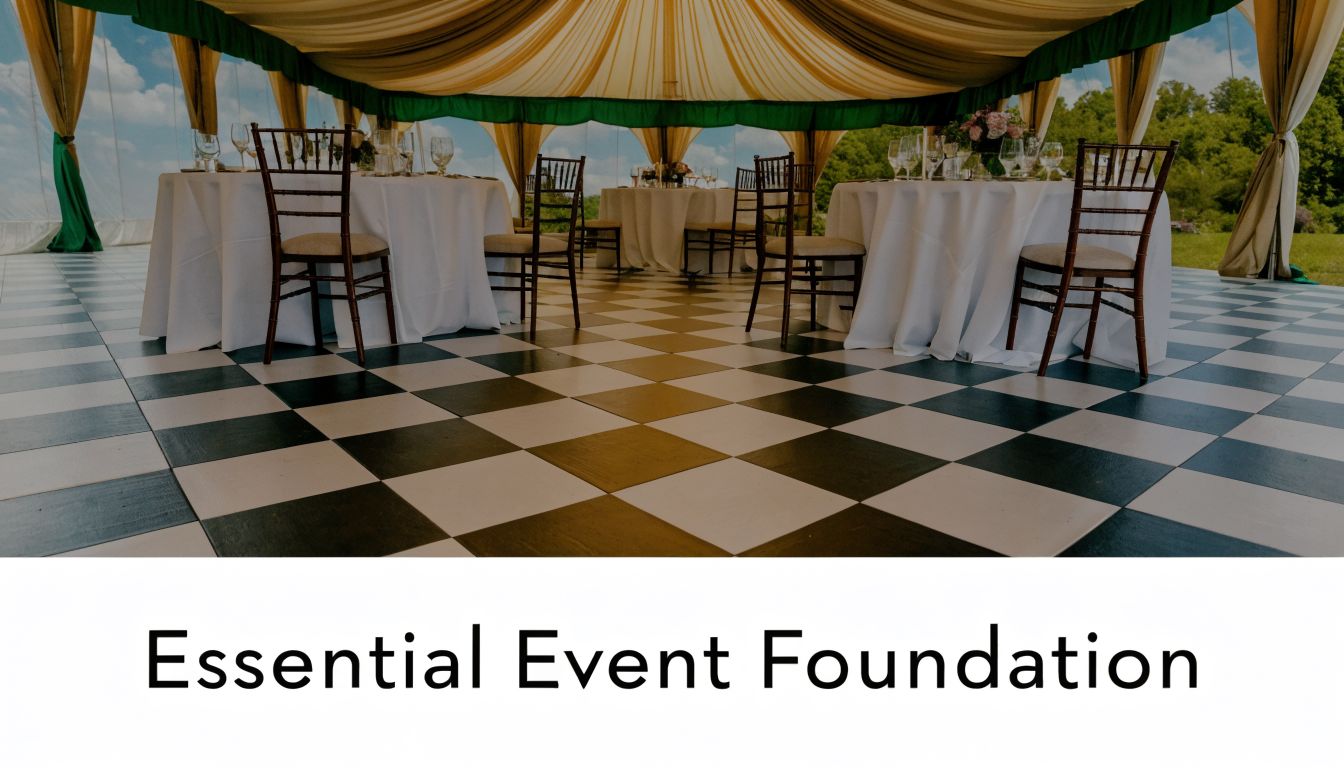
Safety starts underfoot
Grass rarely stays as stable as people expect once guests begin moving through the marquee. Paths wear quickly. Dining areas become uneven. Edges near entrances get churned up first, especially if the weather is unsettled.
A proper floor gives you one continuous surface. That matters for heels, pushchairs, serving staff carrying trays, and older guests who don’t want to negotiate soft patches or hidden dips. It also matters for public and community events where a tidier, more controlled surface reduces avoidable trip points.
Comfort matters more than people realise
The cold comes up from the ground long before most hosts notice it. That’s why flooring makes such a difference from autumn through spring. In the UK, marquee flooring is essential for over 80% of events held between September and April, and it typically raises the floor by around 1 to 2 inches (25 to 50mm) to help create an insulated barrier between the event space and the cold ground. Without that barrier, heating becomes less efficient and energy costs can rise by up to 30 to 50%, according to Abacus Marquee Hire’s guidance on marquee flooring.
That point is especially relevant across London and Surrey, where winter weddings and year-round garden events are common. The marquee may be heated well, but guests still notice a cold floor immediately.
Practical rule: If your event is between September and April, assume flooring is part of the job unless the site survey proves otherwise.
A better event feels more settled
Even when guests can’t explain why a setup feels polished, they notice it. Tables sit properly. Bars feel secure. Speeches sound calmer when the room isn’t dealing with movement and wobble underfoot. The whole marquee feels like a finished venue rather than a temporary shelter.
That’s why flooring has such a visible effect on weddings, dinners and formal events. It helps every other element perform properly.
For a visual sense of how flooring changes the space, this video is worth a look before you finalise your layout.
What works and what doesn’t
Some hosts try to compromise by flooring only part of the marquee, or by relying on basic matting where the site really needs a levelled base. That can work for very light footfall, but it often creates a mismatch between the appearance of the event and how it functions.
A quick way to think about it is this:
- Works well: full flooring on damp lawns, formal dining events, winter functions, sloped gardens, and any event with mixed age groups
- Usually causes issues: exposed grass under dining furniture, soft entrances, uneven surfaces under bars, and relying on dry weather as the plan
If the event matters, the floor matters.
Choosing Your Marquee Flooring Type
The easiest way to choose flooring is to think about it like choosing the foundation for a house. If the base is wrong, everything above it becomes harder to use. The right choice depends less on style than on the surface below, the time of year and how the marquee will be used.
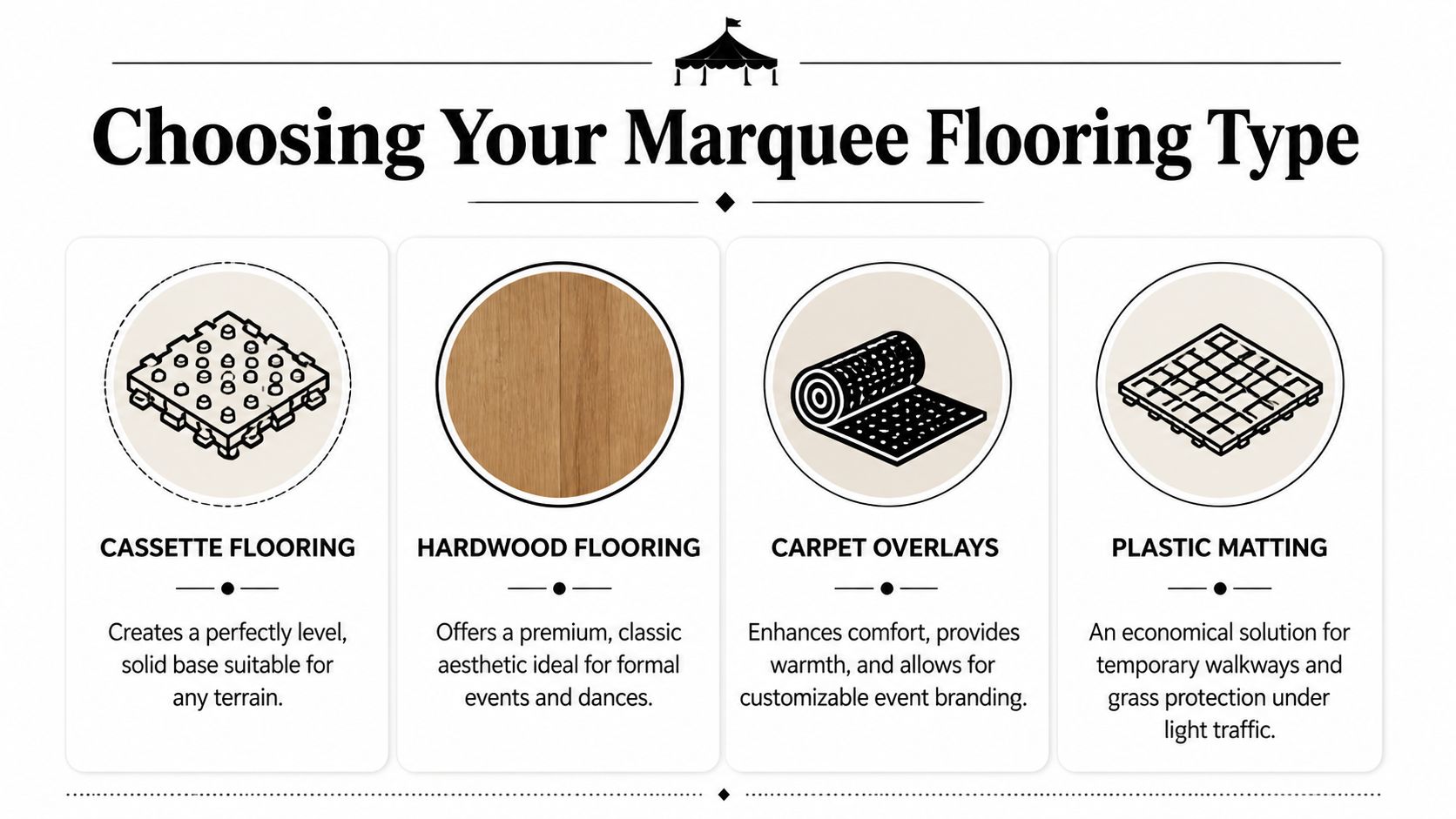
Cassette flooring
Cassette flooring is the premium answer when the ground isn’t straightforward. It uses modular floor sections laid on a support system so the finished surface sits level even when the garden doesn’t.
This is the one you reach for on sloped lawns, mixed surfaces or sites where a standard direct lay floor would follow the shape of the ground too much. It’s also useful for events where the floor needs to feel absolutely solid because there’s heavy furniture, a dance area or a lot of foot traffic.
Pros
- Creates a level surface on awkward ground
- Feels firm and consistent under dining furniture and dance floors
- Better suited to formal weddings, larger parties and public events
- Gives a cleaner finish where the site has visible irregularities
Cons
- Costs more than simpler flooring systems
- Takes more planning and accurate site assessment
- Can be unnecessary on flat, easy ground
Cassette flooring isn’t the automatic choice for every job. But if a garden slopes, drops away at one end or has different levels across the footprint, it’s often the difference between a smooth event and a compromised one.
Direct lay flooring
Direct lay flooring is the workhorse option for flat gardens, patios and straightforward lawns. It sits directly onto prepared ground, so it’s most suitable where the site is already reasonably level and accessible.
This is also the most cost-effective option in common use. Direct lay marquee flooring is selected for approximately 70% of events on flat, level sites in the UK, and it costs around 20 to 30% less than raised cassette alternatives, according to Tents and Events’ guide to marquee flooring.
That’s why it’s often the right answer for garden parties, family celebrations, school events and community functions where the surface is good and the budget needs to stay sensible.
| Flooring type | Best for | Main strength | Main limitation |
|---|---|---|---|
| Cassette | Sloped or uneven gardens | Levels the site | Higher cost |
| Direct lay | Flat lawns and patios | Better value | Depends on ground quality |
| Carpet overlay | Comfort and finish | Softer feel and cleaner look | Needs a stable base underneath |
Carpet overlays
Carpet isn’t usually the structural answer on its own. It’s the finishing layer that improves the feel of the floor once the right base is in place.
On a practical level, carpet helps with warmth, appearance and noise. It softens the room. It gives a wedding or formal dinner a more complete look. It also helps avoid that hard, temporary feel some clients worry about when they hear the phrase “marquee flooring”.
Where carpet works best:
- Formal dining events where the visual finish matters
- Autumn and winter bookings where guests will notice the extra warmth underfoot
- Corporate interiors where branding, colour coordination or a cleaner presentation is important
Where carpet doesn’t solve the problem is uneven ground. If the lawn dips, shifts or slopes, carpet follows the problem. It doesn’t remove it.
If the site is poor, add structure first and finish second. A nice carpet over a bad base still feels like a bad base.
Boarded and hardwood-style finishes
Clients sometimes use “hardwood floor” as a catch-all phrase. In practice, there’s a difference between the structural flooring system and the decorative finish above it. A hard floor can give the marquee a more classic look and a firmer feel, especially for weddings with dining and dancing in the same space.
For some events, that polished wood-style finish is worth prioritising. For others, especially where the focus is on practicality, a simpler hard floor with carpeted zones is the better route.
A few sensible trade-offs help here:
- If the event is mainly seated dining, guests care most about level tables and warm footing.
- If there’s a busy dance floor, the transition between dining floor and dance area matters.
- If access is tight through a London driveway or side path, the installation method matters as much as the surface finish.
Plastic matting and lighter-duty surfaces
Plastic matting has a place, but not as a substitute for full event flooring where guests are dining, dancing or sitting for long periods. It’s more often useful for temporary walkways, grass protection and service routes.
That makes it handy around the edges of an event rather than at the heart of it. For example, a walkway from the house to the marquee, or a route to loos and catering areas. It can reduce mess and help preserve the lawn, but it won’t give you the solid feel of a full flooring system.
The practical decision
When clients are unsure, the easiest question is this. Do you need the flooring to finish the space, or do you need it to fix the space?
If it only needs to finish the space, direct lay flooring with the right top surface often does the job nicely. If it needs to fix levels, cold ground, awkward access or a difficult garden shape, cassette flooring becomes much more important.
That’s the point where a site visit saves a lot of guesswork.
Matching Flooring to Your Event Surface
The best flooring choice usually becomes obvious once you stop thinking in brochure terms and look at the actual garden. In this part of London and Surrey, no two sites are quite the same. A level lawn in Shirley behaves very differently from a stepped garden in Bromley or a patio-led setup in Purley.
Flat lawns
A flat, firm lawn is the easiest site to work with. If the grass is healthy, the ground is reasonably dry and there aren’t hidden undulations across the marquee footprint, direct lay flooring is often the sensible answer.
The important point is that “flat” has to mean more than looking level from the patio doors. During a site survey, you’re checking for shallow dips, soft edges and any changes in level where furniture will sit. A garden can be almost flat and still create problems once a long dining run or dance floor goes in.
For this type of surface, what works well is:
- Direct lay hard flooring for dining, bars and general guest circulation
- Carpet overlays where you want a warmer or more formal finish
- Protected entry routes if guests will cross other parts of the garden
Patios and hard standing
Patios, tennis courts and other hard surfaces are often simpler because the base is already solid. But they still need checking. Drainage falls, uneven slabs and threshold changes between house and marquee can all affect how the space feels in use.
This is also where access becomes important in dense London settings. A compact rear garden can be workable, but only if the delivery route, gates and turning space are considered early. Tight side returns and narrow passages can affect the choice of flooring system because some installations are easier to bring in and assemble than others.
On hard standing, the surface may already be solid, but the details around the edges usually decide whether the finished marquee feels seamless.
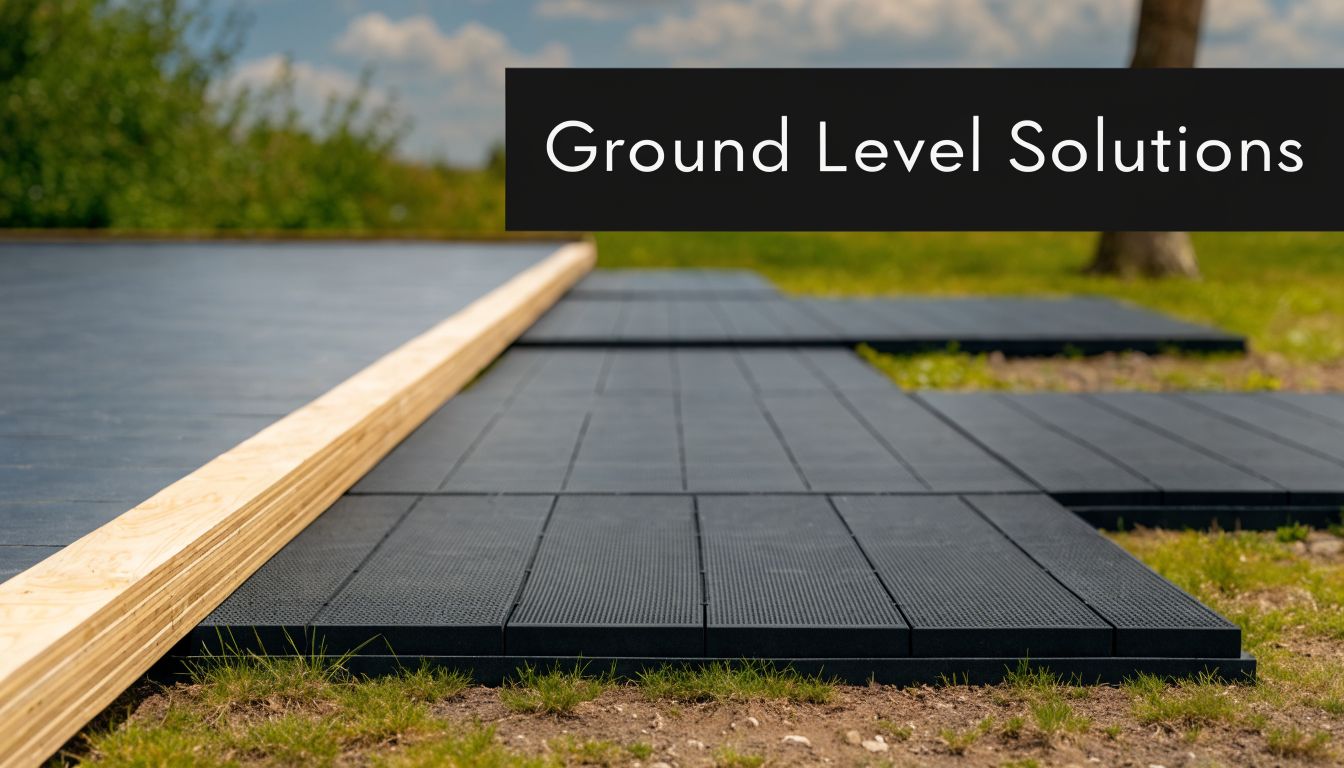
Sloped or uneven gardens
This is the surface that worries clients most, and for good reason. Uneven gardens are common across London, especially in family homes where the lawn falls away from the house or has been altered in sections over time.
For UK marquees on uneven ground, suspended cassette flooring systems are the recommended option. These systems can create a fully level platform, can bear loads of up to 500kg/m², and are suitable for slopes up to 1:20, as outlined in the Tents and Events flooring guide PDF. That same guidance notes their relevance to public access requirements by providing a more level, usable surface.
What that means in practice is simple. A garden that looked unsuitable can often still host a proper marquee with flooring, provided the floor system is chosen correctly.
A sloped site usually needs more than one decision:
- How much level correction is needed
- Whether the whole marquee needs levelling or only part of it
- How guests will enter and move through the structure
- Whether ramps or transitions are needed at key points
Mixed surfaces and awkward footprints
Some of the trickiest jobs aren’t steep gardens. They’re gardens with a bit of everything. Half lawn, half patio. A path running through the middle. Tree roots near one side. A shed base or raised border eating into the footprint.
Those sites need planning rather than assumptions. Often the right answer is a marquee layout that works with the usable areas rather than trying to force a symmetrical design onto a difficult footprint. The floor choice then follows that plan.
Measured surveys and layout drawings help most. They stop costly decisions being made off phone photos and rough estimates.
Budgeting and Planning Your Flooring Installation
Flooring costs vary because the ground varies. The same marquee size can be straightforward on one site and far more technical on another. That’s why a sensible quote starts with the surface, access and intended use, not just the square metreage.
One of the clearest signals of this is how often garden slopes become the sticking point. A 2025 UK Wedding Survey found that 68% of London-area couples report garden slopes as a setup barrier, and the same source says cassette floors average £25 to £35 per m² for solving that issue. It also notes that skipping flooring on damp ground can lead to 15% higher cleanup costs from tracked-in mud, according to Time Marquees’ guide to awkward spaces.
Typical budget ranges
A useful way to think about spend is by flooring category rather than by one headline figure.
| Flooring option | Typical budget range | Best suited to |
|---|---|---|
| Direct lay flooring | Lower-cost end of marquee flooring | Flat lawns, patios, simple private events |
| Cassette flooring | Higher-cost structural option | Sloped gardens, formal events, uneven sites |
| Carpet overlays | Added finish cost on top of a base floor | Weddings, winter events, premium presentation |
The final figure depends on how much prep the site needs, whether access is straightforward, and whether the event needs extras such as ramps, dance floor zones or transitions into the house.
If you’re comparing overall event costs, this page on marquee hire prices in London helps put flooring into the wider budget alongside structure, furniture and other hire elements.
What happens during a site visit
A proper site visit isn’t just a quick look at the lawn. It should answer the questions that affect cost and fit.
A survey normally checks:
- Ground condition so the right floor system is chosen
- Levels and slope across the full footprint, not just one corner
- Access routes for equipment through side gates, driveways or service paths
- Integration points such as house doors, patios, paths and utility areas
- Intended layout including dining, bar, dance floor and circulation
This is also where practical compromises often save money. Sometimes a small shift in marquee position reduces levelling work. Sometimes changing the entrance point improves guest flow and lowers installation complexity.
The quote should reflect the real site, not an idealised version of it.
Installation timing and sequencing
Installation timing depends on the size of the marquee, the flooring system and the site conditions. A simple direct lay floor on an easy site is much quicker to install than a levelled system on sloped ground.
What matters to clients is the sequence. The team needs enough time to set the structure, install the floor correctly and finish the space without rushing. Tight build windows can be done, but they leave less room for adjustment if access is awkward or the weather turns.
In practical terms, the floor should never be treated as an afterthought added at the last minute. It affects the pace of the whole install and the feel of the finished marquee.
A supplier such as Premier Marquee Hire may also provide free site visits and CAD layout support on request, which is useful when you need to test furniture placement before committing to a floor specification.
Finishing Touches, Dance Floors, Accessibility, and Layouts
Once the structural floor is sorted, the marquee starts to become a proper event space rather than just a covered area. Layout decisions then become important. Dining, dancing, access, catering flow and visual finish all need to work together.
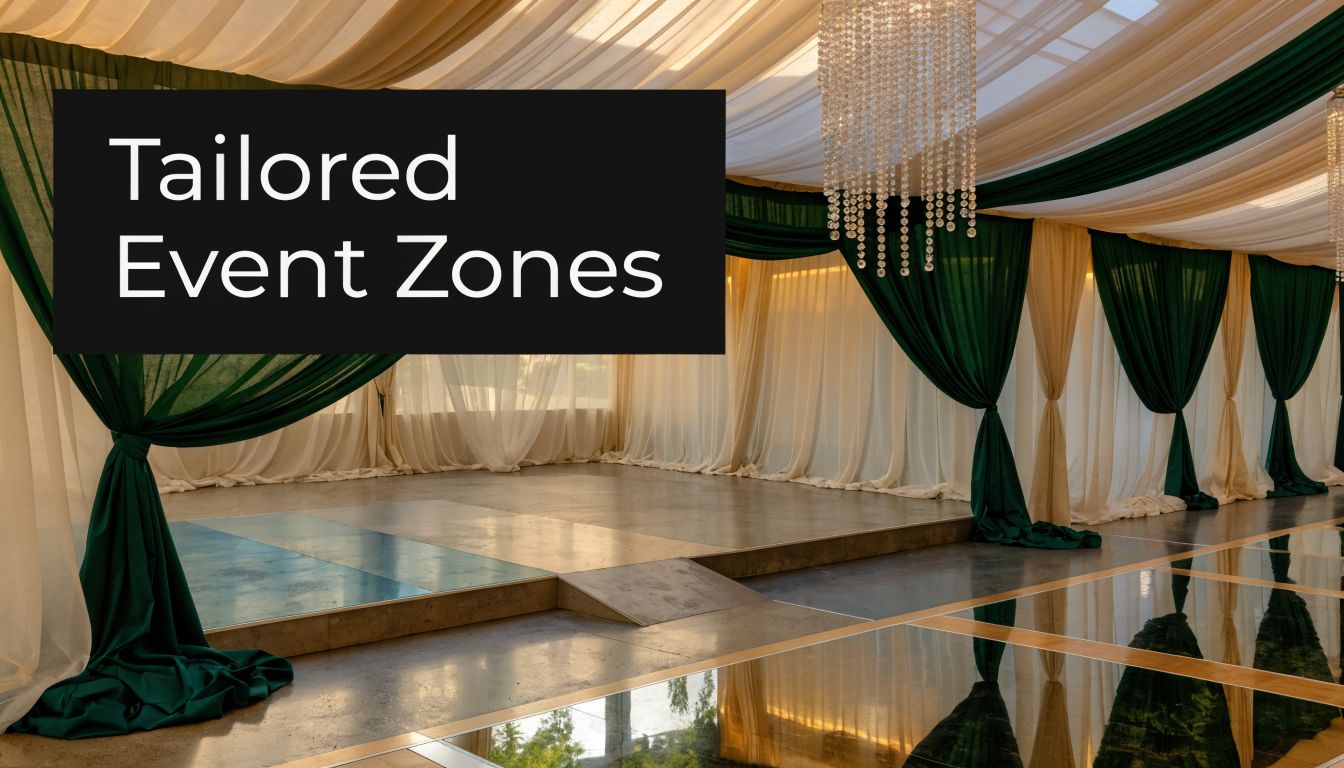
Dance floors that sit properly within the room
A dance floor shouldn’t feel dropped into the marquee as an afterthought. It should feel connected to the room, with enough clearance around tables, bar areas and access routes so guests can use it comfortably.
That usually means thinking about the dance floor as one zone within a wider flooring plan. In some setups, the main floor carries through and the dance surface is defined by finish. In others, the dance floor is a distinct insert within the room. Both approaches can work, but they need to suit the event.
For weddings and parties, the surrounding circulation matters just as much as the dance area itself. If chairs back onto the edge of the dance floor, or the DJ setup blocks the natural route to the bar, the room quickly feels cramped.
Accessibility needs proper planning
Accessibility isn’t a box-ticking exercise. It changes how guests experience the event from arrival onwards. Level transitions, practical entrances and sensible route widths make a marquee more welcoming for wheelchair users, older guests and anyone who doesn’t move easily on uneven ground.
The current conversation around flooring increasingly includes sustainability and access. Only 12% of South East England marquee hires currently use recycled modular floors, yet those options can support repeat community bookings, and level ramps for wheelchair users remain vital for compliance with the Equality Act 2010, particularly given that 22% of London events are held by religious and community organisations, according to this discussion of uneven-floor marquee planning.
Those figures matter because community and faith events often need the space to work for a wide range of ages and mobility needs. A level platform is only part of the answer. The route into it matters too.
Good access starts before the entrance and continues all the way to the seating, toilets and service points.
Layout drawings save trouble later
CAD planning earns its keep. On paper, a marquee can look large enough for everything. In reality, once you account for bars, serving space, dance floor clearance, entrance routes and furniture spacing, the room can tighten up quickly.
A clear layout helps you decide:
- Where guests enter and whether that route stays clean in bad weather
- How dining and dancing interact without tables feeling too close
- Whether accessibility routes stay level and clear
- How furniture choices affect the usable floor area
If you’re also planning table and chair layouts at the same time, this guide to event furniture hire in London is useful for understanding how furniture selection changes the room’s flow.
The strongest marquee interiors usually look simple. That simplicity is planned.
Your Flooring Planning Checklist and FAQs
Before you ask for a quote, it helps to answer a few practical questions. That makes the site visit faster and the recommendations more accurate.
Quick planning checklist
- Check the surface. Is the marquee going on lawn, patio, mixed ground or a sloped garden?
- Think about the season. Autumn, winter and early spring events usually need more protection from cold and damp ground.
- Decide how formal the event is. Dining, speeches and weddings usually need a firmer, more polished base than a casual garden gathering.
- Consider who’s attending. Children, older relatives, wheelchair users and guests in heels all benefit from a more stable surface.
- Map the layout. Dining area, dance floor, bar, entrance route and service space all affect the flooring choice.
- Be realistic about budget. Saving money upfront can create extra mess, cleanup and compromise later.
Common questions
Is flooring ever optional?
Sometimes, on very flat and firm ground in settled weather, lighter setups can work. For most formal events, a marquee with flooring is the safer and more practical choice.
Will the lawn be protected?
A proper setup helps protect the event area far better than leaving guests directly on the grass. The exact outcome still depends on ground condition, weather and how long the structure stays in place.
Do I need a separate dance floor if I already have flooring?
Often yes. The structural floor and the dance surface do different jobs. The best answer depends on the type of event and the look you want.
What else should I plan alongside the floor?
Catering access is a big one. If you’re feeding a large number of guests, the service route and kitchen support area need as much thought as the guest-facing space. For that side of planning, Monopack offers useful reading through Monopack's insights on catering success.
A short conversation and a proper site survey usually resolve most flooring questions quickly. Once the ground, access and layout are understood, the rest of the event becomes much easier to plan.
If you’re planning a garden wedding, party, Mehndi, corporate event or community function, Premier Marquee Hire can help you assess the ground properly, plan the right marquee with flooring, and produce a clear quote based on the site rather than guesswork. A no-obligation site visit is the best place to start.
Sorry, the comment form is closed at this time.