

07 May Croydon Expert: How to hire large marquee in 2026
If you're looking to hire large marquee space, you're probably already juggling guest numbers, a venue that isn't quite a venue yet, and a long list of practical questions nobody thinks about until late in the process. Will it fit the garden? Can suppliers get in? Will it still work if the weather turns? And above all, will it feel right once everyone arrives?
Around Croydon and across Greater London, those questions matter more than people expect. A large marquee can turn a back garden, school field, private estate, temple grounds, or business car park into a polished event space, but only if the size, layout, access, and setup have been thought through properly. The difference between a smooth event and a stressful one is usually planning, not luck.
Choosing the Right Size Marquee for Your Guests
The first number that matters is your real guest count. Not the optimistic version from early planning. Not the “maybe” list. The figure that drives marquee size is the number of people you expect to host.
A large marquee should feel lively, not half-empty and not packed so tightly that people can't move. UK event planning guidance gives a useful rule of thumb of at least 3.5 square metres for every 8 to 10 seated people or 20 standing guests, which is a practical starting point when sizing larger structures for events of different styles, as outlined in Leisure Domes' large event marquee guidance.
Start with event style, not just headcount
A guest list alone doesn't tell the whole story. A seated wedding breakfast needs a different footprint from a standing drinks reception, even with the same attendance.
Industry guidance on marquee space planning puts seated dinners at 1.5 to 2 square metres per person and cocktail-style events with circulation at 1 to 1.2 square metres per person, based on ATAWA's advice on marquee hiring mistakes. That's why a wedding for a large family in Sutton or a networking function in Croydon town centre can land on very different layouts.
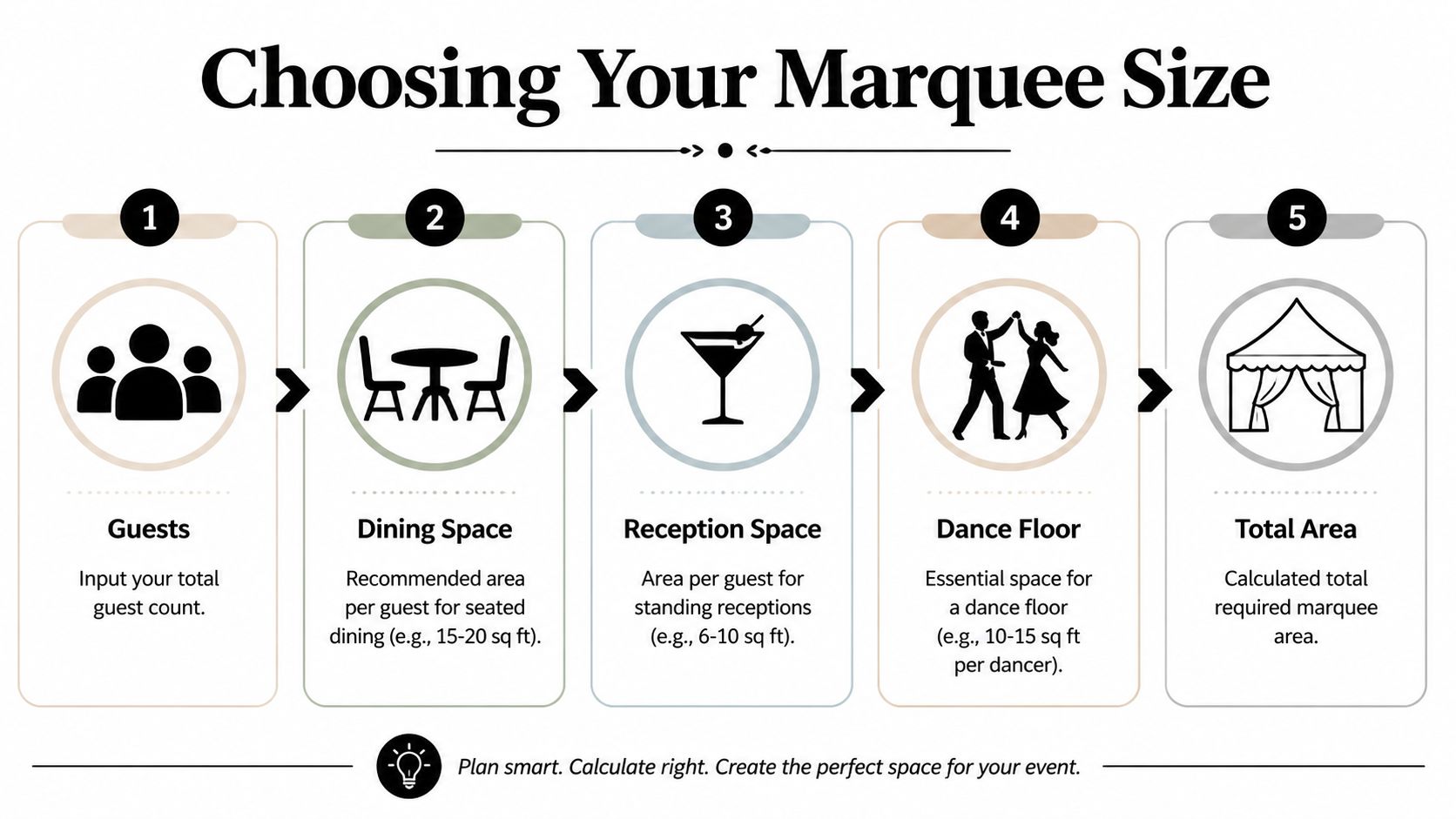
A practical way to estimate size
Use this as an initial planning method before a site visit:
Confirm attendance
Work from expected guests, not invited guests.Choose the main format
Seated dining, mixed dining and dancing, or standing reception.Think about table shape and circulation
Round tables, long banqueting runs, buffet lines, and family-style seating all change how the room feels.Check the site shape
A long narrow garden in South Croydon may suit one format better than a square plot in Purley.Match the estimate to available marquee spans
That helps you narrow down realistic options quickly.
Practical rule: Guest numbers decide the starting size. Layout decides whether that starting size actually works on the day.
There are some useful real-world benchmarks. For example, for a 100-guest wedding, combinations like 10m x 12m or 6m x 15m are often ideal for seated layouts, according to Fews Marquees' large marquee guide. That doesn't mean every 100-guest event should use one of those exact footprints, but it gives you a sensible reference point.
What works well in local settings
Large marquee planning in London suburbs often comes down to balancing capacity with the shape of the site.
| Event type | Usually works well | Common issue |
|---|---|---|
| Wedding reception | Wider structure for round tables and clear central circulation | Underestimating space for top table, cake table, and service routes |
| Corporate function | Cleaner rectangular layout with reception, presentation, and catering zones | Trying to fit too much branding or staging into guest space |
| Mehndi or pre-wedding event | Longer layouts that separate dining, seating, and celebration areas | Forgetting how much room family seating and décor features need |
| Community gathering | Open plan with clear entry and service points | Booking a marquee based only on seated count, not flow |
If you're at the early stage and want a visual reference for larger structures, this guide to large marquee hire options is a helpful place to compare formats before you lock in a layout.
Designing Your Marquee Layout and Choosing Extras
A large marquee only works when the space inside works.
I see this regularly across Croydon and the wider London suburbs. A client books a marquee with enough room for the guest count, then adds the practical pieces later. By the time the bar, catering tables, DJ setup, cake display, gift table, buggy parking, and heater positions are accounted for, the layout feels pinched. The structure was big enough on paper, but the plan inside it was not.
The best layouts are planned in zones
For a family wedding reception in a Croydon garden, I usually map the space by function first and furniture second. That avoids the common mistake of filling the centre nicely but leaving no room for people to arrive, queue at the bar, or move between tables without squeezing past chairs.
The main zones usually look like this:
Entrance and welcome area
Guests need a clear first step into the marquee. A little breathing room at the entrance stops congestion and makes the whole event feel calmer.Dining space
Round tables need more circulation than clients expect, especially once chairs are pulled out and service starts. If staff cannot move cleanly, guests feel it all evening.Entertainment area
A dance floor, DJ, dhol player, band, or stage works better when it has its own footprint instead of borrowing space from dining.Bar and service positions
Bars need queue space. Caterers need prep space. Neither should interrupt the main guest routes.Feature points
Cake tables, photo backdrops, sweet carts, and gift tables should sit where people can use them without creating a bottleneck.
That zoning matters even more for South Asian pre-wedding functions. Mehndi and sangeet events often need lounge-style family seating, a focal décor area, food service, and open room for dancing or performances. In many London gardens, a longer marquee shape works better than a squarer one because it lets the event flow from welcome, to seating, to dining, to celebration without everything competing for the same central space.
If a guest has to cut through a queue, past the DJ, and around a chair to reach their table, the layout needs work.
A visual walkthrough helps at this stage:
Extras should solve a practical problem
The best add-ons are not chosen because they sound impressive. They are chosen because they fix a known issue on that site, in that season, for that style of event.
| Extra | Why people choose it | What to check |
|---|---|---|
| Hard flooring | Gives a firmer, more venue-like finish and keeps heels and furniture stable | Ground level, trip points, and whether the garden needs full or part flooring |
| Lighting package | Changes the room after dark and helps dining, speeches, and dancing feel distinct | Power supply, switch points, and whether you want warm wash lighting or feature lighting |
| Mobile bar | Keeps drinks service inside the marquee and reduces trips to another area | Queue direction, back-bar space, and distance from the dance floor |
| Photo feature | Creates a focal point for guests between key moments | Keep it away from the entrance and away from service routes |
Winter events need extra thought here. In December and January, I would rather see money spent on the right flooring, lining, and marquee and heater hire for cold-weather events than on decorative extras that do nothing for comfort. Guests forgive simpler styling much faster than they forgive a cold marquee.
Some providers, including Premier Marquee Hire, offer CAD layout designs so clients can see table positions, walkway widths, bar placement, and feature points before installation day. For larger weddings, community events, and corporate functions, that drawing often prevents the last-minute reshuffle that causes delays and compromises.
Preparing Your Site for a Year-Round Marquee
The site decides more than most clients realise. Two gardens can look similar in photos and behave completely differently on install day.
In Croydon, Purley, Bromley, and nearby areas, the big variables are usually access, slope, surface condition, and how the site behaves after rain. A large marquee can work brilliantly in a domestic garden, a school field, or a private venue, but the planning needs to reflect the ground it's going on, not just the celebration you're hosting.
London access can be harder than the marquee itself
A site can be large enough and still be difficult. That's common in London.
A narrow side path, steps from the driveway to the lawn, controlled parking, shared access, low branches, or a tight turn for delivery vehicles can all affect installation. In areas with older housing stock, especially around South Croydon and parts of Dulwich or Wimbledon, access is often the primary design constraint.
Check the route from street to setup area, not just the setup area itself.
Before confirming a booking, look at these practical points:
Width of access points
Gates, alleyways, and side returns matter.Ground level
Even slight gradients affect flooring, table stability, and the visual finish.Surface condition
Grass, paving, gravel, and mixed ground all need different preparation.Supplier routes
Caterers, florists, DJs, and toilets may need separate access planning.
Winter events need proper planning, not optimism
Large marquee events aren't only for summer. That's one of the biggest misconceptions in this trade.
The UK averages 152 rainy days annually, and winter events represent 18 to 25% of bookings, which is why heating, wet-ground stability, and weather contingency matter for year-round setups, as highlighted in this industry note on seasonal event planning. If you're holding a winter wedding, Christmas function, or New Year celebration, the comfort of the structure depends on decisions made well before the event date.
What usually works best in colder months:
- Solid flooring systems that separate guests from soft or wet ground
- Appropriate heaters integrated into the layout rather than added at the last minute
- Lining and entrance planning to reduce draughts and improve comfort
- Extra installation thought for muddy access and slower winter setup conditions
If you are comparing practical cold-weather options, this guide to marquee and heater hire covers the questions frequently asked once the temperature drops.
Site prep that saves trouble later
A good site visit usually answers the issues that become expensive or stressful if left too late.
| Site factor | Why it matters | Better approach |
|---|---|---|
| Uneven lawns | Affects flooring and table stability | Assess level changes early |
| Wet ground | Changes access and comfort underfoot | Plan flooring and protect routes |
| Trees and borders | Reduce usable footprint | Measure clear usable space, not whole garden |
| Neighbour proximity | Affects timing, lighting, and sound planning | Build the event layout around local constraints |
Planning permission questions do come up, especially for residential settings and public-facing events. The answer depends on location, duration, land use, and event type, so it's worth checking early if your setup is on public land, part of a venue with its own rules, or linked to a larger licensed event.
Understanding Marquee Hire Costs and Budgeting
The price of a large marquee isn't just the price of the canopy. That's the biggest budgeting mistake people make.
What you're really paying for is a temporary venue. The structure is one part of it, but flooring, lighting, furniture, delivery logistics, access time, and the complexity of the setup all shape the quote. Two marquees that look similar in photos can have very different costs once the specification is fully built out.
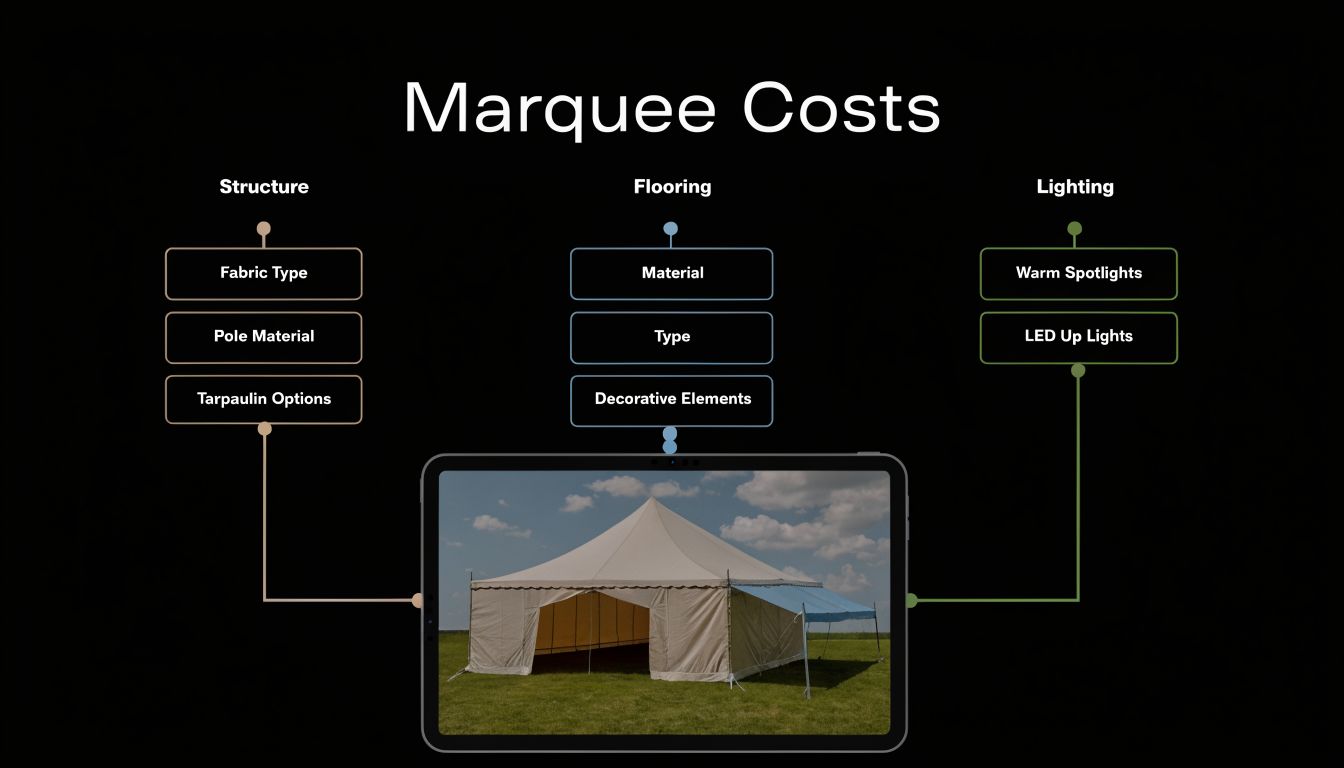
What usually drives the quote up or down
A sensible quote normally reflects a combination of event requirements rather than a single flat package.
Marquee size and shape
Larger widths and longer runs obviously increase the base cost, but shape matters too. A simple clean footprint is easier to install than a layout built around awkward boundaries.Flooring choice
Basic surface coverings and full solid flooring create very different finishes. If the ground is uneven or the event is formal, flooring becomes a practical requirement, not a cosmetic extra.Interior finish
Linings, lighting, and furniture change the feel of the space more than clients expect. Chiavari chairs give a different look from folding chairs, and warm lighting does far more for atmosphere than an oversized floral budget in the wrong room.Logistics
Central London restrictions, narrow access, parking controls, and longer carry distances all affect labour and install planning.
Where to spend and where to stay lean
Not every event needs the same specification. A corporate hospitality setup may justify investment in flooring, lighting, and a clean entrance experience. A garden celebration may be better off putting budget into heating, seating, and weather protection first.
Budget for the parts guests actually feel. Dry flooring, comfortable temperature, good lighting, and sensible circulation are worth more than decorative extras that make setup harder.
An effective method for managing your budget involves separating essential requirements from optional extras.
| Budget priority | Usually worth protecting | Often adjustable |
|---|---|---|
| Guest comfort | Structure size, flooring, weather readiness | Decorative styling layers |
| Functionality | Lighting, seating, service flow | Feature add-ons |
| Logistics | Access planning, delivery, install time | Optional entertainment zones |
Transport often gets missed too. If your event involves moving guests between a church, registry office, hotel, or off-site parking area, grouped travel can be easier to control than multiple individual arrivals. For readers comparing ways to manage transport spend, this guide to Oz Coach Hire for budget travel shows the kind of planning logic that applies when guest movement becomes part of the event budget.
If you're trying to understand what a quote should include before you enquire, this breakdown of prices for marquee hire helps you spot the line items that matter and ask sharper questions.
A better way to compare quotes
Don't compare only on headline price. Compare on scope.
Ask whether the quote clearly covers installation, collection, flooring, lighting, furniture, access assumptions, and any layout support. A cheap-looking number often grows once the practical details are added back in. A clear quote usually saves money because it reduces surprises.
Your Marquee Hire Timeline and Booking Checklist
Many marquee challenges begin well before the day of installation. Throughout Croydon and across London, the main pressure points are access, neighbour considerations, parking, and late decisions on guest numbers. Summer weddings fill up first, but winter dates need early planning too if you want flooring, heating, and a structure that suits a wetter site.
The booking process works best when each decision enables the next one. Get the date and guest range clear first. Then check the site. Then approve a layout that matches how the event will run, whether that is a wedding breakfast, a Mehndi with separate activity zones, or a company function with staging and service space.
A practical booking sequence
Send the first enquiry
Include the event type, estimated guest count, postcode, and a short note on the setting. A back garden in South Croydon raises different questions from a school field in Thornton Heath or a venue lawn near Purley.Arrange a site visit
This is usually the point where avoidable mistakes get caught. Side access, steps, narrow gates, trees, overhead cables, soft ground, and power distance all affect what can be installed and how long it takes.Review the draft layout and quote Use your guest count as the starting point, then test the plan against the event format. As noted earlier, the sizing rule of thumb gives a useful baseline, but the essential question is whether the layout leaves enough room for catering, circulation, entertainment, and any cultural requirements such as a stage area or flexible family seating.
Confirm the booking
Once the structure, main extras, and installation dates are agreed, secure them. Waiting too long can limit your options, especially around peak wedding weekends and bank holidays.Finalise event details closer to the date
This is the stage for table numbers, lighting, heating, generator needs, catering timings, and supplier access slots. For South Asian pre-wedding events, I always recommend confirming music, décor, and catering positions together, because each one affects the others.
Your checklist before installation
- Guest numbers updated so the furniture plan still fits the event
- Access route confirmed for delivery vehicles, crew, and any plant or lifting equipment if needed
- Ground conditions checked after recent weather, especially for winter builds
- Power and catering positions agreed before the team arrives on site
- Other suppliers scheduled properly so florists, caterers, DJs, and marquee crews are not competing for the same space
- Neighbour or venue restrictions understood if there are timing limits, noise limits, or protected surfaces
One practical tip from London garden builds. Measure the route to the marquee position, not just the lawn itself. A generous garden does not help if the only side access is a tight passage behind a garage.
If you want a broader planning framework for business events, this resource on building a timeline for event ROI is useful, particularly where event timing affects guest experience, staffing, and reporting as well as setup.
FAQs for Large Marquee Events in London
Questions change depending on the event. A wedding client worries about comfort and atmosphere. A business client worries about flow, branding, and timings. A family planning a Mehndi often needs flexibility for seating, catering, and celebration space all at once.
Frequently Asked Questions by Event Type
| Question | Expert Answer |
|---|---|
| How do I know if I need a large marquee or several smaller structures? | It depends on how the event works. One large structure usually creates a better shared atmosphere for dining and speeches. Separate structures can make sense if your site has awkward breaks, different activity zones, or access limits that prevent one clear footprint. |
| Is a large marquee suitable for a London back garden? | Often, yes, but garden depth alone doesn't decide it. Side access, trees, level changes, neighbouring boundaries, and supplier routes matter just as much. A long, narrow footprint can work well where a wider structure won't. |
| What's the best layout for a wedding reception? | For most weddings, clear circulation is more important than squeezing in extra furniture. Guests should be able to move easily between entrance, tables, bar, and dance area. If the room feels blocked by décor or oversized furniture, the celebration feels more crowded than it needs to. |
| Can a marquee work for South Asian pre-wedding functions? | Yes. These events often benefit from thoughtful zoning. Family seating, food service, decorative focal points, and celebration space all need room. Longer formats often work well because they let you separate quieter seating from more active areas without losing the atmosphere. |
| Are winter marquee events realistic in London and the South East? | Absolutely, if the setup is designed for winter rather than treated like a summer event with heaters added at the end. Flooring, heat retention, protected entrances, and wet-ground planning make the biggest difference. |
| What catches people out with corporate marquee events? | It's usually not the marquee itself. It's forgetting registration space, storage, catering routes, branding positions, or power for AV. Corporate events need a room plan that supports timings and presentation, not just a good-looking shell. |
| Do community and religious events need different planning? | Yes. These events often involve higher traffic flow, longer dwell times, or different patterns of seating and serving. Entry points, queuing space, and circulation become especially important when guests aren't all seated at once. |
| How far ahead should I book? | If your date is fixed and the event matters, don't leave it late. The earlier you start, the more choice you have on structure size, extras, and installation timing. Busy periods fill first, particularly for larger formal setups. |
| Can I change numbers later? | Usually, some details can be refined closer to the date, but late changes are easier when the original layout allowed sensible flexibility. That's another reason not to plan too tightly from the beginning. |
| What should I ask before choosing a marquee company? | Ask how they handle site visits, layout planning, access issues, winter readiness, flooring options, and what exactly is included in the quote. Clear answers on those points usually tell you a lot about how the event will be handled. |
The right marquee setup should solve problems before your guests ever see them.
If you're planning an event in Croydon, South London, or the surrounding counties and want clear advice on size, layout, access, and all-season setup, Premier Marquee Hire is a practical place to start. You can request a quote, ask for a site visit, and get help narrowing down the right marquee without overbooking space or missing the details that make the day run properly.
Sorry, the comment form is closed at this time.