

08 May How to Hire a Large Marquee: A London & SE Guide
You’ve found a venue you like, or you’ve decided to use your own garden, and then the practical problem appears. The guest list keeps growing, the house won’t cope, the patio is too tight for dining, and you still need room for a bar, a dance floor, or a stage. That’s usually the point where people start looking into how to hire a large marquee.
Around Croydon, Bromley, Sutton, Wimbledon, Surrey and Kent, that decision often starts with one simple need. More space. But a large marquee isn’t just overflow cover. It becomes the event space itself. It can hold a formal wedding breakfast, a Mehndi celebration with mixed seating and open circulation, or a corporate summer function that needs a clean entrance, service area and branded presentation space.
Modern marquees are far removed from the old rope-and-pole image many people still have in mind. The UK marquee hire trade grew from Victorian estate entertaining, and by the late 1990s lighter aluminium frame systems had made larger, more flexible structures practical for weddings, festivals and corporate events, including 15m+ spans configurable in 3m increments for current event use in London and the South East, as outlined in this history of marquee hire in the UK.
The difference between a smooth event and a stressful one usually comes down to planning early, measuring properly, and dealing with the site as it really is, not as it looks in a quick phone photo.
From Big Idea to Grand Occasion Your Marquee Journey
A large marquee usually becomes the sensible option after a clear moment on site. You stand in the garden in South Croydon, look at the patio, the lawn, the side access and the guest list, and realise the event needs proper structure, not borrowed indoor space and a few pop-up covers. The same thing happens at business premises in Bromley, private estates in Surrey, and heritage venues across the South East where the grounds are attractive but the usable event space is limited.
A marquee solves the space issue, but that is only part of its value. It also lets you shape how the day works. Guests can arrive under cover, move into a reception area, sit down for dinner, and reach the bar, toilets or dance floor without crossing service routes. That level of control matters far more in London and the South East than many clients expect, because sites here often come with awkward boundaries, trees, listed walls, restricted access or a noticeable slope.
Large marquees work well in this region because they can be configured around the site you have. A long garden in Purley may suit a narrower run with linked sections. A sloped lawn in Surrey may need flooring and careful positioning rather than the biggest structure the plot could theoretically hold. At a heritage property, the job may depend on ground protection, restricted staking, and a build plan that respects the venue's conditions.
A good marquee plan starts with the site, the guest flow and the service setup. The structure follows from that.
Clients often focus first on styling, which is understandable. The experienced approach is to pin down the practical points early, because they affect cost, comfort and what is realistically possible on the day:
- How guests will use the space: standing reception, formal dining, dancing, ceremony seating, or a mix of all four
- How suppliers will work: catering access, refrigeration position, waste collection, and load-in routes
- How the site behaves in poor weather: wet grass, pooling water, exposed entrances, and covered walkways back to the house or facilities
- How the ground and boundaries limit the build: slopes, trees, sheds, fences, neighbouring access, and underground services
This stage is where expensive mistakes are avoided. A marquee that looks right on paper can still fail on a Surrey garden with a steep fall, or on a London site where the only access is through a narrow side gate. Get the early decisions right and the rest of the planning becomes far more straightforward.
Choosing the Right Size Marquee for Your Guests
A 120-guest party can feel generous in one marquee and cramped in another. The difference usually comes down to layout, furniture choice and how the event will run once guests arrive.
That is why sizing starts with use, not just numbers. A drinks reception in Wimbledon, a formal wedding breakfast in Banstead, and a family celebration in Croydon with dining, dancing and a stage will all need different amounts of room, even with the same guest count.
Start with event style, not just guest count
The first question is simple. What are guests doing for most of the event?
If people are mainly standing with a drink in hand, the footprint can stay tighter. Once you introduce round tables, staffed service, a bar, gift table, dance floor or live music, the area needs to grow. Guests also need to move comfortably between tables, toilets, exits and any outside spaces.
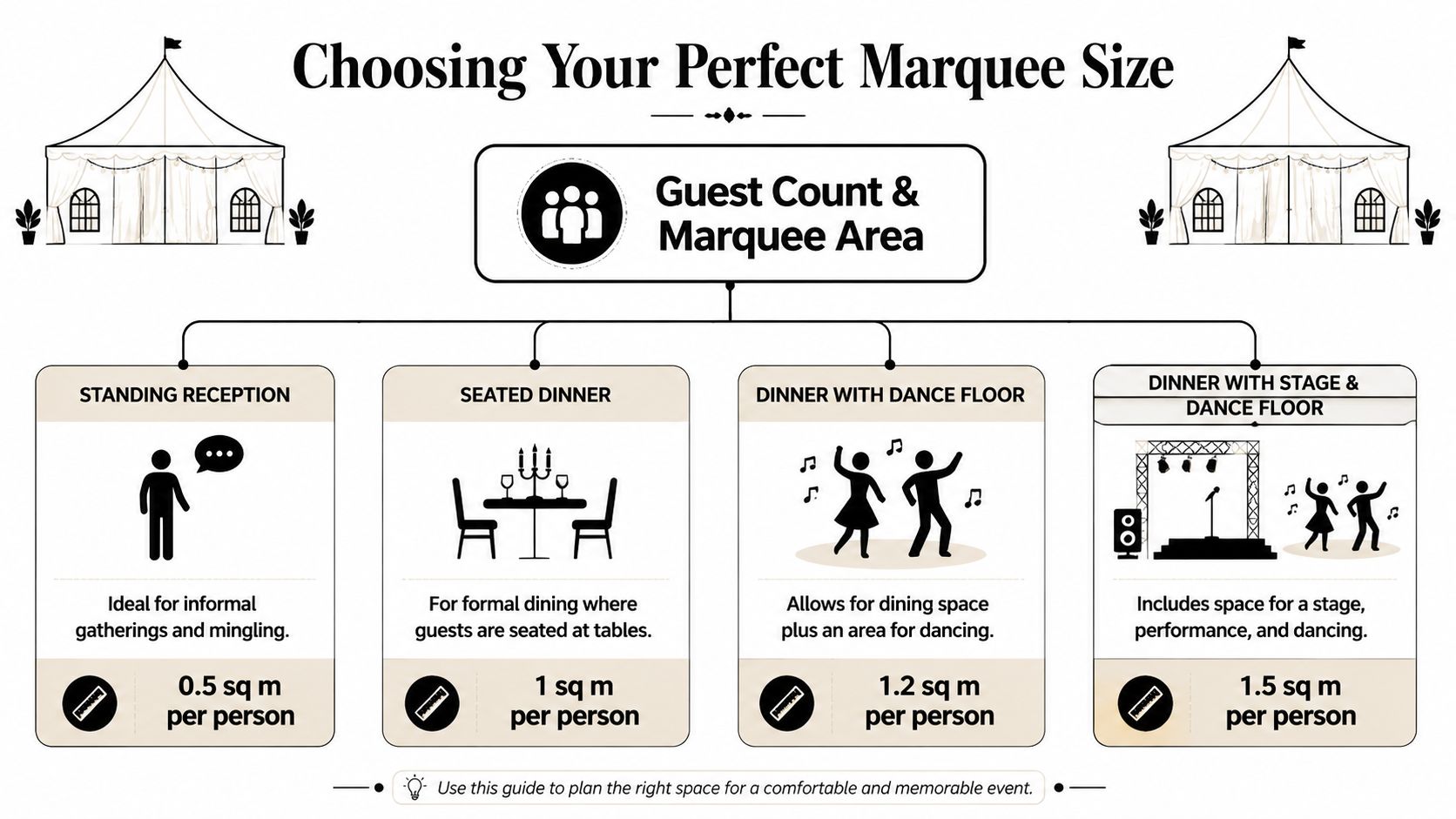
Here is a practical guide for early planning:
| Marquee Capacity Quick Guide | Space Per Person (sq m) | Example for 100 Guests (sq m) |
|---|---|---|
| Standing Reception | 0.5 | 50 |
| Seated Dinner | 1 | 100 |
| Dinner with Dance Floor | 1.2 | 120 |
| Dinner with Stage & Dance Floor | 1.5 | 150 |
Use those figures as a starting point, not a final answer. In practice, I would always adjust for table size, catering style, whether children need their own tables, and whether the client wants the room to feel full and lively or more open and formal.
The space people forget
The missing square metres are rarely in the dining area itself. They are usually in the supporting pieces around it.
Common pressure points include:
- Walkways between tables: waiting staff need room to serve, and guests need space to sit down and stand up without blocking others
- Bar and queueing space: one bar in the wrong place can choke the whole room
- Entertainment footprint: DJ booths, speakers, band setups and staging all take more room than clients expect
- Entrance and reception area: coat rails, welcome signs, escort cards and arrival drinks need their own zone
- Catering and storage: service tents, chillers and prep space often sit outside the main marquee, but they still affect the overall plan
This matters even more for larger family events across London and Surrey, where one structure may need to do several jobs at once. A South Asian pre-wedding celebration is a good example. The guest count may suggest one size on paper, but family clusters, buffet service, feature décor, musicians and a dance area can push the layout well beyond a standard seated dinner plan.
Width matters as much as capacity
Clients often ask for a marquee that holds a certain number of guests. The better question is whether the shape suits the event.
For larger occasions, width can matter more than length. A long narrow marquee may technically fit the tables, but it can feel awkward once you add a central aisle, a dance floor, or a stage at one end. Round tables work best when there is proper clearance around them. If the structure is too narrow, the room starts to feel pinched very quickly.
That is one reason modular frame marquees are useful on South East sites. They can often be configured to suit a tighter London footprint or a Surrey garden where you need to work around borders, patios or mature trees.
A practical rule that saves expensive changes
If you are choosing between two marquee sizes, decide from the floor plan.
The guest list gives you a headline number. The floor plan tells you whether the event will feel comfortable once tables, bars, entertainment and service space are included. It also tells you whether you need marquee flooring for uneven or mixed ground, which can affect usable space around entrances and edges.
A well-sized marquee should feel busy, not cramped. On London and South East jobs, getting that balance right usually comes from matching the structure to the way the event will operate on the ground, not from picking the biggest option that appears to fit the guest count.
Mastering the Site Survey and Ground Preparation
The site survey is where a marquee plan becomes real. It’s also where avoidable problems get caught before they turn into expensive ones. In Croydon and across the South East, the biggest issues are rarely dramatic. They’re usually practical. Narrow side access, a hidden slope, tree branches, retaining walls, soft ground after rain, or a patio edge that interrupts the footprint.

What a proper site visit should check
A serious site visit should cover more than tape measurements. It should test whether the event can be built, serviced and cleared safely.
Look for a survey that checks:
- Access route: Can delivery vehicles reach the build area without damaging walls, lawns or paving?
- Build footprint: Is there enough clear space for the marquee plus anchoring, entrances and service zones?
- Ground condition: Grass, hardstanding and mixed surfaces all need different treatment.
- Levels: Even a gentle slope can affect flooring, door alignment and furniture stability.
- Nearby obstacles: Trees, drains, low cables, sheds, raised beds and boundary fences matter.
- Underground services: Stakes and anchoring methods must account for buried utilities.
A sloped garden in Surrey may still be workable. It just needs honest assessment and the right flooring plan rather than assumptions.
Listed properties and sensitive venues
One of the most overlooked issues in the UK events market is the challenge of setting up on listed properties or sloped gardens common in Surrey and Kent, where planners may need to deal with heritage regulations and planning rules. That’s why professional site visits are essential, as noted in this overview of marquee venue considerations.
This matters more than many clients realise. A lovely house with heritage status or protected grounds may allow an event, but not every installation method or access arrangement will be acceptable. The answer isn’t to panic. It’s to ask the questions early.
Ground preparation that actually works
Ground preparation depends on what the event needs after the marquee is standing. Dining, dancing and high heels all place different demands on the floor beneath them. If you’re comparing options, it helps to understand the difference between basic surface tolerance and proper event-ready flooring. This guide to marquee flooring options gives a useful overview of what to consider.
A garden can look flat to the eye and still need correction once tables, bars and dance flooring go in.
For homes in Purley, Caterham or Sanderstead, access is often as important as the ground itself. If the installation route is through a side gate, around a garage, or over delicate landscaping, that affects what can be delivered, how long setup takes, and which structure makes sense.
Powering Furnishing and Lighting Your Space
Once the structure and site are sorted, the next job is making the marquee work like a venue rather than an empty shell. That means planning essentials in the right order. First power. Then furniture. Then lighting and atmosphere.
Start with the loads that matter
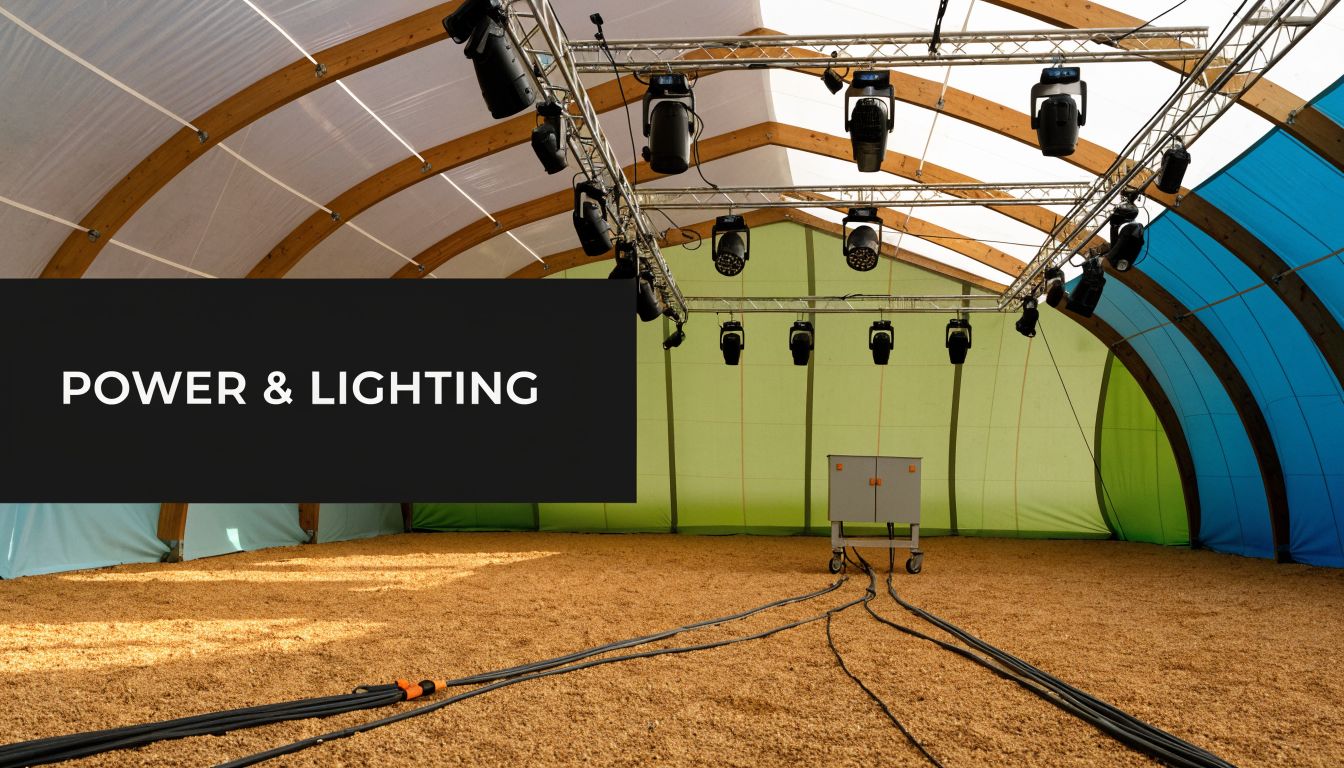
Power planning often goes wrong because people think only about lights and music. In reality, the heavy demands usually come from catering, refrigeration, heating, bar equipment and distribution across the site.
A practical power conversation should include:
- Catering equipment: Ovens, hot cupboards, prep units and serving stations
- Bar service: Fridges, ice machines and till points
- Entertainment: DJ setups, PA systems, staging and AV
- General supply: Decorative lighting, service lighting and charging points
- Weather contingencies: Heating or additional covered work areas if conditions turn
If mains supply is limited or too far from the marquee, generator planning becomes part of the job. For clients who want a plain-English starting point, this guide on choosing a residential generator is useful because it explains the thinking behind load planning without overcomplicating it.
Furnishing for use, not just appearance
Furniture should match the way the event runs. Community functions may work best with straightforward folding furniture and wide circulation. A wedding in Wimbledon may call for more formal seating, clear top tables and a defined dance floor edge. A corporate event in a field near Bromley may need lounge seating, poseur tables and presentation sightlines instead of full dining.
That’s why one of the most practical early tools is a scaled layout. A provider such as Premier Marquee Hire can supply CAD layouts on request for marquee planning, which helps visualise table count, guest flow and working space before anything is booked.
Lighting changes the room more than décor does
Poor lighting makes a good marquee feel temporary. Well-planned lighting makes it feel intentional.
Useful lighting layers include:
- Functional lighting: Safe entry, exits, catering and toilet routes
- Ambient lighting: Washes, uplighting and warm perimeter light
- Feature lighting: Chandeliers, festoon runs or focused décor highlights
- Performance lighting: Dance floor and stage coverage where needed
If you’re weighing options, this guide to lighting for marquees is a sensible place to start because it separates practical lighting from decorative lighting.
A short visual example helps when you’re trying to picture how power and production fit together:
The best interiors don’t throw in every extra. They support the event brief. Guests should notice that the room feels comfortable and usable, not that a long list of hire items was added.
Navigating Timelines Permits and Insurance
The paperwork side of marquee hire worries people more than it needs to. Most of it becomes manageable once you deal with it early and ask the right questions in the right order.
The first of those questions is timing. Large marquee events usually need more lead time than clients expect, especially in peak summer when dates, crews and specialist extras get booked first. If your event sits around a bank holiday, school holiday, or a high-demand wedding weekend, leave more room than you think you need.
Booking windows that make life easier
For a large private event, the sensible approach is to start conversations as soon as the date and rough guest number are known. That gives you time to compare structure options, site logistics and furnishing choices without making rushed decisions.
A strong planning sequence looks like this:
- Fix the event date and guest range
- Arrange a site survey or venue review
- Confirm the general footprint and layout direction
- Discuss access, power and flooring
- Review quote detail before approving extras
- Check whether the venue or site has any restrictions
- Confirm insurance responsibilities in writing
Late planning usually creates two problems. Reduced availability and more compromise.
When permits may matter
A marquee in a private garden doesn’t always trigger the same permissions as a public event, but some circumstances need closer attention. Public attendance, licensed activity, protected land, listed buildings, heritage settings and sensitive local conditions can all change what’s required.
If your event is on school grounds, church land, a council-managed site, or a listed property, ask early. The answer might be straightforward, but assumptions are risky. Some venues will handle parts of the process themselves. Others expect the organiser to coordinate approvals.
If a site has any heritage, council or public-use angle, check the permission position before you commit to the final layout.
Insurance should be clear before build day
Clients often assume insurance is “included” without checking what that means. It’s better to ask direct questions.
A sensible checklist includes:
- Public liability: Who covers the installation and event structure?
- Venue requirements: Does the venue need specific documents in advance?
- Third-party suppliers: Are caterers, DJs and production teams insured separately?
- Weather and damage risk: What happens if the ground, access route or nearby property is affected?
- Client responsibility: Are you responsible for contents brought into the marquee?
The goal isn’t to create bureaucracy. It’s to avoid confusion when several suppliers, one venue and a large guest list all meet on the same day.
Getting Accurate Quotes and Avoiding Hidden Costs
A vague quote is usually cheap for one reason. It leaves things out.
That doesn’t always mean anyone is being dishonest. Sometimes it means the job hasn’t been properly scoped. But if you’re trying to hire a large marquee, a one-line figure without detail is a problem. It makes it impossible to compare like for like, and it leaves you exposed to changes once the practical issues emerge.
What a proper marquee quote should show
A usable quote should separate the main elements so you can understand what drives cost and where changes may happen.
Look for clear lines covering:
- Structure hire: The marquee size, style and configuration
- Flooring: Type, level corrections and any sub-floor need
- Linings and finishes: Interior treatment, doors, windows and presentation
- Furniture and equipment: Tables, chairs, bars, staging or extras
- Lighting and power: Distribution, fittings and any generator requirement
- Delivery and labour: Installation, dismantle and access-related implications
If the wording is broad, ask for clarification before you accept it. “Flooring included” can mean very different things on a level lawn versus a sloped garden with guest dining.
Why layout drawings save money
A scaled layout or CAD plan isn’t a luxury for larger events. It’s a decision tool.
Without one, people tend to approve a marquee size based on feel, then discover later that the dance floor cuts into table count, the entrance conflicts with service flow, or the bar position creates a bottleneck. Those are exactly the kinds of changes that cost more when they happen late.
A visual plan helps answer questions such as:
- Can the table plan fit the chosen marquee width?
- Will guests move cleanly from entrance to seating to dance floor?
- Is there enough space for entertainers, catering and staff movement?
- Does the layout still work in bad weather when people stay inside longer?
The cheapest quote can become the expensive one if the first proper layout happens after booking.
Compare detail, not headline price
The strongest comparison is rarely between two totals. It’s between two levels of thoughtfulness. If one supplier has asked about site access, flooring, guest flow and service space, and another has only priced the shell, those aren’t equivalent proposals.
That’s why it helps to review what different marquee hire companies include in their planning process, not just what they charge.
The right quote should feel specific enough that you can picture the event being built from it. If it doesn’t, ask more questions before signing anything.
Your Partner for a Perfect London Event
A large marquee event succeeds when the practical decisions are made in the right order. First the guest use. Then the size. Then the site. Then the services, interior and paperwork. That approach removes most of the stress before build day arrives.
In London and the South East, details matter more because sites are rarely simple. A Croydon garden may have awkward access. A Surrey property may slope more than expected. A Kent venue may sit inside planning or heritage constraints. The marquee itself can solve a lot, but only when the planning respects the setting.
The strongest marquee events usually share the same qualities. The layout feels natural. Guests don’t queue awkwardly. Staff can work efficiently. Power is where it needs to be. Lighting feels deliberate. And nothing important is left to be guessed at on the day.
That’s why a proper site survey is often the best next step if you’re serious about hiring a large marquee. It turns assumptions into measurements and ideas into a workable plan. It also gives you a realistic sense of what the site can support before you spend money on the wrong structure or extras you don’t need.
If you’re still in the early stages, it also helps to create your own checklist. Note the guest range, event style, likely service needs, access route, ground type, and whether the location has any special restrictions. That simple exercise usually reveals the main planning questions very quickly.
A marquee should make your event more flexible, not more complicated. With the right preparation, it does exactly that.
If you're planning an event in Croydon, London, Surrey, Middlesex or Kent, Premier Marquee Hire can help you take the next sensible step. Ask for a free, no-obligation site survey, request a quote, or speak to the team about the structure, layout and practical setup your event will need.
Sorry, the comment form is closed at this time.