

23 May Marquee Hire Croydon Surrey: Expert Event Solutions
If you're planning a wedding in a South Croydon garden, a birthday party in Purley, or a company event on a Surrey site, you're probably juggling the same initial questions. Will a marquee fit? What happens if the ground is wet? How much should you budget for the parts nobody mentions at first, like flooring, lighting, heating, or access?
That early stage can feel messy because marquee hire isn't just about picking a tent. You're effectively building a temporary venue, and in Croydon and Surrey that means dealing with real local variables such as compact gardens, side access, sloping lawns, hardstanding areas, and changeable weather.
The good news is that the process becomes straightforward once you break it into the right decisions, in the right order. A local planning approach helps. If you're comparing options for marquee hire in Croydon, it helps to think like a project manager from day one: space first, access second, guest layout third, then comfort and finish.
Your Guide to Hiring a Marquee in Croydon and Surrey
Most clients don't begin with technical drawings or flooring specifications. They begin with a date, an occasion, and a rough picture in their head. It might be a family celebration where the house won't comfortably hold everyone, or a wedding where the venue options don't quite match the atmosphere they want.
In Croydon and Surrey, that often means turning a garden, private grounds, school field, or business premises into an event space that feels intentional rather than improvised. That's where marquee planning differs from ordinary venue booking. You're not choosing from a fixed room. You're deciding how people will arrive, where they'll dine, how the service team will move, and what the site can realistically support.
What a sensible starting point looks like
A good first conversation usually covers four things:
- The event type. A seated wedding breakfast needs a different layout from a standing drinks reception.
- The site itself. A flat lawn with open access behaves very differently from a narrow garden behind a terraced property.
- The season. Summer styling and winter practicality are not the same brief.
- What must happen inside the marquee. Dining, dancing, catering, speeches, a bar, ceremony space, or all of them.
The clients who have the smoothest build always start by describing how they want the event to feel, then let the technical choices follow that.
That approach keeps you from overspending on the wrong extras or choosing a structure that fits the garden but not the event.
Why local knowledge matters
Croydon and the surrounding Surrey areas offer everything from modest suburban gardens to larger private sites, but they also come with practical constraints. Trees, fences, neighbouring boundaries, paving changes, and tight access routes can all affect what works on paper versus what works on the day.
That's why marquee hire croydon surrey planning works best when it's grounded in site reality rather than generic online advice. The right setup should feel calm, practical, and properly thought through from the start.
Choosing the Right Marquee Type and Size
The professional default for most events is the clearspan marquee. It gives you a clean interior without central poles, which matters far more than many first-time clients realise. Once you start planning tables, a dance floor, staging, or a bar, uninterrupted internal space becomes a major advantage.
Local market listings also show how this works in practice. Croydon suppliers commonly advertise widths from 3m up to 15m, with lengths added in 3m increments, and Trafalgar Marquees states it can provide structures from 3m by 3m up to 95 metres long through the modular clearspan format used across the South East, as shown on Croydon marquee supplier listings.
Why modular sizing works
A marquee rarely needs to match a standard room size. It needs to match your site and your event flow.
That's why modular systems are useful. If a garden is wide enough but not especially deep, you may choose a broader footprint with a shorter run. If the site is long and narrow, the layout might reverse. This flexibility is one of the biggest practical differences between a professional marquee system and a basic shelter hire.
For larger-format events, the large marquee hire options available locally are particularly useful when you need clear separation between dining, lounge, dance, and service zones.
Size depends on layout, not just guest count
The most common planning mistake is asking for a marquee based only on attendance. Guest numbers matter, but they don't tell the full story. A standing drinks event can work in a very different footprint from a formal seated meal.
Use this as a practical starting guide, then refine it during a site survey.
| Marquee Size (Width x Length) | Standing Reception Capacity | Seated Dining Capacity (Long Tables) | Ideal For |
|---|---|---|---|
| 3m x 6m | Small informal gathering | Limited dining setup | Catering space, entrance cover, small garden use |
| 3m x 9m | Small drinks event | Small seated group | Compact gardens, side return spaces |
| 6m x 6m | Moderate reception | Small to medium dining layout | Garden parties, birthdays, casual entertaining |
| 6m x 9m | Larger social event | Medium seated layout | Private celebrations with dining and mingling |
| 6m x 12m | Comfortable mixed-use event | Larger dining arrangement | Weddings, anniversary parties, corporate hospitality |
| 9m x 12m | Broad open reception | Formal dining plus circulation | Events needing dining, speeches, and dance space |
| 12m x 18m | Large gathering | Large seated function | Corporate events, community celebrations |
| 15m x 24m | Major event footprint | Large-scale formal dining | Public events, festivals, substantial wedding builds |
Practical rule: decide whether your priority is dining density, social circulation, or multi-zone use. The same guest list can require very different marquee footprints.
What works and what doesn't
What works is choosing size after you've decided on table style, entertainment, and whether guests will mostly sit, stand, or move between areas.
What doesn't work is booking a marquee that only fits the headcount on paper. Once furniture, walkways, service space, and weather contingencies are added, an undersized structure feels cramped very quickly.
Understanding Marquee Hire Costs
A Croydon marquee quote often looks straightforward until the practical items are added. Clients usually start with the structure price, then realise the actual budget sits in the parts that make the space comfortable, safe, and workable for the event itself.
In this part of Surrey and South London, costs move quickly because sites are rarely blank canvases. A neat square lawn with direct side access is one job. A narrower garden in South Croydon, a sloping plot in Sanderstead, or a property with a tight side return and mixed surfaces is another. The marquee may be the same size on paper, but the labour, flooring requirement, and build method can be very different.
What a marquee quote usually includes
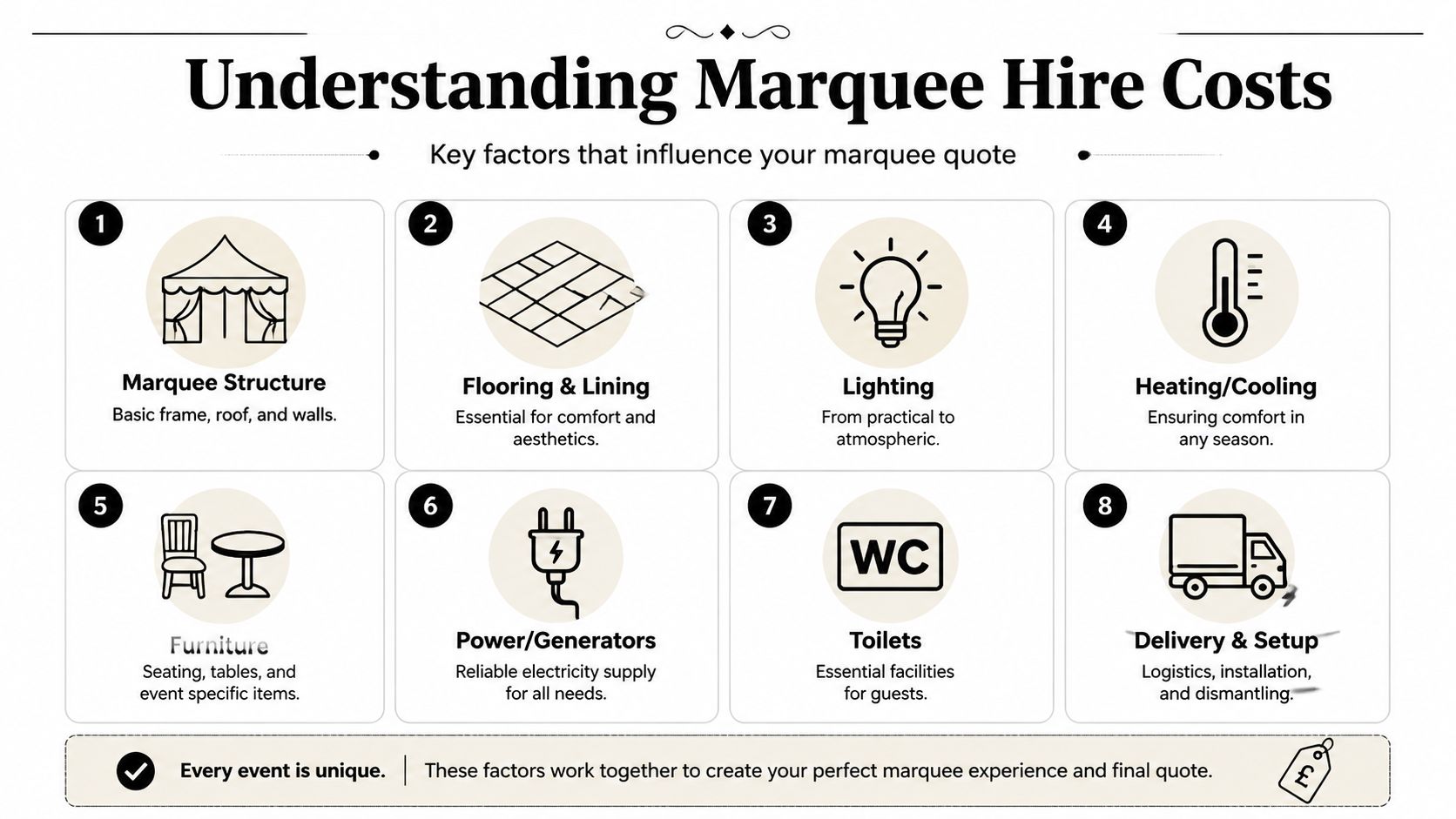
A proper quote should separate the core structure from the items that turn it into a functioning venue. That usually means:
- The marquee itself. Frame, roof, walls, and standard installation.
- Flooring. Matting, boarded flooring, or a raised floor, depending on ground conditions and season.
- Lighting. Working light for dining and service, plus any decorative options.
- Heating. Often needed for spring evenings, autumn events, and winter use.
- Furniture and event infrastructure. Tables, chairs, bar units, staging, dance floor, and catering space.
- Power setup. Distribution, cabling, and sometimes generator provision if house supply is not suitable.
- Delivery, build, and collection. Labour, transport, and time on site.
The part clients miss most often is flooring.
For many Croydon garden events, flooring decides whether the marquee feels like a proper venue or a temporary cover on wet grass. If the event is in cooler months, or the ground has any fall to it, boarded flooring with carpet can be money well spent. If it is a short summer drinks party on firm, level ground, a simpler finish may be enough.
Why prices vary more than people expect
Two marquees with the same footprint can land at very different totals. The difference usually comes from site conditions and how the space needs to function, not from inflated pricing.
The main cost drivers are usually:
- Season and weather protection. Enclosed walling, heaters, and heavier-duty flooring add cost quickly.
- Ground surface. Grass, paving, gravel, and mixed levels all change the build.
- Access for the crew. Long carries through houses or narrow passages increase labour time.
- Interior specification. Linings, clear walls, lighting schemes, and formal furniture packages shift the budget.
- Event use. Dining, dancing, catering, and speeches need more infrastructure than a standing reception.
I usually advise clients to price the event from the ground up. Start with structure, flooring, lighting, and weather cover. Then add visual upgrades. That order keeps the money in the areas guests feel on the day.
How to compare quotes properly
Price comparison only works if the specification is lined up properly. One supplier may quote a shell. Another may quote a usable venue with flooring, lighting, and labour included.
Check these points before deciding:
- Is flooring included, and what type is it?
- Are the walls full-height and suitable for poor weather?
- Does the price include delivery, installation, and dismantle?
- Are lighting, heating, and power distribution priced separately or included?
- Is there allowance for site-specific labour if access is tight?
A cheaper figure can become the more expensive option once the missing items are added back in.
The sensible approach is to ask for an itemised quote and read it alongside how you plan to use the space. In Croydon and Surrey, that matters more than the headline number.
The Importance of a Site Survey and CAD Layout
The most expensive mistakes in marquee work usually happen before the build starts. A client estimates the space visually, assumes access will be fine, or chooses a size based on a rough garden measurement. On installation day, the team discovers a pinch point at the side passage, a level change across the lawn, or overhead obstacles that alter the usable footprint.
That's why the site survey is the point where a marquee project becomes real.
What a proper site visit checks
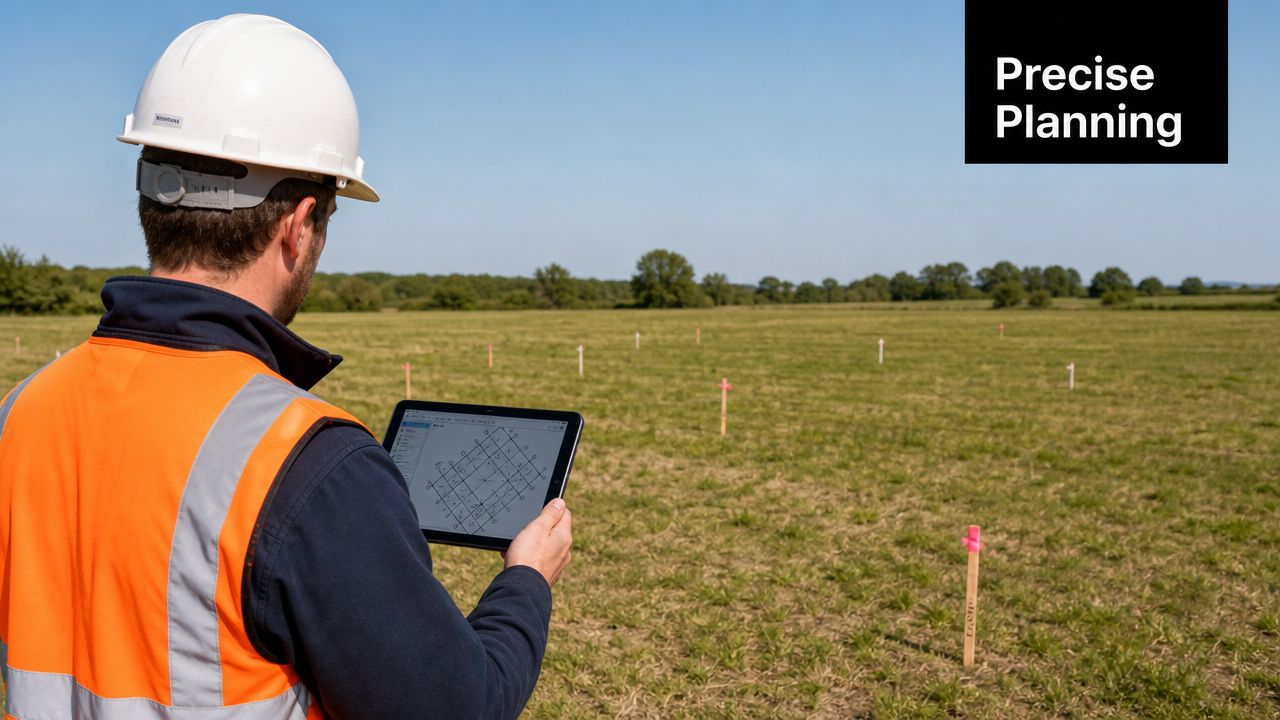
A professional survey does more than measure width and length. It checks the parts of the job that affect whether the installation is smooth, safe, and visually balanced.
A useful survey typically looks at:
- Access route. Side gates, passage width, steps, tight turns, and where equipment can be unloaded.
- Ground condition. Level changes, soft patches, drainage issues, paving, or mixed surfaces.
- Obstructions. Trees, sheds, fences, cables, lights, or overhanging branches.
- Operational layout. Where guests enter, where catering works, and how furniture fits without congestion.
In residential Croydon and Surrey jobs, access often decides the build sequence. A marquee can fit the garden perfectly and still be awkward to install if the route in is restricted.
If the survey is rushed, the quote is often too. Good marquee planning starts with measurement, not assumptions.
Why CAD layouts remove guesswork
Once the site is understood, a CAD layout becomes one of the most useful planning tools available. It lets you see not just the marquee footprint, but how the event functions within it.
That means you can test decisions before money is committed to the wrong setup. Round tables versus trestles. Position of the dance floor. Whether a bar near the entrance helps flow or creates a queue. Whether the catering route crosses the guest route.
A provider such as Premier Marquee Hire offers free site visits, pressure-free quotations, and CAD layout designs on request, which is useful when you want to visualise capacity and circulation before confirming a final package.
Where clients benefit most
CAD planning is especially valuable when the event needs more than one purpose inside the same structure. Weddings are the obvious example, but so are company functions, school events, and community gatherings.
It helps answer practical questions early:
- Can guests move easily between dining and dance areas?
- Is there enough perimeter clearance for service staff?
- Does the entrance position make sense in bad weather?
- Will furniture placement leave the marquee feeling open or crowded?
What works is treating the survey and layout plan as part of the event design. What doesn't work is leaving those decisions until after the structure has been booked.
Navigating Access, Ground Conditions, and Permits
A Croydon marquee job can look straightforward on the phone, then change completely when the crew arrives. A garden that seems "plenty big enough" often has a 900mm side passage, three steps down from the patio, or a shared drive that cannot be blocked for long. Those details decide how the build is carried out, how long it takes, and sometimes whether the original size choice is realistic.
That is why access checks matter as much as the footprint itself.
In Croydon and across Surrey, residential installs come with familiar constraints. Victorian terraces, tight side returns, low garden walls, steep lawns, and limited street parking are common. On larger plots, the issue is often distance from the unloading point to the build area. On smaller plots, it is working room around the frame and whether the team can carry sections through safely without damaging fences, doors, or planting.
Access issues clients often miss
The back garden is only one part of the site. The full route from vehicle to installation area needs to be workable.
The points I ask clients to check before we confirm a build are simple:
- Clear width through gates and side passages. This affects what can be hand-carried in and how labour is planned.
- Steps, slopes, and tight turns. These slow the install and can rule out certain layouts.
- Parking and unloading conditions. Some roads in Croydon are easy first thing in the morning and much harder later in the day.
- Obstacles along the route. Planters, bins, garden furniture, and wall-mounted lights all reduce usable clearance.
- Working space around the marquee position. Crews need room to assemble and secure the structure, not just the final internal footprint.
Photos help, but a proper site visit is better. It is the quickest way to spot issues that do not show up on a rough sketch or estate-agent-style garden photo.
Ground conditions change the build
Ground condition affects two things immediately. Safety for the structure and comfort for your guests.
Lawns in this area are rarely perfectly level, especially after wet weather or on gardens that have been reconfigured in sections. Patios can be easier underfoot, but they raise different questions about fixing methods, height changes, and where entrances will sit. Split-level gardens need careful measurement because a marquee can fit on paper and still feel awkward once tables, catering access, and guest movement are added.
Soft patches, hidden drainage covers, tree roots, and recent turfing all need to be picked up early. They do not always stop the job, but they do affect the setup plan. If your event is in a colder month, it also makes sense to review practical heating and enclosure options at the same time as the base conditions. A guide to marquee heating and weather planning for temporary events helps explain those choices in plain terms.
One bad assumption causes more trouble than clients expect. If the garden "looks flat enough," people often assume furniture will sit properly. In practice, even a modest fall across the site can show up quickly once dining tables, bars, or staging go in.
Guests may not notice the frame specification, but they notice wobbling chairs, uneven tables, and an entrance that feels awkward in the rain.
What about permits
Private garden events usually involve fewer formal approvals than public or commercial sites, but permit questions still need to be raised early. The answer depends on where the marquee is going, how long it will stay up, and what else is being brought onto the site.
Check the position carefully if your event includes:
- A school, sports ground, or community venue
- Council-owned land or a managed estate
- Public attendance rather than invited private guests
- Extra infrastructure such as generators, toilets, staging, or catering tents
- A longer installation or de-rig period
Noise limits, access rules, and venue-specific conditions often matter more than planning language clients expect to hear. On private homes, neighbours are also part of the practical picture. If a build needs early unloading on a narrow road or collection late at night, that should be discussed well before installation week.
The safest approach is simple. Raise access, ground, and permit questions during the survey stage, while there is still time to adjust the plan without stress.
All-Season Setups and Essential Add-Ons
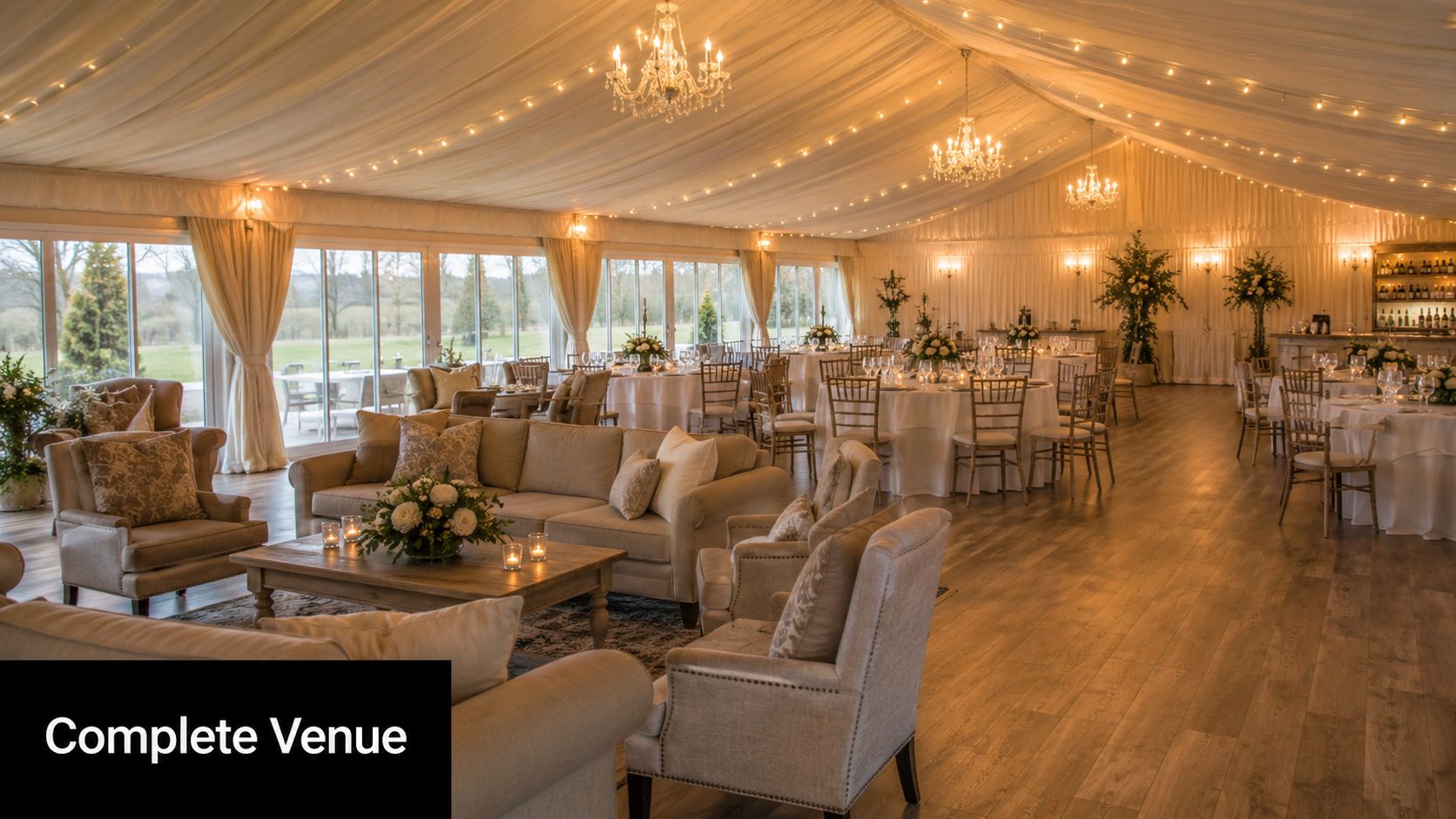
A marquee becomes a proper venue when the practical build and the styling work together. Clients sometimes think of those as separate choices, but on real events they overlap. The warmth of the room, the feel underfoot, the way guests move through the entrance, and the quality of the lighting all shape the atmosphere as much as flowers or table décor do.
Building for comfort first
Year-round use is possible, but only if the setup is specified properly. Generic FAQs often say marquees can be used in all seasons, yet they rarely explain the actual trade-offs around comfort, condensation, and spending. That gap matters because organisers want to understand the impact of heating, insulated linings, and double-door entrances, especially with UK weather becoming both warmer and stormier, as discussed in these winter marquee planning considerations.
For practical planning, the strongest all-season setup usually starts with the basics:
- A proper enclosed structure that controls draughts
- A solid floor system that separates guests from cold or damp ground
- Heating matched to the event type
- An entrance solution that doesn't dump outside air straight into the main space
If you know your date falls in a colder month, it's worth looking at dedicated marquee and heater hire options early rather than treating heating as a late add-on.
The add-ons that genuinely improve the event
Some extras are decorative. Others transform how the event works.
The most useful additions usually include:
- Furniture that matches the event style. Banquet seating creates a very different impression from folding chairs.
- Lighting with two jobs. Practical lighting keeps the room usable. Festoon or feature lighting creates mood.
- Bar units and service stations. These help flow if they're positioned well.
- Dance floors and entertainment features. These define where the event's energy sits.
- Entrance treatment. This is often overlooked, but it affects first impressions and heat retention.
A short visual reference helps many clients picture how these elements come together in a finished event space.
What works in real Croydon and Surrey setups
For a summer garden party, lighter flooring, open sides where appropriate, and relaxed lounge furniture can work well if the forecast is stable and the site is sheltered.
For autumn, winter, or exposed sites, the priority should shift. Flooring first. Heating second. Controlled entrances third. Styling after that.
What doesn't work is trying to save budget by stripping out the comfort layer while keeping all the visual extras. Guests remember whether they felt cold much longer than they remember the roof lining.
Your Booking Checklist and Common Questions
Good marquee projects tend to follow a simple rhythm. The booking is easier when decisions are made in the right order and nothing important is left to the final week.
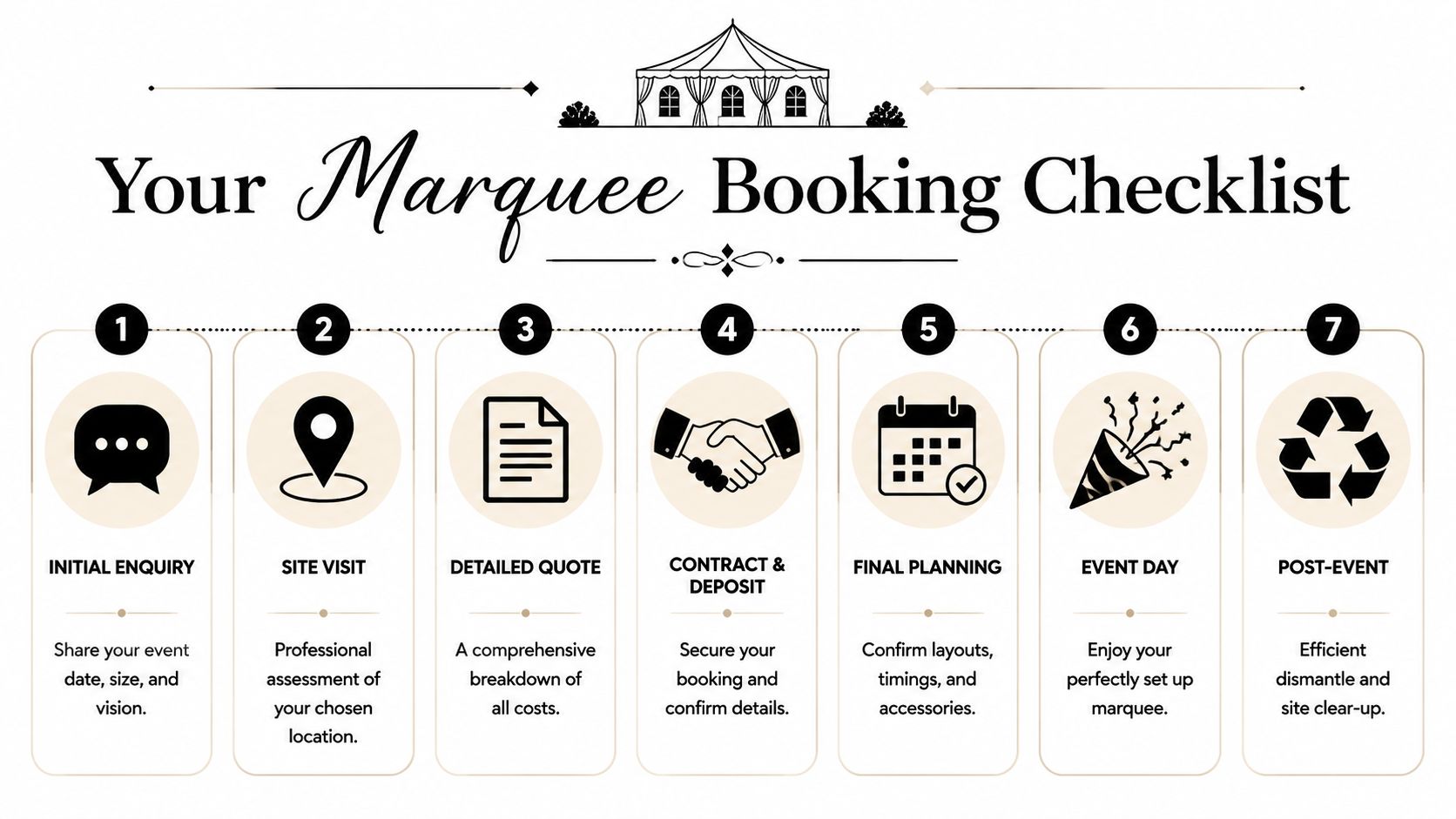
A practical booking checklist
Start with the date and event type
Confirm the occasion, rough guest count, and whether the event is seated, standing, or mixed-use.Measure the space roughly
A quick starting measurement helps narrow options before the formal survey.Book a site visit early
The site visit clarifies access, levels, and realistic layout options.Review the quote carefully
Check structure, flooring, lighting, heating, furniture, installation, and collection.Lock the layout before styling details
Tables, dance floor, bar, and service routes should be settled before decorative decisions.Finalise guest numbers and schedule
The marquee should support the actual event plan, not an early guess.Think about the finish
If you're deciding how the interior should feel, outside inspiration from home decor and design trends can help you refine colours, furniture mood, and styling direction before you make final hire choices.
Bookings run more smoothly when the practical decisions are made before the aesthetic ones. Layout drives everything else.
Common questions clients ask
How far in advance should I book
Earlier is better for peak dates, especially weddings and summer weekends. If your event needs a specific size, flooring build, or multiple extras, don't leave it until the last minute.
What happens in very windy weather
The build team will assess conditions, site exposure, and safe operating requirements. In poor weather, the key issue is not just the marquee itself but the full setup, including entrances, walling, and how the site behaves around it.
Do I need to know every detail before I enquire
No. A good first enquiry only needs the basics: date, location, event type, and approximate numbers. The technical details can be shaped after the site visit.
Is a deposit usually required
Most marquee bookings involve a formal confirmation process so the date, equipment, and crew allocation can be secured. The exact terms should always be clear in the quotation and booking paperwork.
If you're planning an event and want clear advice on what will work on your site, Premier Marquee Hire can help you move from rough idea to practical layout, with straightforward guidance on size, access, flooring, heating, and the full marquee setup.
Sorry, the comment form is closed at this time.