

25 May Large Marquees for Hire: A London & Croydon Guide 2026
You're probably at the stage where the event feels exciting and slightly overwhelming at the same time. The guest list has grown, the venue options are narrowing, and somebody has asked the practical question that changes everything: how big does the marquee need to be, and how on earth does it all fit on site?
That's where large marquees stop being a simple hire item and start becoming a proper event project. In Croydon and across London, the challenge usually isn't just choosing a tent. It's dealing with restricted access, mixed ground conditions, neighbours close by, parking limitations, power supply, weather cover, and a layout that still feels welcoming rather than packed.
Large marquees for hire work brilliantly when they're planned as temporary venues, not treated like oversized garden shelters. The difference shows up in comfort, flow, safety, and how calm the day feels once guests arrive.
Your Expert Guide to Hiring a Large Marquee in London
A large marquee can solve problems that fixed venues can't. It gives you control over location, layout, guest flow, catering position, and how formal or relaxed the day feels. For weddings, that often means keeping family on private land or at a venue with outdoor space. For corporate events, it means creating a branded event space where you need it. For schools, councils, and community groups, it means building capacity quickly on familiar ground.
London and the South East bring their own realities. A generous field in Surrey is one kind of job. A long garden behind a house in South Croydon, accessed through a side passage with tight turns and paving changes, is another. The marquee itself may be the easy part. The successful part is matching structure, access, services, and timing to the site you have.
What tends to worry clients most is usually one of five things:
- Size and comfort. Will everyone fit without the room feeling cramped?
- Ground conditions. Can the marquee go on grass, paving, or a mixed surface?
- Weather exposure. What happens if it rains, gets windy, or turns cold?
- Logistics. How do deliveries, catering, toilets, and generators work?
- Booking confidence. When do you commit, and what should be decided first?
Practical rule: Treat the marquee as the framework for the whole event. Once the structure and layout are right, the rest of the planning becomes much easier.
The good news is that none of this needs to be guessed. A large marquee project becomes manageable when you break it into the right sequence: guest numbers, layout, site assessment, weather planning, infrastructure, then booking. That's the order experienced teams use because it avoids expensive changes later.
Choosing the Right Size Marquee for Your Guests
A client in Croydon might tell us they have 120 guests and a decent-sized garden. That sounds straightforward until we factor in the side access, the shape of the lawn, the catering area, and the fact they want round tables, a bar, and space for a band. Guest count sets the starting point. The right marquee size comes from how the event will work on the day.
That is why I size large marquees from the inside out. Start with what guests will be doing, then allow for the operational space that keeps the event comfortable. If you are still comparing options, our guide on how to hire a marquee for your event gives a useful overview before you settle on a footprint.
Start with event style
A seated dinner needs more room than a standing reception. A wedding with round tables needs a different layout from a corporate event with trestles and poseur tables. The same guest list can fit well in one structure and feel cramped in another, depending on what has to sit around the guests.
These are the questions that matter early:
- Will everyone be seated for food? Dining layouts need space for tables, chairs, and staff service.
- What table shape are you using? Round tables usually improve the feel of the room, but they take more floor area than straight runs of trestles.
- Do you need a dance floor? It should have its own defined zone rather than borrowing space from dining.
- Will there be a stage, DJ, or band? Entertainment kit reduces usable guest space and affects speaker and power positions.
- Are you including a bar or buffet? Bars attract queues. Buffets need circulation on both sides if you want service to stay orderly.
- Do you need accessible routes? Wide, clear walkways make a real difference for older guests, wheelchair users, pushchairs, and staff carrying trays.
Small details change the answer. In London and the South East, I often find that the site can physically take a marquee of one size, but the event brief really needs the next size up to avoid a squeezed layout.
Use capacity charts as a starting point only
Standard size charts are useful for first estimates. They are less useful once you add real event requirements. A marquee listed for a certain number of guests may be counting a simple seating plan with very little spare room. That is rarely how larger private parties, weddings, or corporate functions are set up in practice.
A better approach is to work from zones:
- guest seating
- entrance and welcome space
- bar or drinks point
- catering or service support
- entertainment area
- clear circulation routes
That is also the point where safety starts to overlap with comfort. GM GROUP Services' event risk advice is a helpful reminder that layout decisions affect more than appearance. They affect movement, trip risk, queueing, and how easily people can leave the structure if the weather turns or the event gets busy.
Typical sizes and where they work
The table below gives sensible first estimates for seated events. They are planning guides, not final promises.
| Marquee Size (meters) | Typical Guest Capacity (Seated) | Ideal For |
|---|---|---|
| 3m x 3m | Small group | Catering cover, entrance point, compact private dining |
| 3m x 10m | Medium group | Narrow gardens, smaller celebrations, long restricted spaces |
| 4m x 8m | Medium to larger group | Family parties with a simple dining layout |
| 4m x 12m | Larger group | Celebrations that need more flexibility for dining and guest flow |
Those dimensions only tell part of the story. A 3m-wide structure can be useful on a tight Croydon access job or along the side of a property, but width restrictions often limit furniture options and aisle comfort. A wider marquee usually gives a better room shape for round tables, dance floors, and mixed-use events.
Why slightly larger often feels better
Clients sometimes worry that booking a bigger marquee will make the event feel sparse. In reality, poor spacing causes more problems than extra room.
Guests notice when chairs knock into each other, queues block the entrance, or staff have to squeeze behind tables to serve. A little spare floor area fixes a lot of that. It also gives you flexibility if the final numbers change, the weather pushes everyone inside at once, or the caterer needs more back-of-house room than expected.
I usually advise clients to leave space for four things that get missed on the first draft:
- An arrival area so guests are not stopping in the doorway.
- Service room behind bars, buffets, or dining lines.
- Clear walkways between tables and exits.
- Furniture tolerance so chairs can move properly and the room still feels calm when full.
If you size only for tables and headcount, the marquee may fit on paper and still feel tight within ten minutes of guests arriving. The best bookings come from matching numbers to layout, access, and how people will move through the space.
The Importance of a Professional Site Assessment
A large marquee can only work if the site works. That sounds obvious, but it's where many event plans either settle into place or start to unravel.
A supplier can give you a broad idea from photos and measurements. They can't reliably confirm the actual requirements until someone assesses the ground, access route, anchoring method, obstructions, and service points in person. This matters even more in London, where outside space often looks straightforward from the house and much tighter from the installation team's side.
According to UK guidance on large marquee planning from Fews Marquees, benchmark capacity is tied to floor area and intended use, and a 15 m x 30 m marquee might be listed for 250 guests only under a simple layout assumption. Once catering tents, dancefloors, and accessible circulation are added, the required footprint expands significantly. That's why site visits and CAD layouts are part of serious marquee planning rather than optional extras.
What a proper survey should check
On a Croydon or Greater London job, the site assessment usually answers practical questions such as:
- Access width. Can equipment pass through side gates, alleys, or service routes?
- Ground type. Grass, paving, gravel, and mixed surfaces all affect anchoring.
- Level changes. Slopes and steps influence flooring and entrance design.
- Overhead restrictions. Trees, cables, and building projections can limit height and placement.
- Working space. The team needs room to build safely, not just room for the finished marquee.
A terraced garden in Bromley may have enough square footage but poor access. A school field may have excellent access but soft ground after rain. A venue in Surrey may allow the marquee itself but place limits on vehicle routes or protected landscaping.
What goes wrong without one
The common failures are rarely dramatic. They're the kind that cost time, money, and calm.
- The chosen marquee fits the footprint but blocks a fire exit route
- The bar location works on paper but clashes with catering access
- The generator has nowhere sensible to sit without affecting guests
- The entrance ends up on the wrong side for arrival flow
- A hardstanding area needs a different fixing method than originally assumed
For organisers who want a broader planning framework, GM GROUP Services' event risk advice is a useful read alongside a marquee survey because it frames site checks as part of wider event risk management, not just equipment planning.
A good survey also saves awkward conversations later. If a space is too tight, or if the better answer is a different footprint, linked structure, or revised layout, it's far better to discover that early. For a practical starting point on the hire process itself, this guide to hiring a marquee helps clarify what to ask before you lock anything in.
Planning for All Seasons and Weather Conditions
People still talk about marquees as if they only make sense in July. That isn't how professional event work runs. Large marquees are used throughout the year. The key question isn't whether the season is suitable. It's whether the structure, flooring, heating, and installation plan match the conditions.
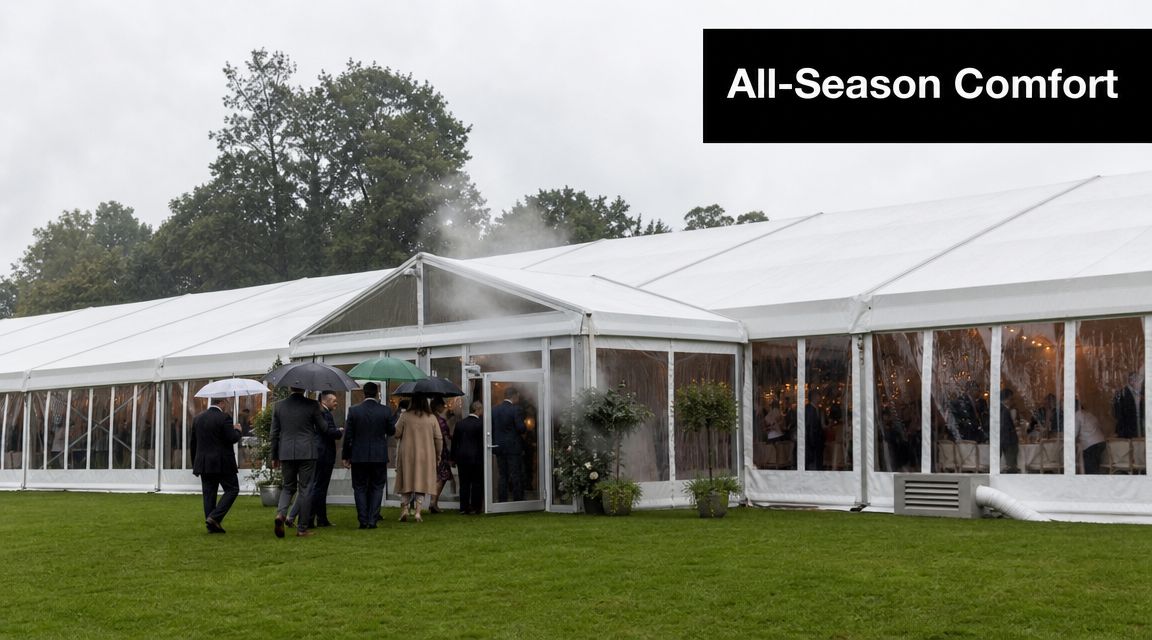
In the UK marquee sector, Marquee Tech's industry report notes that the trade is highly seasonal and many firms operate with a small full-time core supported by trained freelance crews for installations. The same report explains why capacity for large, complex structures depends more on logistical expertise and access to skilled labour than on the number of permanent staff alone. That matters for all-weather jobs, because poor weather exposes weak planning immediately.
Winter events can work exceptionally well
A winter marquee needs to feel like a venue, not a cover. That usually comes down to a few core choices:
- Heating that's properly matched to the marquee volume and event duration
- Solid flooring so guests aren't walking on cold or damp ground
- Lining and entrance planning to help hold warmth and improve finish
- Thoughtful zoning so dining and social areas stay comfortable
What doesn't work is underestimating heat loss, leaving entrances unmanaged, or assuming a domestic heater will deal with a large event space. Commercial setups are planned very differently. If you're considering a cold-weather event, this overview of heated marquee hire is worth reading before you choose your structure.
Summer needs planning too
Hot days create a different set of issues. Guests need airflow, shade management, sensible entrance orientation, and enough room that the marquee doesn't feel close and stuffy once it fills up.
The best summer setups usually include a mix of openable sides, window panels where appropriate, and a layout that doesn't put every warm element in one zone. Bars, catering, and dance areas all generate heat. If they're packed too tightly, comfort drops quickly.
Large marquees handle weather well when the team plans for the likely conditions in advance. They become difficult when weather is treated as an afterthought.
The difference between a marquee and a gazebo
This is one of the biggest practical misunderstandings. A large professional marquee is a temporary structure built and secured as part of an event installation. It isn't the same thing as a lightweight domestic gazebo bought for occasional garden use.
For London weddings, corporate functions, and public events, clients should expect strong anchoring, proper load thinking, stable flooring options, and a crew that knows how to install in less-than-ideal conditions. That's what turns a forecast from a panic point into a planning point.
Designing Your Marquee Layout with CAD Planning
Once the marquee size is chosen, the next job is making the space behave like a venue. Success in this task determines whether many events start to flow properly or become a shuffle of awkward corners, blocked sightlines, and furniture moved at the last minute.
CAD planning solves that before installation day. It turns an empty footprint into a working layout with usable zones, service paths, furniture positions, and realistic spacing. Clients often think they need a marquee first and the layout second. In practice, the layout is what tells you whether the marquee is right.
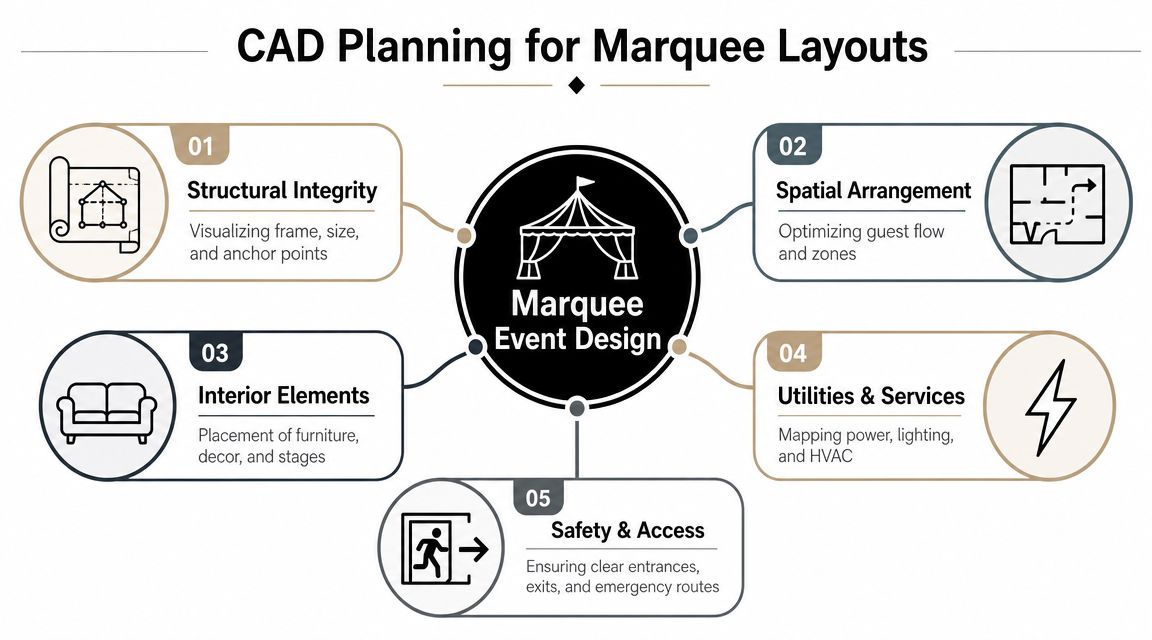
Large clearspan structures are especially useful here. Field and Lawn's large marquee guidance notes that large frame marquees are commonly 15m wide and above, built with modular 5m bays that can extend to 80m or more. That modular approach allows planners to create separate areas for reception, dining, and service within one unobstructed structure.
How a good layout comes together
A strong marquee layout starts with movement. Guests need to enter comfortably, find the main focal point quickly, and move between functions without crossing service routes every few minutes.
A typical large event layout may include:
- Arrival zone near the entrance, often with welcome signage, cloakroom space, or drinks reception
- Dining zone set away from service congestion
- Bar position where queues don't cut across table service
- Dance floor or stage area with enough surrounding space to gather naturally
- Back-of-house edge for catering, storage, or staff circulation
Furniture and finish make the plan feel real
This is the stage where the marquee stops being a technical drawing and starts to feel like your event.
Round tables can soften the room and suit formal dining. Trestle tables can be more efficient in long, narrower spaces. Chiavari chairs create a different atmosphere from folding chairs. A mobile bar can anchor one end of the marquee, while lighting changes the room after dark more than most clients expect.
Useful additions often include:
- Dance floors for evening transition
- Staging for speeches, DJs, or live music
- Feature lighting such as fairy lights or uplighters
- Flooring finishes that help define zones
- Decor elements like letter lights or photo areas
The best marquee layouts don't just fit everything in. They make each part of the event feel intentional.
For events on uneven or mixed ground, flooring design has a big effect on both comfort and appearance. This guide to flooring for marquees is useful if you're deciding between basic cover and a more venue-like finish.
Why CAD prevents expensive changes
Without a proper plan, clients often add items one by one. A bar goes in, then a band area, then extra tables, then a cake table, then heaters, then a photo booth. Individually, each choice seems manageable. Together, they can undo the original spacing.
CAD planning forces the event to work as a whole. That means fewer compromises on the day, fewer rushed decisions during install, and a much better chance that the marquee feels calm when guests walk in.
Navigating Permits Power and Essential Facilities
The marquee itself gets most of the attention. The hidden work sits around it. That includes permissions, power, fire safety, toilets, accessibility, and the practical details that make the event usable for everyone.
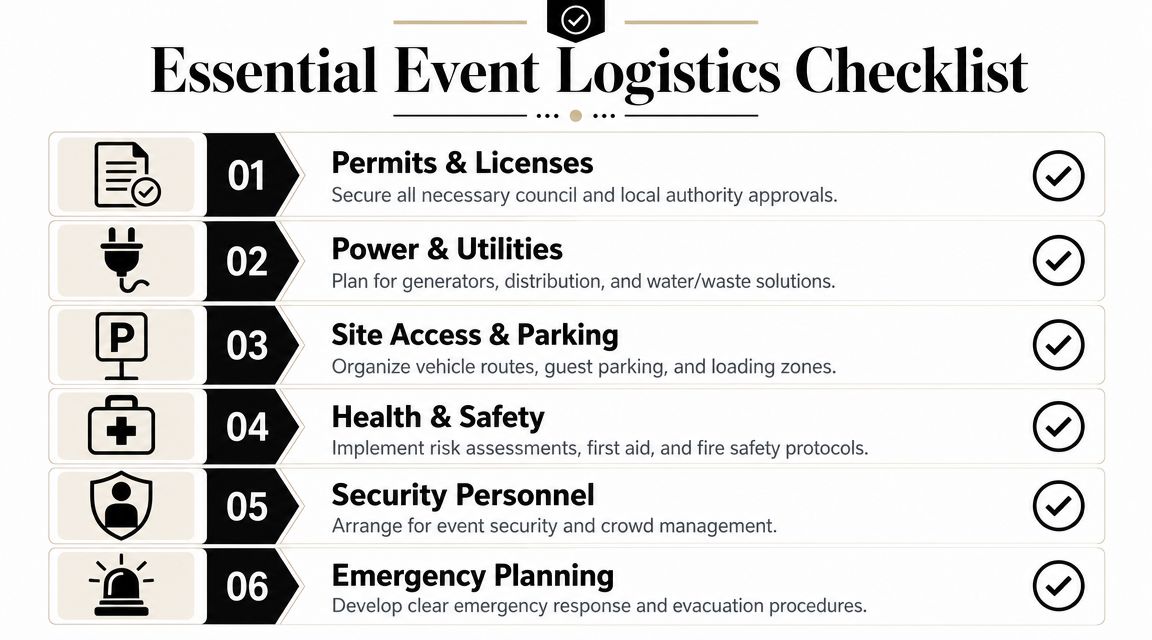
For large temporary structures in the UK, guidance discussed by Marquee Tents for Sale points organisers toward considerations such as fire safety, occupancy limits, and escape routes through frameworks like the Purple Guide. The same source highlights that the 2021 Census recorded 16.1 million disabled people in the UK, which is why level access, ramps, and accessible facilities shouldn't be treated as optional extras.
Permissions and compliance
Whether you need formal permission depends on the site, event type, and local authority expectations. Private land events can be straightforward. Public events, licensed premises, and larger gatherings may involve more checks.
The practical question isn't only “do I need planning permission?” It's also:
- Does the site owner need documents before approval?
- Are there local authority notices or event permissions to consider?
- What occupancy and fire precautions need to be reflected in the layout?
- Where are the escape routes, and do they remain clear after furniture is installed?
This short video gives a useful overview of the broader planning mindset involved in event logistics:
Power, toilets, and access
Large marquees become quasi-venues very quickly. Once you add lighting, catering equipment, heating, sound, refrigeration, and entertainment, power planning can't be improvised. Some sites have a usable supply nearby. Others need generator support and safe distribution planned in advance.
A practical checklist usually includes:
- Power load review for lighting, heating, catering, and entertainment
- Generator position away from guest areas where possible
- Cable routes that don't interfere with movement
- Toilet provision matched to guest profile and site conditions
- Waste and water arrangements where required
Accessibility should run through every one of those decisions. Ramps, level thresholds, suitable gangways, and sensible toilet access matter because guests need to use the whole event comfortably, not just enter it.
Treat it as venue planning
The easiest way to stay organised is to stop thinking of a marquee as “just the structure”. Think of it as a venue you're creating from the ground up. Once you do that, permits, utilities, and guest facilities stop feeling like side issues and become part of the core event plan.
Understanding Marquee Hire Costs and Booking Timelines
A client in Croydon often starts with one question. “How much is a large marquee?” The honest answer is that the price depends less on the word “large” and more on what has to happen on site to turn a garden, driveway, or open space into a usable venue.
Two events with the same guest count can price very differently. One might be a straightforward build on level ground with easy side access. Another might need floor levelling, careful hand-carry through a narrow passage, extra labour, heating, generator provision, and a longer installation window. In London and the South East, those practical details often shape the quotation as much as the marquee size itself.
That is why a useful quote should show what is included.
What usually drives the quote
The structure is only part of the total hire cost. The final figure usually changes based on a few practical decisions:
- Marquee size and specification. Wider spans, higher eaves, and clearspan structures need more kit and more build time.
- Flooring choice. A simple surface layer costs less than a boarded and carpeted floor designed for dining, dancing, or uneven ground.
- Interior finish. Linings, lighting, staging, bars, and furniture all affect labour, transport, and setup time.
- Access conditions. Tight Croydon gardens, side returns, steps, parking restrictions, and limited unloading space can all increase crew time.
- Seasonal equipment. Heating, additional entrance protection, and weather contingencies add cost but often save stress later.
- Build schedule. A quick turnaround, restricted installation hours, or supplier coordination can push costs up.
The point that catches people out is scope. A basic shelter quote and a ready-to-host venue quote are not comparable, even if the marquee footprint is similar.
Where budgets usually slip
Late changes are expensive. If guest numbers rise after the layout is agreed, the knock-on effect can involve a larger structure, more flooring, extra furniture, revised lighting, and a different heating plan. The same applies if a client decides late in the process to add a dancefloor, catering tent, or separate entrance area.
I always advise clients to set the working brief early. Guest range, event style, dining format, and whether the marquee needs to handle speeches, dancing, catering, or all three will shape the cost far more accurately than asking for a price “for around 100 people”.
Booking timelines for London and the South East
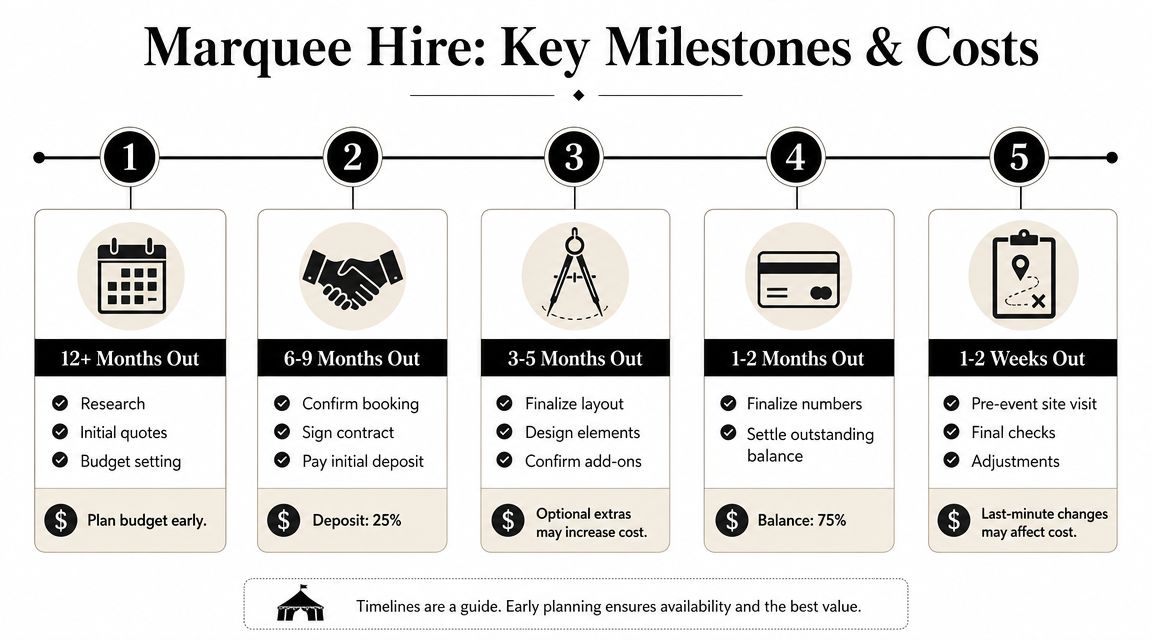
Lead times depend on season, date, and how bespoke the setup is. Peak summer weekends and December dates tend to go first, especially for larger structures and full interior packages. Private parties at home can sometimes move faster, but only if the site is simple and the decisions are made promptly.
A practical booking rhythm looks like this:
- Start with the date and guest range. That gives enough detail for an initial discussion.
- Arrange a site visit. Access, ground conditions, power position, and layout constraints are checked properly then.
- Confirm the specification. Flooring, lighting, heating, furniture, and service areas need to be agreed before the quote is accurately like-for-like.
- Secure the booking. Popular dates should be reserved once the main decisions are made.
- Finalise details closer to the event. Numbers, timings, and supplier coordination can then be tightened without changing the whole plan.
Earlier booking usually gives better choice, better scheduling, and fewer rushed decisions.
The biggest cost problem is rarely hiring a marquee that is slightly too big. It is leaving decisions until the last minute and then paying for avoidable changes under pressure.
Frequently Asked Questions About Large Marquee Hire
What happens on installation and removal day
For large marquees, installation is a proper working schedule rather than a quick drop-off. The team needs access to the site, space to unload, and time to build the frame, fit covers, secure the structure, and install agreed extras such as flooring or lighting. Removal happens in reverse after the event, and the site should be clear enough for safe dismantling.
If you're hosting at home, it helps to think ahead about gates, parked cars, garden furniture, and who needs to be present when the crew arrives.
Can I decorate the marquee myself
Usually, yes, but it's best agreed in advance. Most clients want some personal input, whether that's florals, table styling, signage, or cultural decor. The important part is making sure decorations don't interfere with the structure, exits, lighting positions, or heating equipment.
If you're bringing in your own stylist, ask early about access times and fixing methods. That avoids last-minute clashes between decor plans and the practical setup.
What areas can large marquees be delivered to
Croydon is a strong base for events across Greater London and nearby counties, so deliveries often extend into places like Bromley, Sutton, Wimbledon, Dulwich, Streatham, Surrey, Kent, and other surrounding areas. The better question isn't only distance. It's whether the access, site type, and event schedule make the job workable.
A rural field outside London may be farther away but easier to build on than a compact urban garden much closer in.
How do I know a company can handle a large marquee properly
Ask about site visits, layout planning, access checks, flooring options, and how they handle utilities and weather planning. Large marquees for hire need operational competence, not just stock availability.
You want a team that talks confidently about anchoring, circulation, service zones, and installation sequencing. If the conversation stays vague, that's usually a warning sign.
What if the weather changes close to the event
The strongest plans don't rely on the forecast staying kind. They build in weather resilience from the start through the structure choice, entrance planning, flooring, and seasonal equipment. If conditions change, a well-planned marquee event can usually adapt far better than an open outdoor setup with no cover at all.
If you're planning an event in Croydon, London, or the surrounding counties and want calm, practical advice on structure size, layout, access, and all the details around it, Premier Marquee Hire can help. Ask for a quote or arrange a site visit, and you'll get straightforward guidance on what fits your space, your guest numbers, and your event properly.
Sorry, the comment form is closed at this time.