

28 May Event Tent Rental: London & Surrey Planning Guide
A lot of people arrive at marquee hire the same way. They've looked at venues, realised the fixed packages don't quite fit, and started wondering whether the garden, courtyard, school field, or office car park could work better if the space was built around the event instead of the other way round.
That's usually the turning point. A couple in Bromley wants a wedding that feels more personal than a hotel suite. A family in Croydon needs room for a birthday party without splitting guests between indoors and outdoors. A business in Sutton wants an outdoor summer function but still needs shelter, power, furniture, and a layout that won't fall apart if the weather turns.
A marquee solves that problem well because it isn't just cover overhead. It becomes the venue itself. Dining room, bar area, dance space, entrance, catering zone, sheltered walkway, all planned around your guest list and your site.
Your Guide to London Event Tent Rental
In Greater London and the South East, that flexibility matters more than ever. The UK's event hire market is a mature industry where temporary structures are a core service, not a niche add-on, and that's especially relevant in areas where venue costs are high and outdoor events are common, as noted by IBISWorld's overview of the wider party and event hire market.
That sounds like industry language, but on the ground it means something simple. Event tent rental is a normal, practical way to host serious events in this part of the country. It isn't a compromise. For plenty of London and Surrey clients, it's the more controlled option because the footprint, look, and flow can be designed around the site.
In Croydon, that often means dealing with the realities that generic guides skip over. Rear garden access through a side gate. A patio that looks level until tables go in. A driveway that needs to stay usable. A neighbour's fence line. A school field that turns soft after rain. A venue lawn that allows a marquee but not unrestricted vehicle access.
A good marquee plan starts with the site you actually have, not the event you wish the site could magically become.
The right approach is straightforward. Work out how guests will use the space. Check what can physically be installed. Build in for weather, access, and services. Then choose the structure, floor, lighting, furniture, and finishing touches that make it feel like a proper venue rather than a shelter dropped on a lawn.
Sizing and Layout The Blueprint for Your Event
The easiest mistake in event tent rental is to start with a guest number and stop there. Headcount matters, but it doesn't tell you how the event will function.
A marquee works more like a custom room than a standard product. Width, length, shape, entrances, flooring, furniture, catering position, and circulation all affect whether the space feels comfortable or cramped.
Start with how guests will use the marquee
Professional marquee hire guidance works from the guest's activity first, then adds fixed items such as bars and dance floors. It also treats a CAD plan as essential rather than decorative, because that plan turns an idea into a buildable layout, as outlined in this guide to tent layout planning.
That matters in real London settings. A standing drinks reception in a garden in South Croydon needs a very different footprint from a fully seated wedding breakfast in Purley. The guest number might be similar, but once you add dining tables, a bar, service aisles, a cake table, a DJ setup, and space for staff to move, the marquee size changes quickly.
Think in zones, not just square footage
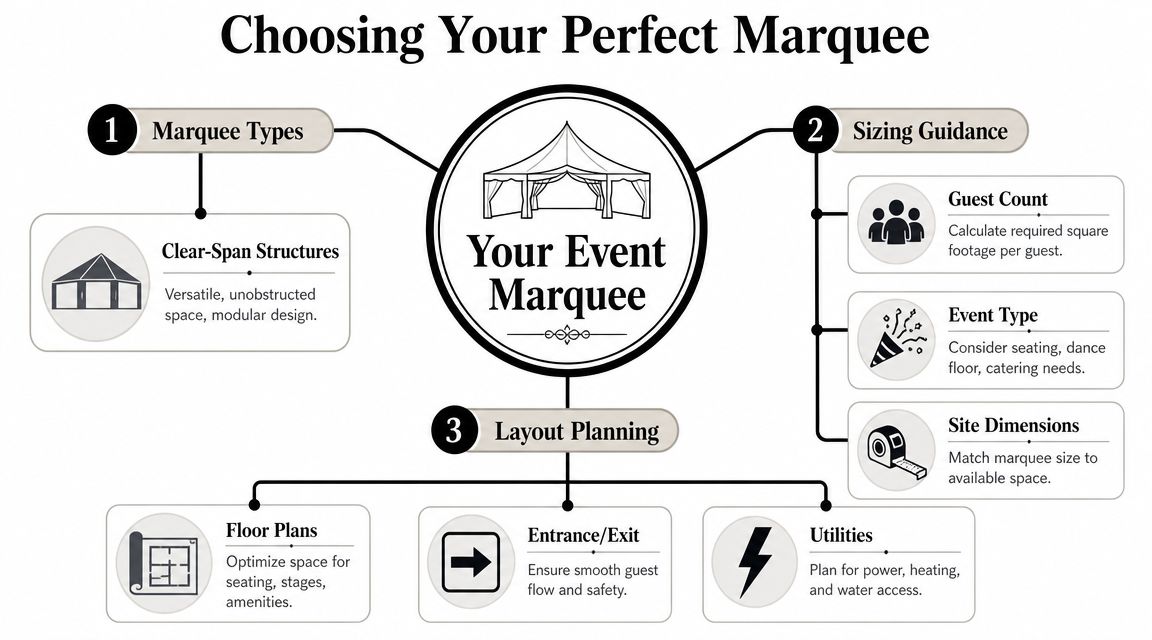
The cleanest way to plan is to split the marquee into zones.
- Arrival space needs room for guests to enter, pause, and get their bearings.
- Main guest area is where most of the event happens, seated dining, standing reception, ceremony seating, or a mix.
- Service space covers buffet runs, catering access, bar operation, and staff movement.
- Entertainment space might mean a dance floor, DJ area, stage position, or children's area.
- Practical edges include doorways, heater positions, power routes, and any space lost to awkward corners or garden features.
Clear-span structures are useful. Without internal centre poles, the usable interior is simpler to plan. That makes a difference in compact London gardens where every part of the footprint has to earn its place.
What fits where in real local settings
A narrow terraced garden in Sutton or Streatham often suits a more linear layout. Dining may run lengthways, with a small bar or lounge area at one end. In a larger Bromley or Banstead garden, there's usually more freedom to create separate zones so the event doesn't feel like one long room.
For commercial sites, the question is often less about raw area and more about shape and access. A corporate courtyard may have decent width but awkward delivery routes. A school or community field may offer loads of space but need walkways, flooring, and sensible entrances because the ground can't be trusted to stay firm.
Practical rule: If you're planning seated dining, don't judge the marquee by how many people can technically fit. Judge it by whether guests and staff can move comfortably once tables, service, and entertainment are in.
Why widths and length extensions matter
Commercial-grade marquees are modular, so the width and the length work together. A compact structure can be ideal for a walkway, catering tent, or small garden event. Wider spans suit open-plan dining, exhibitions, and larger celebrations. Length extensions let the build grow with the event instead of forcing a one-size-fits-all shape.
That flexibility is one reason the wider UK market continues to favour temporary, configurable event infrastructure, with marquee and tent rental sitting inside a broader rental economy that values convenience and adaptable setups, according to Research and Markets' report on the UK party supply rental segment.
When a layout drawing saves you trouble
A proper layout drawing often prevents the last-minute questions that cause stress. Where does the dance floor sit if you still want round tables? Can catering staff get from prep area to service point without cutting through the middle of the room? Does the entrance open into a clear area, or directly into the back of seated guests?
Those details are easy to underestimate until the event is being installed. On paper, a marquee can look generous. Once chairs, tables, bars, and heating go in, the space becomes very real.
A CAD layout helps you spot that early. It can show that a slightly wider marquee gives you a cleaner central aisle. Or that splitting the setup into a main marquee plus a walkway or catering annex works better than trying to force everything into one box.
Budgeting Your Event Tent Rental A Guide to Costs
The fairest way to understand marquee pricing is to split it into two parts. First, the base hire for the structure itself. Second, the variable additions that change according to your event, your site, and the time of year.
That's why two enquiries that sound similar at first can end up with different quotes. “Garden party for around the same number of guests” doesn't always mean the same build. One client may want basic shelter on grass in summer. Another may need flooring over mixed surfaces, linings, a bar, heating, lighting, and a more complex install through restricted access.
What usually sits inside the base hire
The base hire normally covers the marquee structure, delivery, installation, and later collection. It also reflects the type of structure and the amount of labour involved in getting it safely erected and removed.
The big driver here isn't just size. It's also how easy the site is to work on. A straightforward setup on open ground is simpler than carrying kit through a house, navigating a narrow side path in Croydon, or working around tight timing restrictions at a London venue.
What pushes the quote up or down
The final figure usually moves because of the choices made after the structure is selected.
A typical quote may change because of:
- Flooring choice. Basic ground cover is very different from a full solid floor.
- Interior finish. Linings, drapes, and formal styling add labour and materials.
- Lighting package. Functional lighting and decorative lighting do different jobs.
- Seasonal requirements. Winter events often need more than a roof and walls.
- Furniture and extras. Seating, tables, bars, staging, and entertainment all add to the package.
- Access logistics. Difficult loading, long carry distances, and city-centre timing constraints can all affect labour and transport planning.
The price can also change if the brief changes late. A client who starts with drinks and canapés may later add formal dining. Someone planning a daytime celebration may decide they want evening lighting, heating, and a dance floor.
Where clients sometimes misread value
The cheapest quote isn't always the cheapest event. If the structure is under-sized, the floor isn't suitable, or the lighting is too basic for the time of year, you often end up paying elsewhere through rushed changes or compromised comfort.
A better way to compare quotes is to ask what the price is buying. Is the floor suitable for the site? Are delivery and collection included? Has access been considered? Is the quote based on a real layout, or just a rough guest count?
For a more detailed breakdown of likely spend, this guide to marquee hire pricing is useful as a starting point.
If a quote looks vague, it usually means the important details haven't been pinned down yet.
The Practicalities Site Visits Permits and Safety
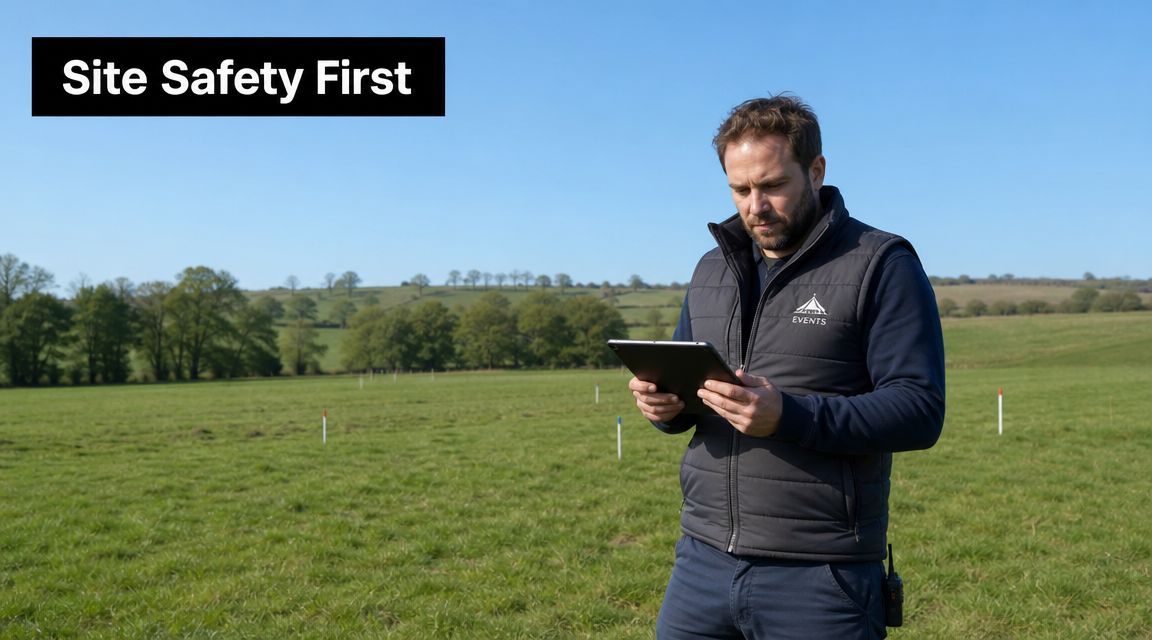
The site visit is where event tent rental stops being theoretical. Up to that point, everyone is working from photos, assumptions, and good intentions. Once someone walks the site properly, the practical job becomes clear.
In Croydon and the surrounding boroughs, site access is often the first issue. A garden might look generous from the back door but only be reachable through a side passage, steps, or a narrow gate. A venue lawn may allow a marquee but limit vehicle movements. A school field can have the space, but not necessarily the best route for getting flooring, furniture, and structure parts into position.
What a proper site survey actually checks
A worthwhile survey doesn't just measure width and length. It checks the conditions that affect whether the marquee can be installed safely and sensibly.
That usually includes:
- Access route through gates, driveways, alleys, or buildings
- Ground condition such as grass, patio, hardstanding, slopes, or soft patches
- Surface changes where one part of the footprint sits on a different level
- Obstacles including trees, sheds, walls, drains, cables, or delicate landscaping
- Operational needs such as power routes, catering position, and guest entry points
For UK event tent rentals, wind loading is the most critical engineering constraint, and anchorage changes according to soil condition, surface type, and whether sidewalls are fitted. That's why a professional site survey is a technical requirement, not an optional extra, as explained in this guide to event tent regulations and wind loading.
Why the surface changes the build
The same marquee can require different fixing methods depending on where it's going. Grass behaves differently from hardstanding. A level lawn behaves differently from a sloped or uneven one. Add sidewalls and the wind behaviour changes again, which affects how the structure needs to be secured.
That's why experienced installers ask what can sound like fussy questions. Is the garden soft after rain? Is the patio sound enough for the load? Are there underground services? Does the site become more exposed when the wind comes across open space or between buildings?
Those aren't box-ticking issues. They affect the engineering of the installation.
A marquee isn't made safe by being large or expensive. It's made safe by being correctly specified for the exact site it's going onto.
Permits, permissions, and the part clients often miss
Private homes and public events are very different once compliance enters the picture. In a back garden, the main questions are usually access, safety, neighbours, and whether anything else is being added that changes the risk profile. For community events, school functions, exhibitions, or larger mixed-use gatherings, there may be local authority requirements, fire safety considerations, accessibility planning, and event documentation to sort out.
Clients often ask whether they “need permission for a marquee” as if the answer is always yes or no. In practice, it depends on the site, the event type, the structure, and what else is happening inside it.
A sensible checklist includes:
- Emergency egress so guests can move out cleanly if needed
- Fire safety planning including how equipment and exits are managed
- Accessibility such as step-free access, ramping, lighting, and toilet routes
- Insurance position for the organiser, venue, and suppliers
- Authority requirements where public or community use triggers extra oversight
If you're planning a larger event with several moving parts, this article on preventing event safety planning pitfalls is a useful companion read because it frames risk assessment in practical terms rather than paperwork language.
Local knowledge does matter here
A local installer usually spots problems earlier. In London, restrictions rarely come one at a time. It's often narrow access plus limited parking plus neighbour sensitivity plus a wet lawn plus an event time that leaves little room for delays.
That's why the planning stage matters so much. The marquee itself may look simple once it's up, but getting to that point properly is where the experience shows.
Hiring a Marquee for Winter and All-Season Events
A marquee isn't just for July. Some of the most successful setups happen in colder months, but only when the build is planned for winter conditions rather than treated like a summer marquee with a heater added at the last minute.
That distinction matters in London and the Home Counties because cold-weather events here aren't defined by snow. They're defined by damp air, wet ground, earlier darkness, doorway heat loss, and guests arriving in coats and formalwear.
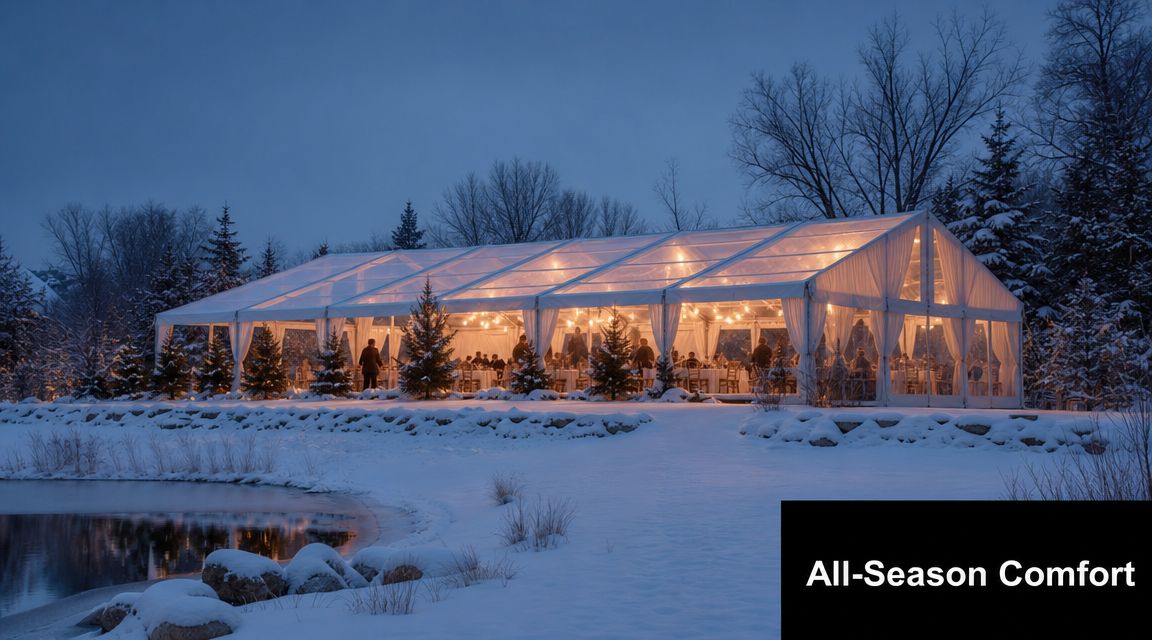
Planning for UK winter events involves more than basic weatherproofing. It calls for attention to thermal comfort, condensation control, safe access on wet ground, and heating load, as highlighted in this discussion of cold-weather marquee planning.
What makes a winter marquee feel comfortable
Warmth doesn't come from one item. It comes from how several elements work together.
A dependable winter setup usually includes:
- Solid flooring to separate guests from cold, damp ground
- Heating sized to the space rather than added as an afterthought
- Lining or interior finishing that helps the space feel warmer and more complete
- Managed entrances so you don't lose heat every time guests arrive
- Practical lighting because events often run into darkness much earlier
In cold months, flooring does more than improve appearance. It changes how the whole event feels underfoot. Guests notice immediately if they're walking over soft, wet, or uneven ground, especially in formal shoes.
The parts people forget until too late
Winter event briefs often focus heavily on the marquee size and not enough on what happens around it. How do guests get from the house to the marquee without crossing exposed ground? Where do coats go? Will the entrance area stay dry? Can older guests, children, or anyone with mobility needs move in and out safely?
Those details affect comfort more than people expect. A warm marquee reached by a muddy, dark path doesn't feel well planned.
Good winter event tent rental is about keeping the whole guest journey usable, not just heating the main room.
Why October to March needs a different mindset
From autumn through early spring, the build has to work harder. Even when there isn't heavy rain, the ground may already be holding moisture. Even when the day is mild, the temperature can drop fast once the sun goes. A clear, crisp evening can still create condensation issues if the structure and heating haven't been planned properly.
That's why it helps to look at heating, flooring, and access as one package. This guide to marquee and heater hire gives a useful overview of how those decisions interact.
A year-round marquee can work beautifully. It just needs to be specified like a winter venue, not a summer tent asked to cope.
Furnishing Your Marquee From Chairs to Dance Floors
A marquee starts as a shell. The atmosphere comes from what you put inside it and how those pieces are arranged.
The same structure can feel completely different depending on the event. For a wedding, the room might centre on dressed tables, Chiavari chairs, a dance floor, soft lighting, and a bar that feels part of the finish rather than an add-on. For a corporate event, the brief often shifts toward cleaner lines, practical seating plans, presentation space, and a layout that supports conversation without feeling stiff. For a Mehndi celebration or family party, colour, movement, and flexible open space often matter more than formal symmetry.
The items that change the room fastest
Furniture is usually the first big visual shift. Chairs, tables, poseur tables, lounge furniture, and bar units do more than fill the marquee. They tell guests how the space is meant to be used.
Lighting does the same job in a different way. Bright, even lighting suits service and speeches. Softer decorative lighting changes the mood once the formal part of the event finishes. Add a chandelier, fairy lights, uplighting, or a wash of colour, and the room takes on a very different character.
Then there's the floor. A dance floor pulls people toward the centre. A bar creates a social anchor. A photo booth or feature piece gives guests somewhere to gather between formal moments.
Why integrated planning is easier than hiring piece by piece
When furniture, flooring, lighting, and structure are planned together, the event usually runs more smoothly because the layout has already accounted for what each item needs. There's less risk of a dance floor being squeezed into leftover space or a bar ending up where staff and guests collide.
That's one reason some clients prefer a package approach where the structure and accessories are considered as one setup. Premier Marquee Hire supplies marquees along with furniture, bar units, lighting, and event extras, which suits clients who want one coordinated layout rather than several separate hires.
If flooring is still an open question, this guide to marquee flooring options is worth reviewing before you finalise the furniture plan.
A blank-canvas marquee only works when the blank canvas is planned. Otherwise, it turns into a room full of items competing for the same space.
Your Marquee Hire Timeline and How to Get a Quote
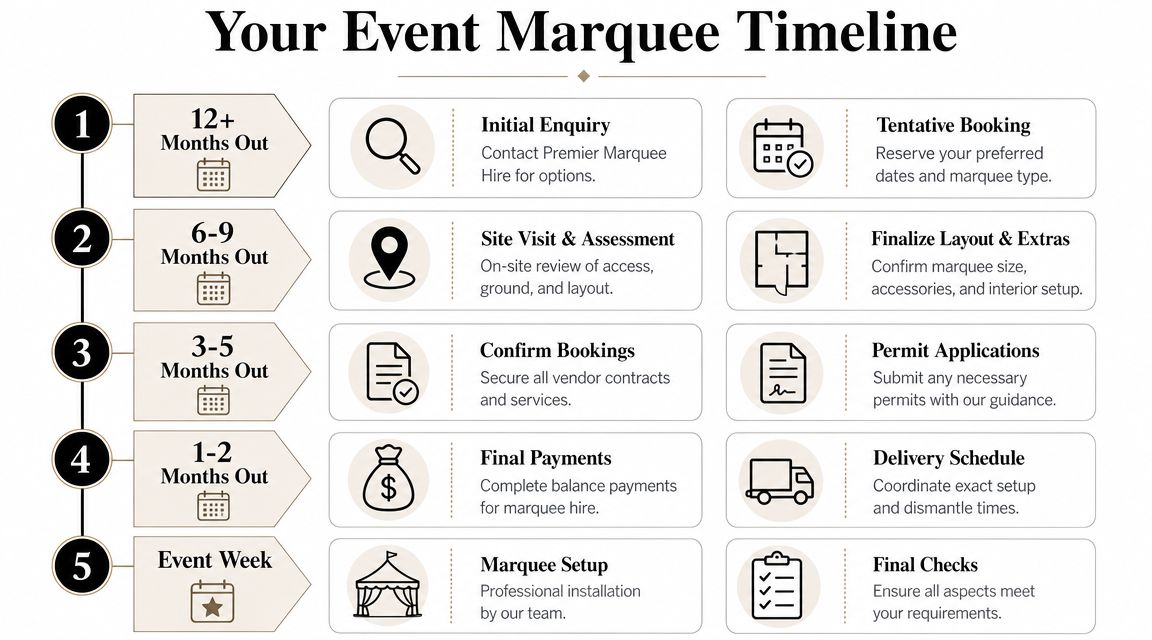
The easiest events to manage are usually the ones that make key decisions early, then tighten the details as the date gets closer. That doesn't mean locking every chair and table months in advance. It means securing the essentials before availability, access, and logistics become more difficult.
A practical planning rhythm
For weddings and high-demand summer dates, it makes sense to enquire early, especially if you need a specific style, a larger structure, or a date that sits in peak season.
A sensible timeline often looks like this:
| Stage | What to do |
|---|---|
| Early planning | Fix the date, event type, rough guest count, and location |
| Next step | Arrange a site visit or send accurate site details and photos |
| Design phase | Confirm likely layout, structure size, flooring, lighting, and core extras |
| Closer to the event | Tighten guest numbers, furniture plan, access details, and timings |
| Final run-in | Confirm the finished layout, delivery schedule, and on-site contacts |
For more complex events, the planning shouldn't stop at size. Many clients start by asking what size tent they need, but a better approach is to consider emergency egress, fire safety, and accessibility from the outset so the event is legal and usable for every guest, as discussed in this overview of permissions, safety, and access considerations.
Questions worth asking before you book
Not every hire company approaches projects the same way. A short conversation can tell you a lot.
Ask things like:
- Do you carry out site visits? If access is tight or the ground is mixed, that matters.
- Will you provide a layout drawing? That helps prevent expensive guesswork.
- What have you allowed for in the quote? Flooring, lighting, delivery, and collection should be clear.
- How do you handle difficult surfaces or restricted access? The answer shows how practical their planning is.
- What do you need from me before installation? Good suppliers are clear about power, access, timings, and final decisions.
What helps you get an accurate quote quickly
The most useful enquiries usually include the basics from the start. If you can provide the event date, venue or postcode, approximate guest numbers, event style, and a few site photos, the initial conversation becomes much more productive.
If the event is at home, photos of the garden, side access, patio, and house connection points are especially useful. If it's at a venue, include any information about access restrictions, setup windows, and whether the marquee is going on grass, hardstanding, or mixed ground.
That lets the installer judge the job properly rather than guessing from a headline description.
The process should feel straightforward
A good marquee quote shouldn't feel like a sales pitch. It should feel like someone has listened to what the event needs, checked whether the site can support it, and translated that into a clear proposal.
That's what most clients want. Not jargon. Not pressure. Just a practical plan that shows what fits, what doesn't, and what the event will require to run properly.
If you're planning an event in Croydon, London, Surrey, or the surrounding counties, Premier Marquee Hire can help you work through the practical side of the setup, from site access and layout to flooring, lighting, and seasonal requirements. Send over your date, location, and a few details about the event, and you can request a pressure-free quote or arrange a site visit to see what will work on your space.
Sorry, the comment form is closed at this time.