

31 May Hire of Marquee in London: Your Complete 2026 Guide
If you're looking into the hire of marquee in London, you're probably already juggling more than one decision at once. You need enough space, you need it to look right, and you need confidence that the garden, venue or open ground will take the structure without last-minute surprises.
This is a common oversight. Planners often begin with guest numbers and Pinterest ideas, when the essential starting point is the site itself. In Croydon and across Greater London, the difference between an easy marquee build and a stressful one usually comes down to access, levels, surrounding obstacles and how the event needs to function on the day.
The Foundation Assessing Your Space and Event Needs
The first serious step is the site survey. Not the marquee style. Not the flooring colour. Not the chair choice.
A marquee only works if the ground, access and layout work first. Guidance aimed at customers often focuses heavily on guest numbers, but it can miss the basic reality that uneven gardens, trees, flowerbeds and access routes all affect layout, and extra clearance is always needed, as noted in this garden marquee guide.
Start with what the site can actually do
A flat open lawn is straightforward. Most London sites aren't.
In Croydon, Purley, Bromley and Wimbledon, it's common to deal with narrow side access, steps, terraced gardens, mature trees, raised beds, sheds, garages and neighbouring boundaries that leave less usable area than the homeowner expected. Church grounds and school sites can be easier in terms of open space, but they often bring their own restrictions around vehicle access and setup times.
A proper survey usually checks:
- Ground levels: A gentle slope might be workable. A pronounced fall across the pitch changes the build plan and the flooring requirements.
- Access route: The marquee doesn't arrive as one neat piece. Sections, framework, flooring, furniture and lighting all need to get from the vehicle to the final position.
- Obstacles overhead and below: Trees, cables, drains, inspection covers, irrigation and buried services all matter.
- Working room around the structure: You need space not just for the marquee footprint, but also for entrances, anchoring, circulation and safe setup.
Practical rule: If a garden looks tight on paper, it's tighter in real life once you allow for doors, guying or anchoring space, walkways, catering support and guest movement.
Define the event before you define the size
A wedding breakfast and a standing drinks reception can use the same site very differently.
For a seated event, think in terms of guest comfort, table spacing, serving routes and where people move once they're inside. For a party, the pressure shifts to bar queues, the dance floor, DJ position, lounge pockets and whether guests can circulate without bunching around the entrance.
That's why the right question isn't only “How many guests?” It's also:
- What's happening inside the marquee?
- Will food be prepared or served from a separate area?
- Do you need a dance floor, stage, bar or photo area?
- Will older guests or children need easier movement and better flooring?
For weddings, this usually becomes clearer when you look at real venue setups rather than abstract dimensions. Browsing examples of venues for marquee weddings often helps people understand how much the setting shapes the final layout.
What works and what usually doesn't
What works is honesty about the site early on. Tight access can still be manageable. Uneven ground can still be manageable. An awkward garden can still host a lovely event. But only if those factors are built into the plan from the start.
What doesn't work is choosing a marquee size first and trying to force the site to fit it afterwards.
Choosing Your Marquee Size and Visualising the Layout
Once the ground and access have been checked, sizing becomes much easier. At that point, you're not guessing. You're working from a site that's been measured properly and an event brief that reflects how people will use the space.
For most smart, flexible event layouts, a clear span marquee is the practical standard. That means a framed structure without internal centre poles interrupting the room. It gives you cleaner sightlines, better flexibility for table plans, and far fewer compromises around dance floors, staging and service areas.
Capacity is only the starting point
People often ask for a capacity chart first, which is fair enough. It gives you a rough planning point. But capacity tables are only useful when paired with the event style.
Here's a simple guide for typical marquee planning conversations.
| Marquee Size (Width x Length) | Standing Guests (Reception) | Seated Guests (Round Tables) |
|---|---|---|
| 3m x 6m | Small reception area | Small dining setup |
| 3m x 9m | Modest standing group | Intimate seated layout |
| 6m x 6m | Comfortable drinks space | Small seated event |
| 6m x 9m | Medium reception | Medium seated layout |
| 6m x 12m | Larger standing event | Larger seated event |
| 9m x 12m | Spacious reception | Wedding and formal dining layout |
| 9m x 15m | Large reception | Large seated event |
| 12m x 18m | Major event space | Large-scale dining and staging |
That table helps frame the conversation, but it won't answer the full question on its own. A marquee that feels generous for a standing evening event can feel cramped once you add round tables, a top table, gift table, dance floor and DJ booth.
The hidden space people forget
Many first-time hirers under-size the structure. They count tables and chairs, but not the supporting areas that make the event comfortable.
The usual forgotten items are:
- Dance floor: Guests need room around it, not just on it.
- Bar area: People gather and queue. It becomes a natural pinch point.
- Catering tent or service zone: Essential if food is being finished or served on site.
- Entrance space: Doors need proper circulation, especially in wet weather.
- Entertainment positions: DJ setups, speakers, live musicians and photo booths all claim floor area.
- Buffet or gift tables: Small on paper, disruptive if squeezed into circulation routes.
A small structure can still work beautifully if the brief is simple. For example, a compact family celebration may suit one of the options discussed in this guide to small marquee hire in London. The key is keeping the layout realistic.
A marquee that is technically big enough isn't always functionally big enough.
Why a CAD layout matters
A CAD layout changes the conversation from guesswork to planning. You can see where the entrance lands, where round tables sit, how far chairs pull back, whether staff can serve comfortably, and whether guests can move from dining to dancing without crossing a bottleneck.
That's especially useful on London sites where the marquee shape may be driven by a boundary line, patio edge or access route rather than an ideal rectangle.
A good layout drawing usually answers questions like these before installation day:
- Will the bar block the main route?
- Can the caterer work without cutting through guest seating?
- Is there a better place for the dance floor?
- Do we need an extra linking section or walkway?
- Would a different table format make the room feel calmer?
That's how marquee sizing should be done. Not as a one-line guest calculator, but as a layout exercise that balances comfort, flow and what the site can realistically support.
Navigating Power Permits and Site Preparation
By the time the marquee size is settled, the focus shifts to the mechanics of turning open ground into a working venue. This is the part many clients worry about because it sounds technical. In practice, it's manageable when handled in the right order.
Power is about load, not guesswork
A simple garden party may run comfortably from a domestic supply if the load is light and the circuits are suitable. Once you add catering equipment, heating, stronger lighting, entertainment or refrigeration, the conversation changes.
The safest approach is to list everything that needs power before making assumptions. That includes:
- Lighting inside and outside the marquee
- Catering equipment
- Bar refrigeration
- Sound equipment and DJ gear
- Heating
- Toilet units if brought in separately
If the event needs more than the site can reliably provide, a generator becomes part of the event infrastructure rather than an optional extra. What matters is stable supply, safe cable routing and proper separation between guest areas and technical equipment.
Larger installs need flexible crews and planning discipline
Marquee work is one of those trades where the visible product is only half the story. The logistics behind it matter just as much.
A UK industry dataset reported that marquee and tent rental businesses ranged from 0 to 11 full-time year-round employees, with a mean of about 3.17, while seasonal teams ranged from 1 to 60 workers, which highlights how much the sector depends on flexible labour for peak-season installs, removals and larger event builds according to this tent rental industry report.
That matters for clients because it explains why larger weddings, festivals, school events and corporate jobs need clear scheduling, proper site access and a team that can scale up when the job requires it. It's also why the hire marquee process should include logistics planning, not just a product list. This is covered well in practical terms in this guide to hire marquee.
Permissions and prep on your side
For many private residential events, formal permission may not become a major issue, but you can't assume the answer is always simple. Leasehold properties, managed estates, listed settings, public land, school grounds and some venue rules can all affect what's allowed.
The sensible route is to confirm early if any of these apply:
- Property restrictions such as lease or management rules
- Venue conditions about installation dates, vehicle movements or anchoring
- Local requirements if the event sits on non-domestic or shared land
Ask about permissions before you commit to suppliers, not after the layout has been signed off.
Site preparation on the client side is usually straightforward. Clear the area, remove movable garden items, confirm gates can open fully, keep pets and children away during build periods, and tell the marquee company anything unusual about the property before the crew arrives.
That preparation saves time and avoids awkward surprises on the day.
Creating the Perfect Atmosphere Inside Your Marquee
A marquee starts as a structure. It becomes a venue once the layers go in.
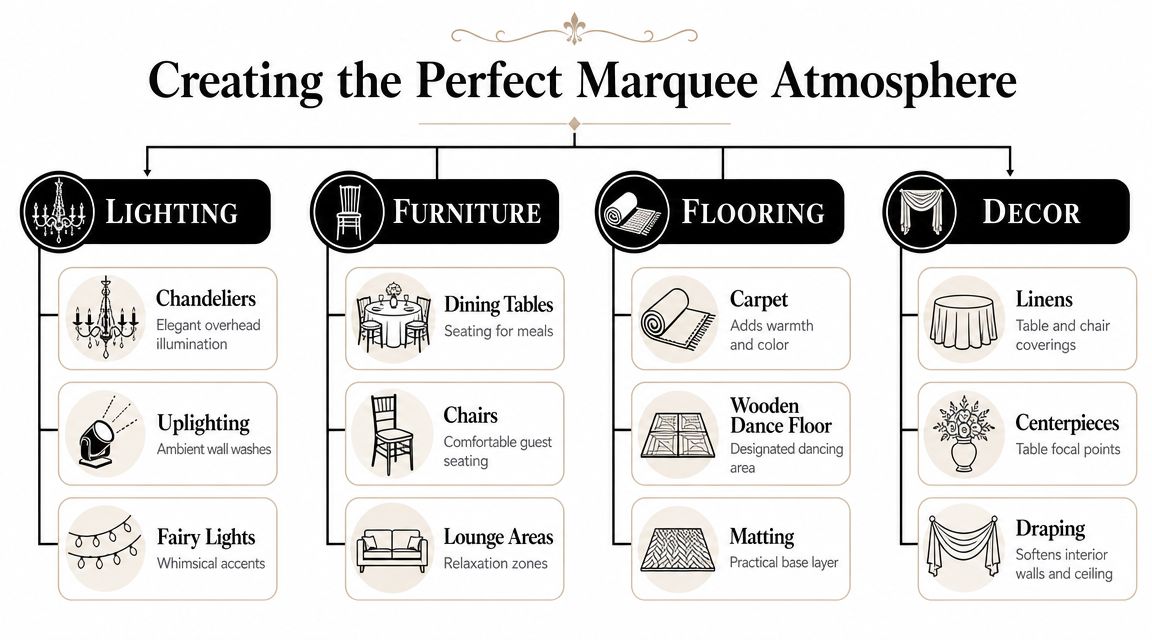
The biggest change usually comes from three things working together: flooring underfoot, lighting overhead and furniture that suits the tone of the event. Get those right and even a plain garden can feel polished by the time guests walk in.
Flooring changes the feel immediately
Flooring isn't only about appearance. It affects comfort, stability and whether the marquee feels temporary or fully finished.
On a casual summer setup, matting can be enough for a walkway or a light-use area. For weddings, formal dining and evening parties, a solid floor creates a completely different experience. Chairs sit properly, tables level out better, heels don't sink, and guests feel more relaxed moving around.
In practice, the decision often comes down to the site:
- Good, even ground can work with lighter flooring options for simpler events.
- Mixed or uneven ground usually benefits from a stronger floor build.
- Dining and dancing nearly always justify a more finished interior surface.
Furniture should match the event, not just fill the room
A corporate hospitality space wants a different rhythm from a family party. A Mehndi setup wants different zoning from a wedding breakfast. A school celebration needs circulation and practicality before styling.
That's why furniture selection should serve the event first. Trestle tables are efficient and useful in catering, buffet and back-of-house areas. Round dining tables soften the room for weddings and formal gatherings. Chiavari chairs change the visual tone immediately if the aim is elegant dining rather than straightforward seating.
For a more relaxed room, lounge corners and poseur tables can stop everyone clustering around the edges.
A useful extra for guest interaction is something beyond the standard guest book. If you want a more visual record of the day, this guide on how to create a guest photo book for events gives a practical idea that works well alongside a photo area or mirror booth.
To see how lighting and interior finishing can shift the mood, this short video gives a useful visual reference:
Lighting does more than illuminate
Good marquee lighting creates zones. It tells guests where to dine, where to gather, where to dance and where to pause.
Common combinations include:
- Warm overhead lighting for the main dining area
- Uplighting to soften the structure and stop the walls feeling flat
- Fairy lights or feature lights for atmosphere later in the evening
- Focused lighting at the bar, entrance and cake or display tables
A marquee rarely feels finished under one type of light. The best interiors use layers.
Weatherproofing is part of the atmosphere too
A comfortable marquee always feels better styled because guests aren't distracted by being cold, damp or squeezed.
Commercial-grade structures, secure anchoring, proper sidewalls and sensible heating make a big difference in cooler months or changeable weather. Winter functions can work very well when the heating plan is realistic and the entrance design stops draughts from cutting straight through the room.
Premier Marquee Hire, for example, provides marquees alongside flooring, furniture, lighting, mobile bar units and features such as a Magic Mirror photo booth, which is useful when you want the marquee and the extras planned as one working setup rather than as disconnected hire items.
Your Booking Timeline and Budgeting for a London Event
The two questions clients usually ask early are simple enough. When should I book? And what affects the price?
In London, both questions matter because availability tightens quickly once peak dates start filling and because quotes can look similar at a glance while including very different levels of planning, equipment and site support.
Book early if the date matters
For weddings and peak summer Saturdays, earlier is safer. For sizeable private parties, school events and company functions, a shorter lead time can still work, but options narrow as the date gets closer.
The practical reason is simple. The UK marquee hire market is a mature industry with over 260 major companies tracked by Plimsoll in its UK marquee and tent hire market report. That tells you this isn't an informal sideline sector. It's a competitive professional market where quality, logistics and availability all matter.
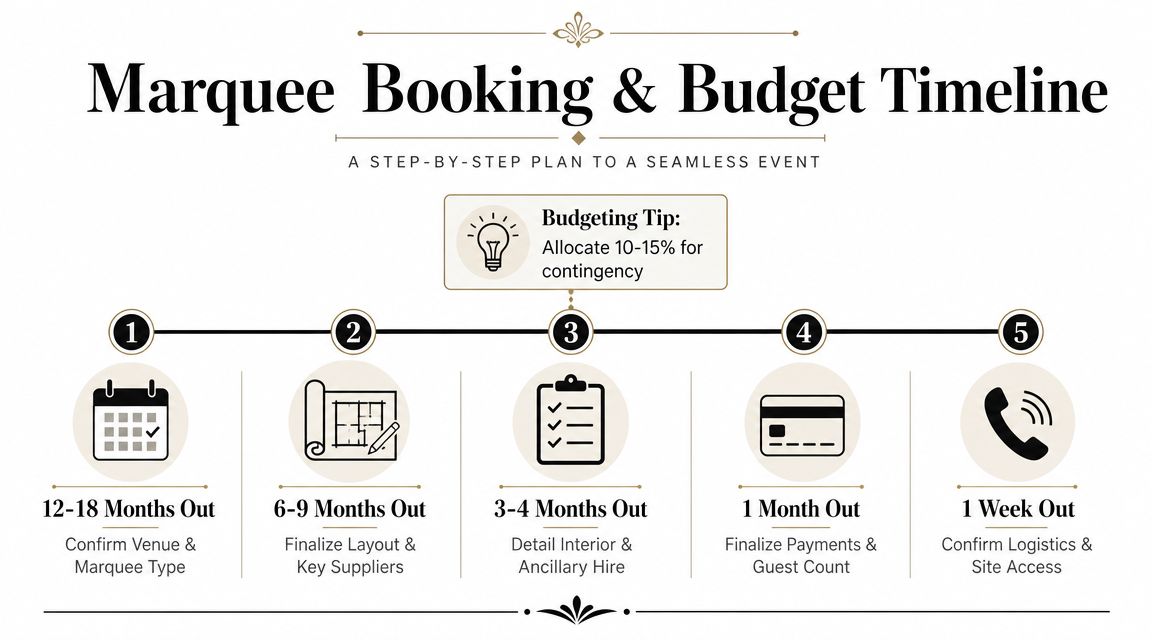
A useful planning rhythm looks like this:
- Well ahead of the event: confirm the date, site and broad marquee requirement
- After the first planning stage: settle the layout, flooring, furniture and any linked structures
- Closer to the day: confirm guest numbers, catering plan, power needs and final timings
- Final week: check access, contacts and site readiness
If you're trying to keep spending under control while planning those stages, this article with expert advice for event budgeting is a sensible companion read because it helps organise decisions before costs creep in through small additions.
What a quote usually includes and what changes it
The base price for the hire of marquee typically covers the structure itself and the core installation. After that, price moves according to the event brief and the site.
The biggest cost drivers are usually:
| Cost factor | Why it changes the quote |
|---|---|
| Marquee size and shape | Larger or more complex layouts use more equipment and labour |
| Ground conditions | Slopes, soft ground or difficult surfaces can affect build complexity |
| Access | Narrow or awkward access increases handling time |
| Flooring | Basic matting and solid subfloors are very different jobs |
| Interior hire | Tables, chairs, lighting, linings and bars all add layers |
| Event infrastructure | Heating, generators, toilets and catering support expand the scope |
What often catches people out is that a cheap quote can leave out exactly the things that make the event workable. Flooring may be omitted. Power distribution may be assumed. Delivery windows may be too tight. Site visits may not be included. The structure may be priced without enough consideration for how guests will use it.
Where to save and where not to
There are sensible ways to trim a budget. Off-peak dates often open up more flexibility. Simpler table formats can reduce space pressure. A cleaner layout can sometimes remove the need for an extension section or separate annex.
Where clients usually regret cutting back is on the parts that affect comfort and reliability. Flooring, proper lighting, realistic weather protection and enough setup time are not decorative extras. They're what make the event feel organised.
That's why transparent pricing is more useful than bargain pricing. In a market this established, the value sits in the planning and delivery as much as the marquee itself.
The Pre-Installation Checklist and What to Expect on the Day
By the final week, the planning should feel settled. If it doesn't, the answer usually isn't to add more things. It's to confirm the basics and remove uncertainty.
The smoothest installs happen when the site is ready, the layout is locked, and everyone knows who the point of contact is on the day.
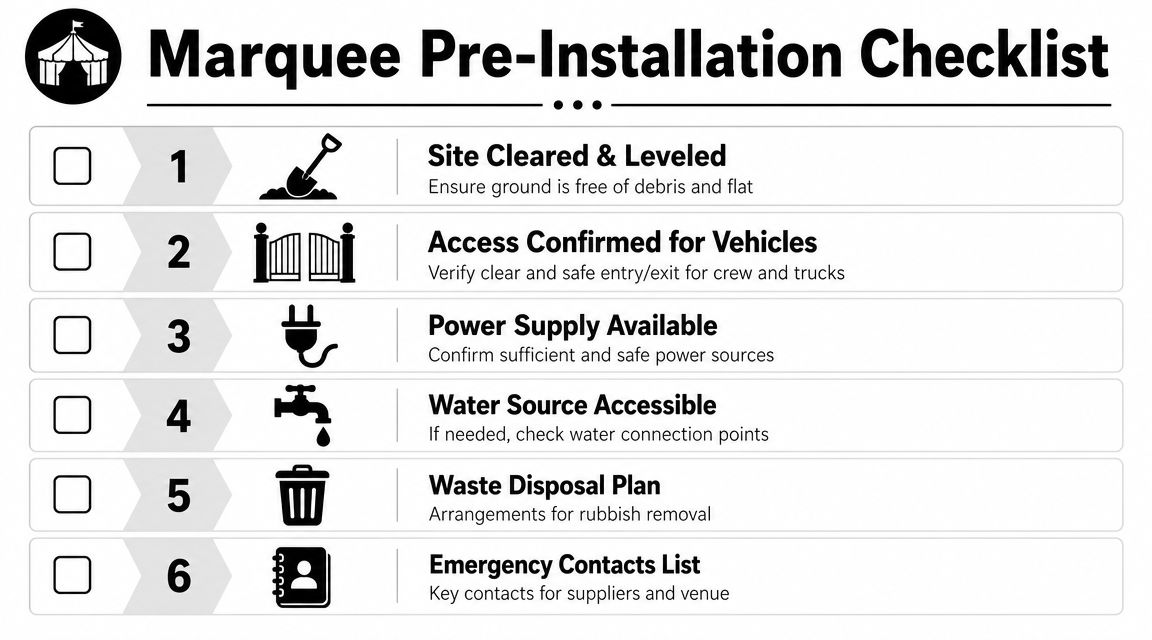
Your final checks before the crew arrives
Run through these practical points in the days before installation:
- Clear the pitch area so garden furniture, planters, toys and loose items are out of the way.
- Confirm access for vans, crew routes and any keys or gate codes needed.
- Lock the layout so table numbers, dance floor position and bar location aren't still moving.
- Review power and supplier timing if DJs, caterers or toilet providers are also attending site.
- Nominate one decision-maker who can answer questions quickly during the build.
For larger or more complex event coordination, this guide to step-by-step event planning for professionals is useful because it shows how small logistics decisions affect the whole event day.
What installation day usually feels like
A professional marquee build should look organised, not chaotic.
The team arrives, checks the site against the plan, unloads in sequence and builds methodically. On a residential job, tidy working matters. Pathways should be respected, materials should be stacked sensibly, and the crew should keep the site as controlled as possible while the structure goes up.
The handover matters as much as the build. Walk the marquee before the crew leaves, check lighting, entrances, flooring and any agreed equipment.
What to expect at the end
Before sign-off, make sure you know:
- How the interior has been set
- Where the power points or cable routes are
- What stays switched on or off before the event
- Who to contact if something needs attention
- When collection will take place after the event
That final walkthrough gives peace of mind. By then, the marquee should no longer feel like a hire item dropped onto a lawn. It should feel like a venue that's ready to host people properly.
If you're planning an event in Croydon, London or the surrounding counties and want practical advice before making any decisions, contact Premier Marquee Hire for a free, no-pressure site survey and quotation.
Sorry, the comment form is closed at this time.