


21 Jun Luxury Marquee Hire London: Plan Your 2026 Event
You're probably starting from the same place most London clients do. You've got a date in mind, a guest list that keeps changing, and a clear sense that a hotel ballroom or fixed venue doesn't quite fit what you want. You need something more personal, more flexible, and better suited to the way your event will run.
That's where luxury marquee hire in London becomes useful. Not because it looks good in photographs, although it does, but because it lets you build the venue around the event instead of squeezing the event into someone else's room. For a wedding in Wimbledon, a corporate launch in Bromley, or a family celebration in Croydon, that flexibility matters more than many realise at the start.
The practical side matters just as much as the styling. A marquee has to suit the site, the season, the guest count, the access, and the way people will move through the space. If one of those is off, the event can still go ahead, but it won't feel effortless. When all of it is planned properly, a marquee stops feeling temporary and starts feeling like a purpose-built venue.
Your Vision Your Venue An Introduction to Luxury Marquees
A luxury marquee isn't just a cover over a lawn. It's a bespoke event structure that can be shaped around your guest numbers, catering plans, entertainment, and site restrictions. That's why it suits London so well. Across Greater London, venues often come with compromises. Limited dates, strict supplier lists, awkward layouts, short access windows, or neighbours close by. A marquee gives you far more control.
For weddings and private celebrations, that usually means freedom over the atmosphere. You can create a formal dining layout, a relaxed lounge-style reception, or something that blends both. For business events, it means you can build a branded space around the way the day works, whether that involves presentations, hospitality, dining, or guest circulation between zones.
Why marquees work so well in London
London clients often need a venue solution that can adapt to very different settings:
- Residential gardens in places like Purley, Sutton, or Wimbledon where space is valuable and access can be tight
- Venue grounds where the marquee needs to sit alongside an existing building
- Corporate sites that need clear guest flow, catering space, and a polished finish
- Religious and community events where capacity, weather cover, and practical layout matter as much as appearance
A good marquee plan starts with the site and the event brief together. It doesn't start with fabric swatches.
A luxury marquee should solve problems before it starts adding style.
That's the main difference between a quick hire and a properly planned installation. The shell matters, but so do flooring, heating, lighting, access, setup time, and how the structure sits within the space. In London, especially across Croydon and the surrounding boroughs, those details usually decide whether the event feels calm or stressful.
What clients often underestimate
The biggest misunderstanding is that marquee hire is similar to hiring a simple tent. It isn't. Once you move into the luxury end of the market, you're effectively commissioning an event environment. That's why early decisions on size, structure, and logistics are so important. If you get those right, the styling becomes much easier, and the end result feels polished rather than patched together.
Choosing Your Marquee Style and Structure
When clients say they want a luxury marquee, they're often talking about the finish. What matters first is the structure. The frame determines how much uninterrupted usable space you have, how efficiently the interior works, and how easily the build can adapt to the site.
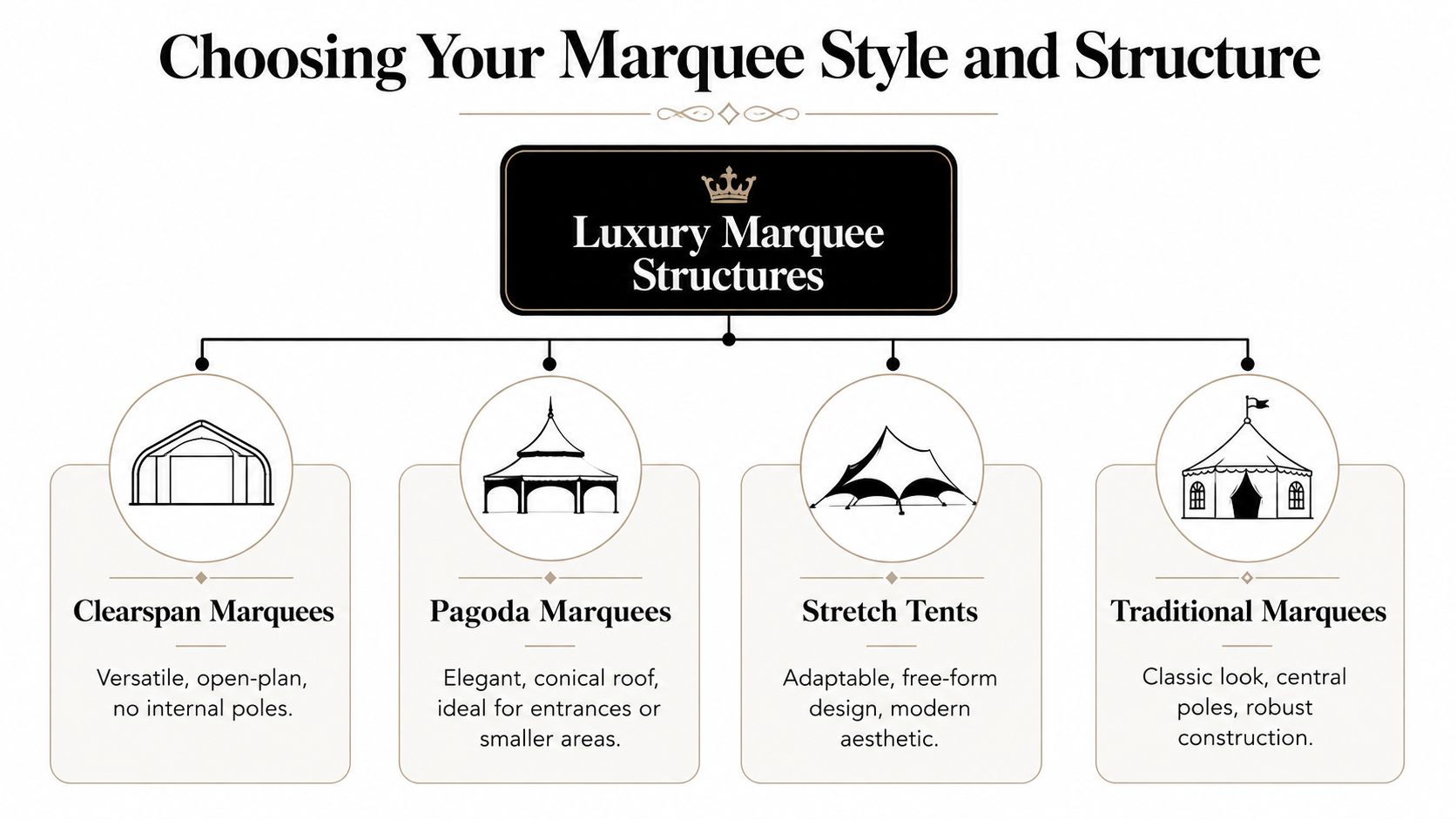
In practice, modern London events usually favour clearspan frame marquees because they give you an open-plan interior with no central poles. That makes a real difference once you start placing dining tables, dance floors, bars, staging, or lounge furniture. You're not designing around obstructions. You're designing from a blank floorplate.
The structures you're most likely to consider
A few marquee styles come up regularly in London planning conversations, but they don't all solve the same problem.
| Structure | Best use | Main trade-off |
|---|---|---|
| Clearspan | Weddings, corporate events, large garden functions | More technical planning needed on tight sites |
| Pagoda | Entrances, cover links, reception points, smaller hospitality areas | Usually works better as part of a wider setup than a main event space |
| Stretch tent | Informal layouts, modern outdoor entertaining | Site shape and weather expectations need careful thought |
| Traditional marquee | Classic appearance for certain settings | Internal poles affect layout flexibility |
If you want an open interior and predictable planning, clearspan is usually the strongest option. If you're comparing formats, this guide to a clearspan marquee is useful because it shows how that structure suits events that need both flexibility and a more polished finish.
How modular sizing actually works
The easiest way to think about marquee sizing is like building blocks. According to Field and Lawn's guide to corporate marquee hire, modular frame structures are typically specified in 3m width increments and 3m length increments, with smaller event builds often starting from 3m to 9m wide and larger spans reaching 30m, with example footprints such as 12m x 45m.
That matters because width and length do different jobs.
- Width controls layout efficiency. It affects whether you can run full dining rows, side service space, or a central aisle comfortably.
- Length lets the structure grow without changing the basic frame logic. That helps when guest numbers rise or when you need to add a bar, cloakroom area, or catering zone.
- Modularity improves predictability. On awkward London sites, that can reduce the need for overly bespoke structural changes.
Practical rule: choose the width for how the event needs to function, then use the length to scale capacity.
What works and what doesn't
What works is selecting a structure around the event flow. What doesn't work is choosing a style because it looks attractive online and trying to make the logistics fit afterwards.
A compact Croydon garden may suit a narrower frame with carefully planned length. A larger wedding on venue grounds may need a wider span to avoid a long, tunnel-like feel. For entrances, caterer cover, or linked breakout areas, smaller complementary structures can make the main marquee work better rather than bigger.
Luxury starts with the engineering being right. The décor only lands properly once the structure does.
Mastering Capacity Planning and Layout Design
“How big does the marquee need to be?” is usually the first serious planning question. It sounds simple, but the honest answer depends on how your guests will use the space, not just how many of them are attending.
A drinks reception, a seated wedding breakfast, and a corporate networking event all place different demands on the same floor area. The numbers matter, but the layout matters just as much. A marquee that technically fits the guest list can still feel cramped if there's nowhere for staff to move, nowhere for guests to queue at the bar, or no proper circulation around tables.
Start with the benchmark, then add function
A useful industry guide from Abacus Marquee Hire on marquee capacity gives a practical rule of 0.6m² per standing guest and about 1m² per seated guest. Using that benchmark, a 6m x 12m marquee, which is 72m², can hold roughly 120 standing guests or 72 seated guests. The same guidance also makes an important point: extra space is needed beyond the raw headcount for functional areas.
That last part is where many plans go wrong.
A guest count is not a floor plan
Two events with the same attendance can need very different footprints.
A standing reception may only need open social space, a bar, and some poseur tables. A formal wedding usually needs:
- Dining space for tables and chairs
- Service space so staff can move cleanly between tables
- Entertainment space for a dance floor, DJ, band, or stage
- Support zones such as gift tables, cake display, cloak area, or photo point
If you add any of those late in the process, the marquee often has to grow. That isn't poor planning. It's the normal reality of turning a guest count into a functioning venue.
Why layout comfort matters more than theoretical maximums
A marquee can be packed tightly on paper. That rarely feels luxurious in real life.
For London events, especially on residential sites, clients often try to hold the structure as compact as possible. That can be sensible, but only if the internal plan still breathes. Guests remember whether they could move easily, whether queues formed at the bar, and whether the room felt balanced. They don't remember that the supplier saved a few square metres.
A scaled floor plan solves this early. CAD layouts are useful because they show where the pressure points are before installation day. You can see whether the dance floor pinches circulation, whether the top table crowds the side wall, or whether catering access cuts through the guest experience.
If the layout only works when every chair is tucked in and nobody is standing, it doesn't work.
The strongest marquee plans aren't just the ones that fit the numbers. They're the ones that give the event rhythm. Arrival space, dining space, social space, and service space all need room to operate without fighting each other.
Deconstructing Luxury Marquee Hire Costs in London
The price question is fair, and it's better answered plainly. Luxury marquee hire in London isn't priced like hiring a simple shelter because you're not hiring a simple shelter. You're assembling the physical infrastructure of an event, often on a blank site, and that includes far more than the roof and frame.
Clients usually start by asking what the marquee costs. The more useful question is what the full setup will cost once the event is workable and comfortable. That's where budget expectations become more realistic.
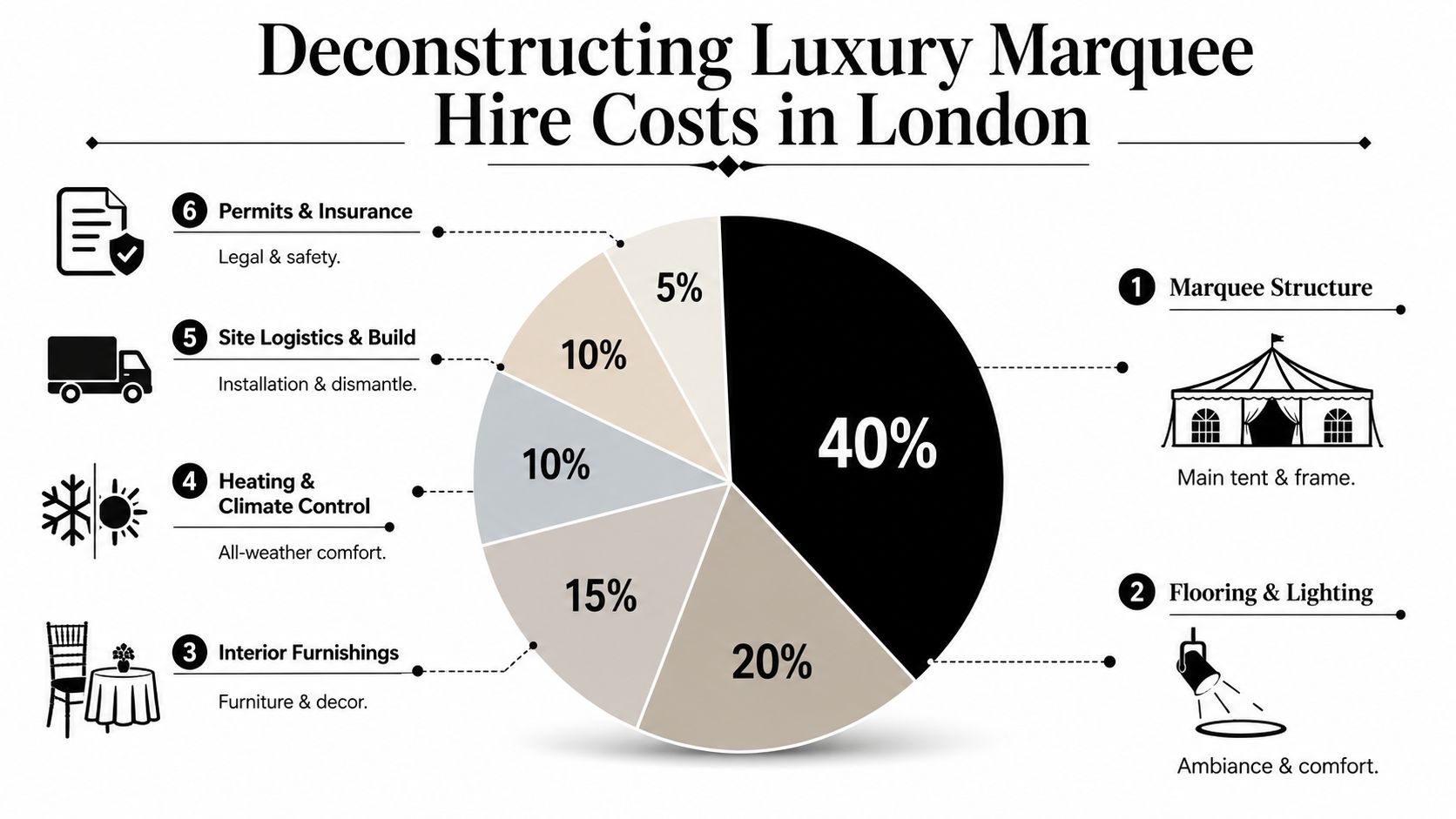
A useful visual can help you think about where spend tends to sit within a full setup.
What the market figures actually tell you
According to Bridebook's guide to wedding marquee costs, the average UK marquee-hire spend is £4,633. The same guide says marquee hire itself typically falls in the £3,000 to £15,000+ range depending on size, style, and location, and once essentials such as furniture hire, toilets, power, staffing, and décor are added, a fully set-up marquee wedding often totals £15,000 to £35,000+.
Bridebook also gives useful planning benchmarks by guest count:
- 50 guests often fall in the £3,000 to £6,000 range
- 80 to 100 guests often fall in the £5,000 to £10,000 range
- 120+ guests often fall in the £8,000 to £15,000+ range
That's why a luxury marquee in London is usually best understood as a full event infrastructure purchase rather than a tent rental.
For a closer look at how suppliers package and price different elements, this guide to prices for marquee hire is a useful starting point when you're comparing quotes.
Where budgets usually shift
The main cost drivers are rarely surprising, but they do add up quickly when they're not discussed early.
| Cost area | Why it changes the price |
|---|---|
| Structure size | Bigger spans and longer footprints increase the base build |
| Flooring | Basic ground cover and solid sub-flooring are very different things |
| Interior finish | Linings, draping, and upgraded lighting change the overall look and feel |
| Climate control | Heating becomes important in colder months and larger volumes |
| Site logistics | Difficult access, complex builds, and longer install times increase labour and planning |
This short video gives a useful general look at the kind of thinking that goes into marquee pricing and setup.
What works when you're budgeting
The best approach is to budget for the event experience you want, not just the shell you can afford. If guests need heating, proper flooring, a bar area, toilets, lighting, and room to move, those aren't optional luxuries. They're part of making the marquee function as a venue.
What doesn't work is chasing the lowest base quote and discovering later that the practical essentials sit outside it. A sensible quote should make it clear what is included, what is optional, and what may depend on the site.
Essential Accessories From Flooring to Furniture
An empty marquee can look larger than it will feel on event day. Once the floor goes in, the lighting is rigged, the tables are dressed, and the bar is built, the space changes completely. That's why accessories shouldn't be treated as last-minute add-ons. They are the parts that turn a structure into a venue your guests enjoy spending time in.
The transformation usually starts from the ground up. A bare grass surface might be acceptable for a very casual summer gathering, but it doesn't create the feel most clients mean when they ask for luxury marquee hire in London. A proper floor changes the whole experience. Guests walk in more confidently, furniture sits correctly, and the marquee immediately feels more settled.
If you're comparing floor options, this guide on flooring for a marquee is helpful because the flooring choice affects comfort, appearance, and how well the marquee performs in poorer weather.
How the marquee changes as each layer goes in
The easiest way to understand accessories is to think about the build in stages.
First comes the floor. This is the point where the marquee stops feeling like a temporary cover and starts behaving like a room. If the ground has minor unevenness, the floor helps create a more stable event surface. It also provides a better base for carpets, dance floors, dining furniture, and service routes.
Then comes the light. Good lighting does two jobs at once. It shapes the mood for guests, and it helps staff work properly. Soft interior lighting can make a wedding feel warm and elegant. Brighter functional lighting is often needed around entrances, service areas, and pathways.
The most convincing luxury setups are usually the ones where practical items have been integrated so well that guests barely notice them.
The details that lift the finish
Furniture is where the style becomes visible. The structure may be impressive, but guests interact with chairs, tables, bars, and lounge areas throughout the event. If those details don't match the brief, the marquee can feel incomplete.
A strong setup often includes a mix of elements rather than one furniture type repeated everywhere:
- Dining furniture that suits the formality of the event
- Feature seating for top tables, lounges, or statement areas
- Bar units that help the room feel hosted rather than improvised
- Entertainment features such as photo areas or decorative focal points
Climate control sits slightly differently because people only notice it when it's wrong. On a cool evening, a marquee with poor heating or draughty flooring becomes uncomfortable quickly. With the right setup, guests stay relaxed and carry on enjoying themselves.
What works and what feels unfinished
A cohesive marquee usually has the accessories chosen as one package. Flooring, lighting, furniture, and heating all support the same event style. What often feels unfinished is a beautiful shell paired with purely functional fittings that don't match the brief.
That doesn't mean every event needs maximum decoration. It means the practical items should still feel deliberate. A clean, well-lit marquee with solid flooring and carefully selected furniture will always feel more luxurious than a heavily decorated space that hasn't dealt properly with comfort and flow.
Planning a Winter Marquee Event in London
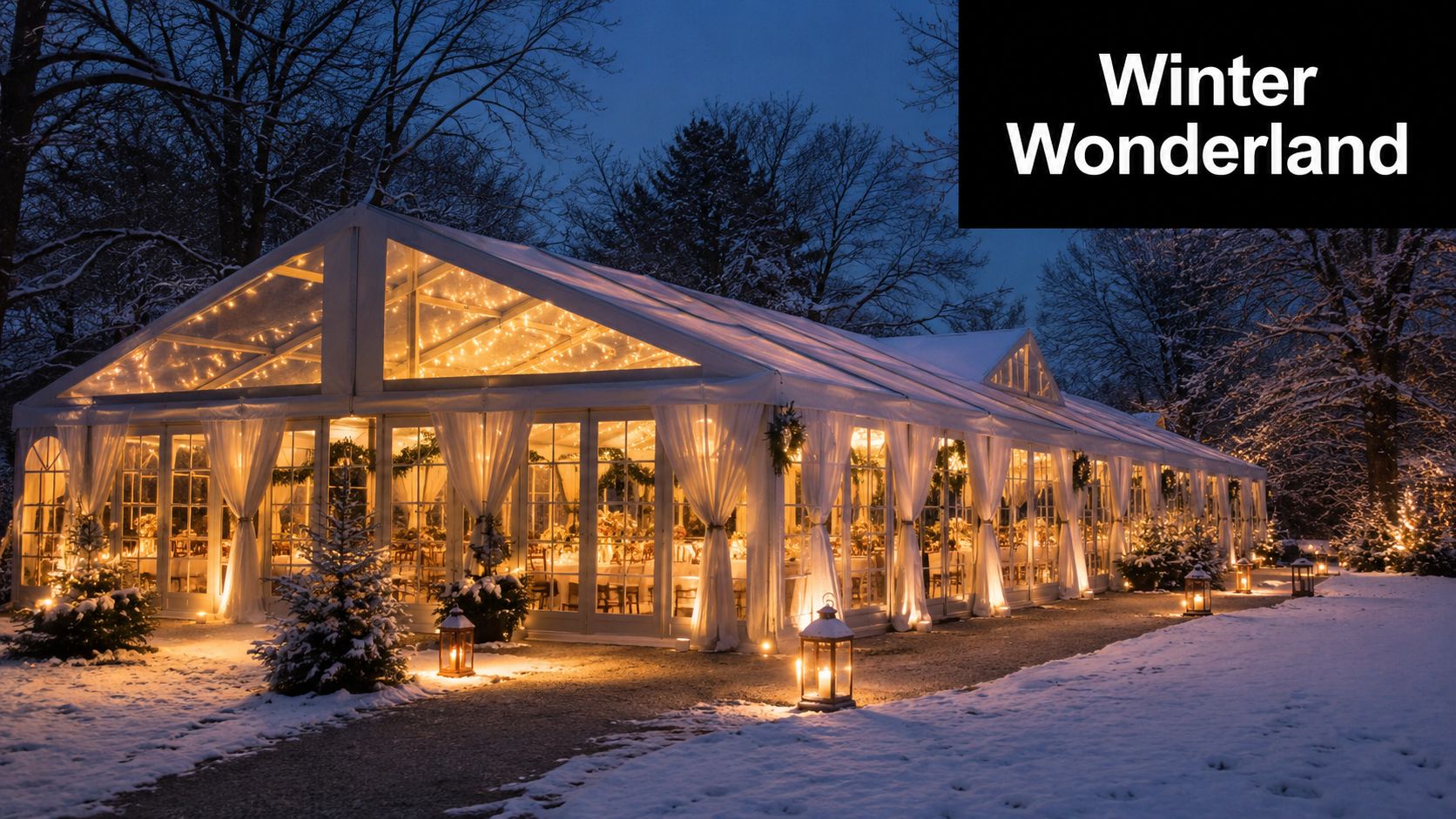
A lot of clients still assume marquees are mainly for summer. That's understandable, but it's not really how modern event structures should be judged. A winter marquee can work beautifully in London, but only if the planning is technical as well as decorative.
The phrase “all-weather” gets used too loosely in this industry. What most clients actually want to know is much more specific. Will the structure stay comfortable during cold, wet conditions? Will the floor feel solid underfoot after rain? Will guests need coats all evening? Those are the right questions.
What clients should ask about winter performance
One of the biggest gaps in marquee marketing is the lack of technical reassurance. The verified planning point here is straightforward: a critical unanswered question is how marquees handle London winters. UK Met Office data shows frequent rainy days and high winds in Q4, yet many hire companies don't provide specific information on structural performance, insulation levels, or heating capacity in kW per m². That leaves clients trying to make an expensive decision on trust alone.
That's why winter planning should focus on practical questions such as:
- How is the marquee sealed and floored
- What kind of lining or internal finish helps retain warmth
- How is heating matched to marquee size and external conditions
- How are entrances managed so heat isn't constantly lost
- What changes if the site is exposed or waterlogged
If a supplier only says “it'll be fine in winter”, that isn't enough.
The parts that make winter events comfortable
Winter success usually comes from layers working together. The structure is only one part of it.
A solid, properly installed floor is often the first comfort upgrade. It creates a better barrier from the cold ground and gives the heating a more controlled space to work with. Without that, even a well-heated marquee can still feel cold underfoot and unsettled around the edges.
Linings and interior finishes also matter because they soften the inside of the structure and help create a warmer feel. Guests respond to that psychologically as much as physically. A lined marquee with good lighting and stable heating feels intentional. A bare interior in winter feels temporary.
Then there's heating design. Heating shouldn't be treated as a single box added near the entrance. It needs to suit the marquee volume, the season, and the way the event will be used. A seated dinner, where guests remain in place for long periods, needs a different comfort level from a standing reception with more movement and body heat.
Winter marquee planning isn't about proving a structure can survive the weather. It's about making the guests forget about the weather.
What works and what doesn't in London winter setups
What works is building winter resilience into the plan from the start. That means proper flooring, sensible access points, suitable heating, and realistic expectations about the site. It also means checking whether caterers, entertainers, and service staff have the practical support they need in colder conditions.
What doesn't work is treating a winter marquee like a summer setup with heaters added later. That approach usually leaves weak points around entrances, comfort, and condensation management. A winter event can feel striking, warm, and polished, but only when the planning is done with the season in mind rather than against it.
The Importance of a Site Survey and Navigating London Logistics
The site survey is where marquee planning becomes real. Until someone has looked properly at the ground, access route, surrounding obstacles, and working space, any quote is still provisional in spirit, even if it looks detailed on paper.
This matters more in London than many clients expect. Across Croydon, Sutton, Wimbledon, Bromley, and other residential areas, the issue often isn't whether the marquee can fit in the garden. It's whether the structure, flooring, equipment, and crew can get there safely and efficiently in the first place.
The hidden issues that affect the build
A major underserved issue in the market is the logistical complexity of installing large marquees on constrained residential sites. Clients regularly ask about extra costs for crane access or ground matting where access points are under 3m, yet many marketing pages barely mention those realities at all.
The site survey needs to answer practical questions such as:
- Access width. Can the build team move frame sections, flooring, and interior equipment to the installation area without damaging walls, paving, or planting?
- Overhead restrictions. Trees, cables, and rooflines can all affect how sections are carried and assembled.
- Ground condition. Slopes, soft patches, drains, and hidden service runs all change the installation method.
- Working room. Even if the finished marquee footprint fits neatly, the team still needs enough space to build it safely.
For clients planning Mehndi events or larger family celebrations in London gardens, this is often the make-or-break stage. The guest count may be achievable on paper, but the build route may be the actual constraint.
Why a survey usually saves money rather than adding cost
People sometimes worry that a site visit is just a formal step before the sales process. In reality, it's usually a cost-control exercise. Problems found early are easier to price, plan, and solve. Problems discovered during installation tend to create delays, extra labour, and awkward compromises.
A proper survey can reveal whether you'll need alternative equipment handling, protective matting, different orientation of the marquee, or staged installation. It also helps identify where clients may need to think about neighbours, parking, timing, or local site rules.
For a wider look at operational thinking around health and safety for events, that resource is worth reading because it explains the wider discipline behind safe event planning, not just the visual side clients see on the day.
A good site survey doesn't just confirm what's possible. It shows what will work cleanly.
What a professional survey should cover
A useful survey should lead to clear answers, not vague reassurance. You should come away understanding:
| Survey topic | Why it matters |
|---|---|
| Build access | Determines whether standard installation is possible |
| Ground and levels | Affects flooring, stability, and comfort |
| Utilities and obstacles | Prevents clashes with drains, pipes, trees, and cables |
| Setup and dismantle timing | Helps manage neighbours, venue rules, and staffing |
| Event layout position | Ensures entrances, catering routes, and guest flow make sense |
What doesn't work is skipping the survey because the site “looks straightforward”. London gardens often look straightforward from the patio. The access route and hidden services usually tell a more complicated story.
Your Final Checklist and Frequently Asked Questions
By this point, most of the important marquee decisions come down to judgment. Not just style, but whether the company you speak to understands layout, access, weather, and the realities of London sites. That's why the final checklist should focus less on brochure language and more on how a supplier thinks.
Questions worth asking before you book
Are you planning the marquee around my event, or just matching me to a standard size?
A good answer should refer to guest flow, layout, site limits, and how the marquee will be used. If the discussion stays too general, the planning may still be too shallow.
Have you considered access as seriously as capacity?
This matters especially for homes in Croydon and the surrounding boroughs. A structure that fits the lawn still has to be delivered, carried, assembled, furnished, and removed.
What is included in the quote, and what depends on the site?
That question often reveals how transparent the supplier is. Flooring, heating, lighting, furniture, and logistics should be discussed clearly. Grey areas are where budgets usually drift.
How do you approach winter or poor-weather events?
You're not looking for vague confidence. You're looking for practical answers about flooring, heating, comfort, and how the build changes with the season.
Why local knowledge still matters
A Croydon-based company usually brings an advantage that's easy to underestimate. Local teams tend to understand the character of London sites better because they work in them regularly. Residential access, borough parking pressures, narrow side returns, mixed ground conditions, and venue constraints aren't unusual to them. They're part of day-to-day planning.
That local understanding can make communication simpler as well. If you're organising an event while managing work, family, or wedding planning at the same time, you don't want to spend weeks clarifying the basics. You want straightforward answers and realistic options.
A simple booking checklist
Before you confirm a marquee hire company, make sure you can answer yes to most of these:
- The structure suits the event type rather than just the headcount
- The layout has been thought through with dining, bar, entertainment, and circulation in mind
- The site has been properly assessed for access and ground conditions
- Seasonal comfort has been discussed if the event is outside the warmest months
- The quote is clear on inclusions, options, and likely site-based extras
One provider that offers free site visits, pressure-free quotations, and CAD layout designs for London events is Premier Marquee Hire. That kind of process is useful because it gives clients a clearer view of fit, flow, and practicality before committing.
Common final questions
How far in advance should you enquire?
As early as you reasonably can. Popular dates, larger builds, and more complex London sites all benefit from more planning time.
Do you need a huge garden for a luxury marquee?
Not always. Some of the most successful installations are on compact sites with a smart layout and realistic expectations about access.
Is luxury marquee hire in London only for weddings?
No. It also works well for milestone birthdays, corporate hospitality, pre-wedding functions, religious celebrations, and community events.
What's the clearest sign that a supplier knows what they're doing?
They ask detailed questions early. Not just about dates and guest numbers, but about the site, access, timings, and how the day will run.
If you're planning an event and want practical advice rather than guesswork, Premier Marquee Hire is a sensible place to start. A clear conversation, a site survey, and a detailed quote will tell you very quickly what's possible on your site and what setup will suit your event properly.
Sorry, the comment form is closed at this time.