

15 Oct How to Hire Marquee Heaters Safely in Croydon
You've spent months planning the marquee, catering, lighting and seating for an evening celebration in Croydon. The forecast looked mild when you booked the venue, but the sun has gone down, guests are arriving in formal clothes, and the first question is no longer whether the décor looks right. It's whether everyone will be comfortable.
Hiring a marquee heater isn't just a matter of choosing the largest unit available. The right system depends on the structure, ventilation, power supply, fuel route, entrances, flooring, wind exposure and the way people will move through the space. This matters for winter weddings, spring and autumn receptions, Mehndi celebrations, corporate events and community gatherings across Croydon, Surrey, Middlesex, Kent and the wider South East.
Why Heating a Marquee Is More Than Switching On a Heater
By the time the evening turns cold, it is too late to discover the warm patch is only near the dancefloor and the tables by the entrance are sitting in a draught. I see this on South East sites all the time. A heater can be running properly and the marquee can still feel uncomfortable because the heat is in the wrong place, the doors are opening every few minutes, or a lining, partition or bar build has interrupted the airflow.
Comfort comes from controlled distribution, not just output. A marquee does not hold heat like a fixed building. The floor, roof height, sidewalls, door positions and internal layout all change how warm air moves. An open-sided summer setup behaves very differently from a sealed winter structure, even when the footprint looks similar on paper.
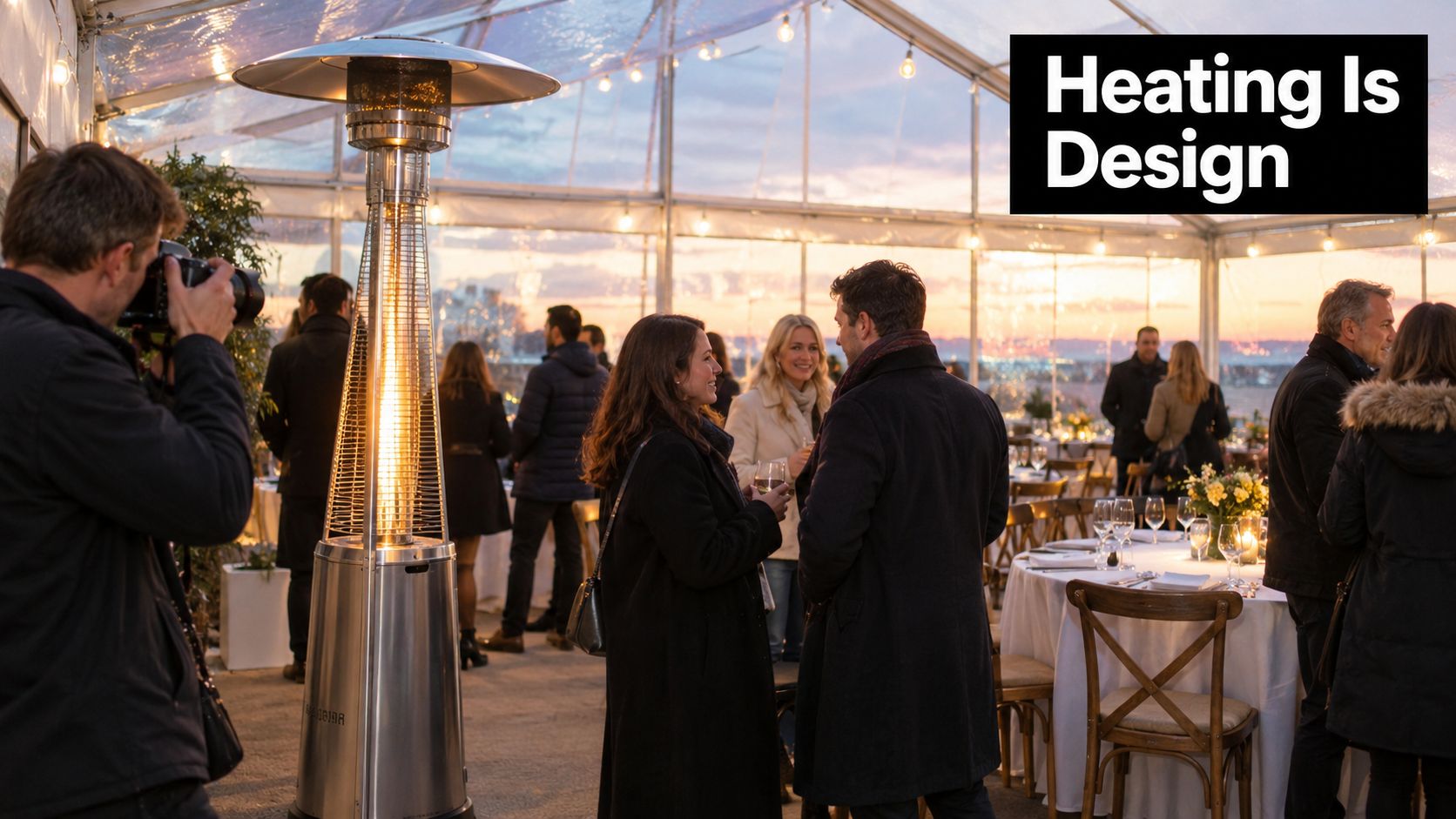
Warmth must work with airflow
The first trade-off is always airflow. Clients sometimes want every gap closed to keep heat in, but blocked vents and improvised coverings can create a different problem if fuel-burning equipment is involved. Then there is the opposite mistake. Too many openings, badly positioned ducting, or a service door left open all evening can dump your heat outside and push fuel use up without making guests any more comfortable.
Fuel placement matters too. LPG vapour is heavier than air, so any leak can collect in low spots instead of dispersing quickly. On a real site, that means you do not look at the heater on its own. You check the cylinder position, hose runs, ducting route, access paths, catering kit, temporary walls and any decorative dressing that might restrict air movement or interfere with safe clearances.
A marquee sits in an awkward middle ground. It is not an ordinary indoor room, and it is not open air either. Treating it as either one causes problems.
Practical rule: A marquee that feels warm isn't automatically a safe marquee. The heating method must suit the enclosure.
Heating also protects the event itself. If the weather turns, poor temperature control can affect guest comfort, catering flow, timings and how usable the layout remains through the evening. In the South East, where conditions can shift quickly between a mild afternoon and a cold, damp night, a sensible heating plan includes weather exposure, fuel siting, ventilation, and a cost buffer for longer run times, not just a rough heater-per-guest estimate.
For a supplier-side view of how portable heating is specified on real sites, this temporary heating solutions guide covers fuel choice and siting in more depth.
Choosing Between Electric and Fuel-Powered Marquee Heaters
Electric heaters are attractive because they don't create combustion gases inside the occupied space. They can work well where the venue has a suitable mains supply or a properly specified generator, but the installation still needs planning. Cables must be protected from vehicles, water and pedestrians, and the total electrical load must be checked against lighting, catering, refrigeration, sound equipment and other event systems.
Fuel-powered systems offer a different advantage. LPG and oil-fired heaters can provide substantial heat without depending entirely on venue electricity, but they introduce fuel storage, ventilation, flue, hose and carbon-monoxide considerations. An indirect unit positioned outside the marquee, with warm air delivered through suitable ducting, is distinct from placing a combustion appliance beside occupied tables.
Petrol-powered equipment must not be used indoors or in an enclosed space unless ventilation has been fully assessed, as explained in UK government carbon-monoxide guidance. Patio heaters designed for open outdoor use also shouldn't be brought inside a marquee unless the manufacturer explicitly approves that application.
Compare the complete setup
| Heater type | Best suited to | Key safety requirement | Typical limitation |
|---|---|---|---|
| Electric fan heater | Smaller structures or venues with suitable power | Protected cabling, load assessment and dry equipment placement | Can exceed available electrical capacity |
| Indirect diesel heater | Larger structures requiring ducted warm air | External positioning, clear flues and protected ducting | Requires fuel access, ventilation planning and suitable space outside |
| Direct gas heater | Approved applications with carefully assessed airflow | Correct ventilation, external cylinder placement and competent installation | Combustion and fuel risks make layout critical |
| Outdoor patio heater | Open-air areas, not occupied enclosed marquees | Use only in the environment for which it's approved | Usually unsuitable inside a marquee |
A fully open-sided structure has more natural airflow but can lose heat rapidly. A winter marquee with sidewalls, doors and internal partitions retains warmth more effectively, yet makes blocked ventilation and poor heater placement more serious. Noise, odour, generator compatibility, fuel storage and guest movement matter just as much as headline output.
For related planning around external heating, see outdoor heating hire options. The practical choice is rarely the cheapest or most powerful unit. It's the system that meets the venue's power, airflow, access and safety conditions without creating a new problem.
Safe LPG Heater Installation and Pre-Event Checks
LPG heating needs a documented process. Before anyone lights an appliance, the organiser and supplier should know how the enclosure will be used, where guests and staff will move, how fuel will reach the equipment and how emergency services can access the site.
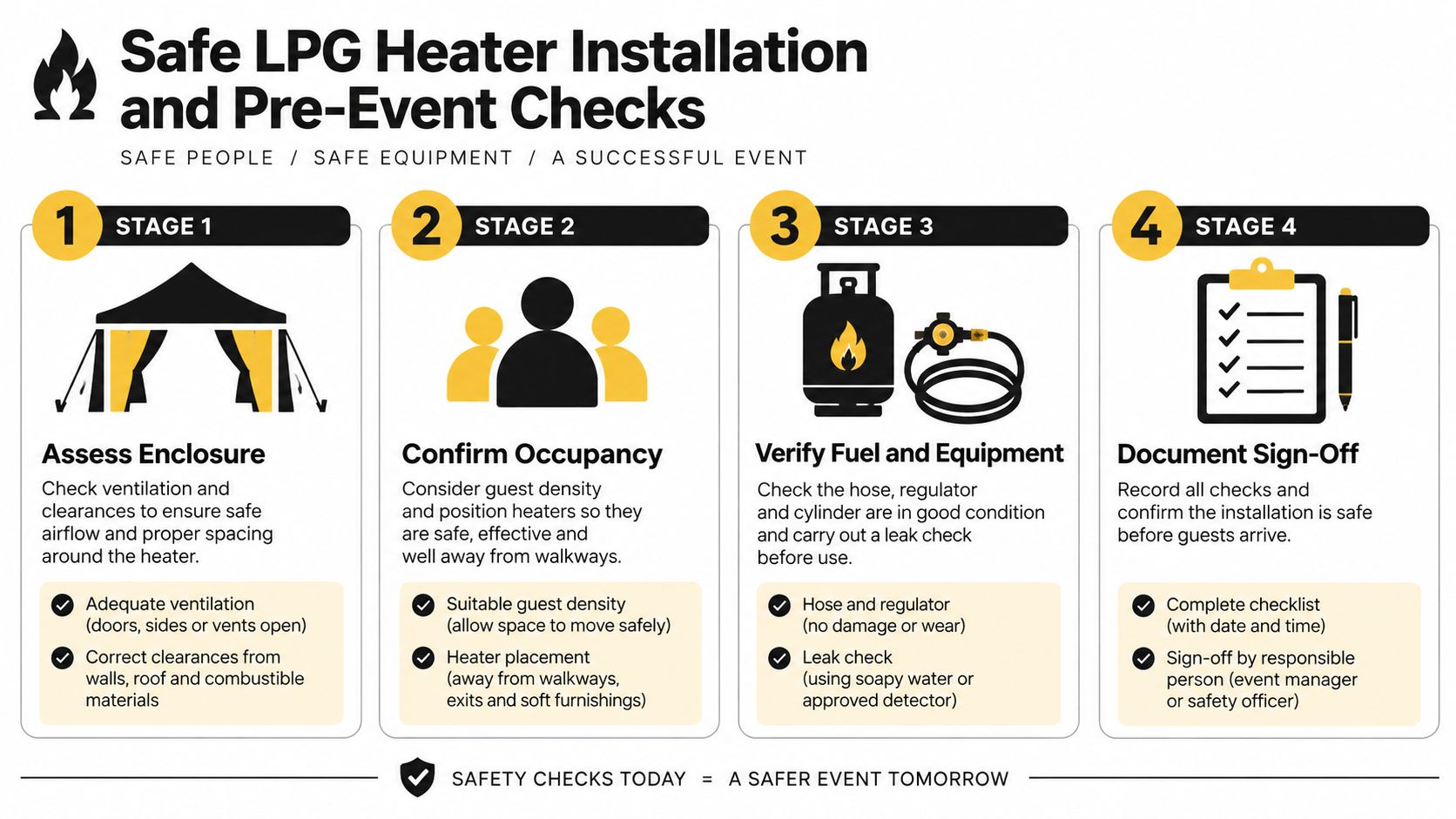
Follow four stages
Assess the enclosure. Record the marquee arrangement, occupancy, sidewalls, doors, ventilation openings, ignition sources, fuel route and emergency access. A structure with open sides presents a different risk profile from a sealed winter layout.
Select an approved appliance. Use a heater designed and approved for the intended environment. Confirm that the unit, flue and warm-air system are suitable for the marquee rather than assuming a general portable heater will work.
Verify the LPG installation. A competent Gas Safe-registered engineer should inspect the appliance, hoses, regulators, cylinders and quick-release connections. The engineer's registration and inspection evidence should be available to the event organiser.
Complete and record checks. Before the event and daily during a multi-day setup, inspect the appliance condition, high- and low-level ventilation, flues, pipework, cylinders and controls. Record the checks and resolve defects before guests enter.
Keep fuel outside the guest area
Cylinders should remain outdoors or in a separately ventilated, fire-resistant enclosure. Spare cylinders need to stay upright, secured and away from ignition sources. Hoses should be protected from vehicle movement, catering activity and pedestrian routes, while quick-release connections must remain accessible for inspection.
UK event guidance stresses that LPG heating inside tents requires risk assessment for fire, explosion and carbon monoxide. It also warns that a tent shouldn't be treated as equivalent to open air, because LPG needs adequate high- and low-level ventilation and vapour can collect in low areas. Never block vents to retain heat.
Keep table linen, paper décor, drapes and other combustible materials away from heaters, flues and hot-air ducts. Guest routes should remain clear, and staff should know how to shut down the system if an appliance behaves unexpectedly.
A supplier's installation routine should include clear responsibility. The person operating the heater needs access to the manufacturer's instructions, knows the controls and understands what to do if a flue is obstructed, a hose is damaged or ventilation changes during the event. Marquee and heater hire planning should therefore include certification, checks and operating arrangements, not just delivery of equipment.
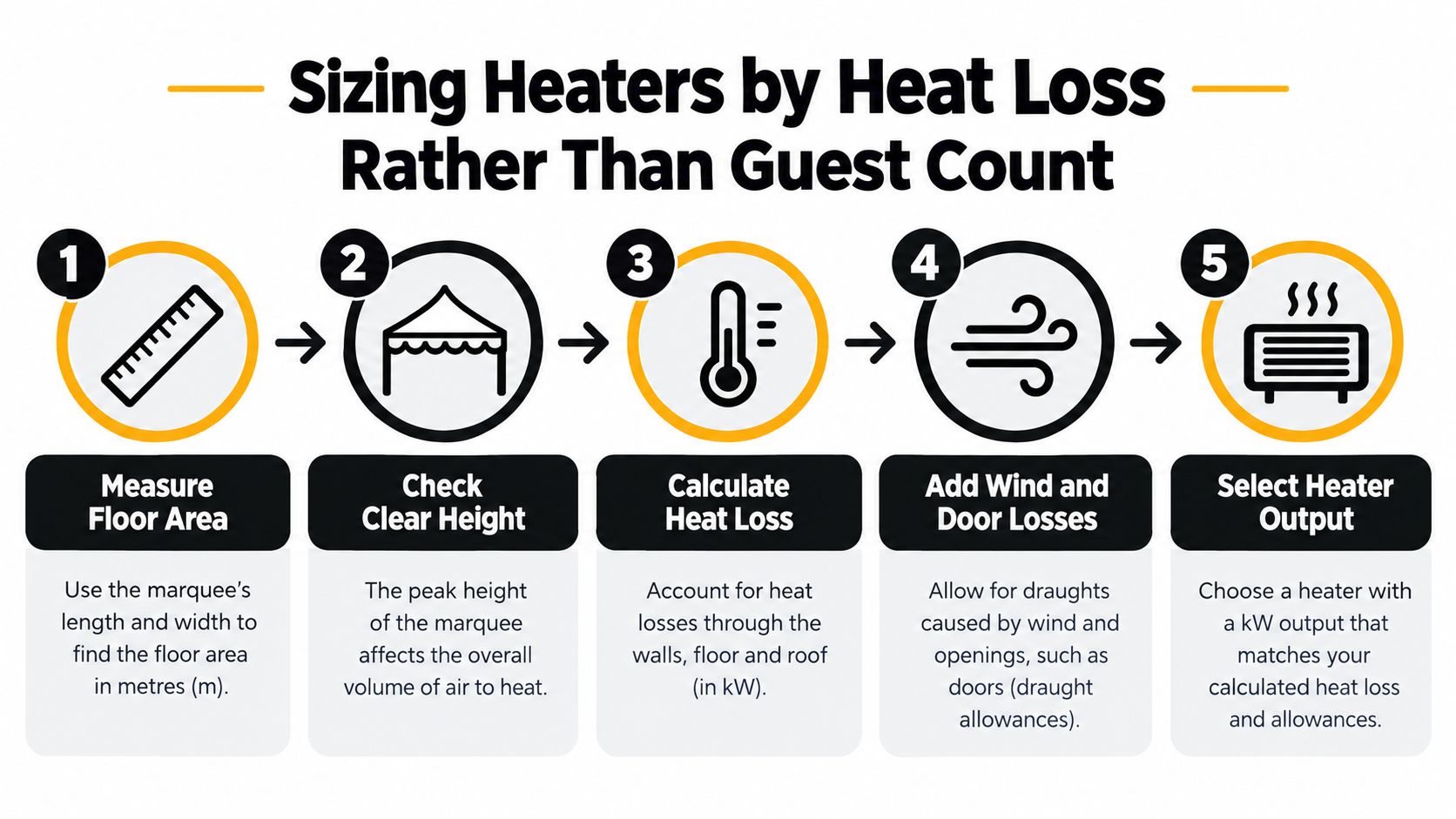
Sizing Heaters by Heat Loss Rather Than Guest Count
A guest-count rule sounds convenient, but it misses the variables that determine whether heat stays in the marquee. Two structures with similar occupancy can need different systems if one has lined walls, flooring and limited door movement while the other has exposed sides, frequent deliveries and wind across the site.
Start with the building envelope rather than the guest list. Record the floor area, clear height, sidewall configuration, expected outdoor temperature, wind exposure, insulation, door-opening frequency and target internal temperature. These details provide a defensible basis for selecting output and positioning delivery points.
Use a heat-loss assessment
A practical assessment asks:
- What is the marquee's floor area and clear internal height?
- Which sides are open, lined or fitted with temporary walls?
- How exposed is the site to wind?
- How often will doors open during guest arrival, catering and entertainment?
- Does the floor separate guests from damp or cold ground?
- Where will warm air enter, and how will it reach seating, dining and circulation areas?
- What internal temperature is appropriate for the event and clothing level?
The point isn't to chase the highest possible output. Excess capacity can create uncomfortable hot spots, noise, fuel waste and difficult control. A staged or thermostatically controlled system can respond as occupancy and door movement change.
Distribute warmth without creating hazards
Hot-air ducting can spread warmth through a larger structure, but the ducts must be positioned so they don't discharge into occupied areas or obstruct escape routes. Heaters and ducts also need protection from contact with décor, furniture, vehicles and guests.
HSE guidance identifies LPG heaters in enclosed spaces as a carbon-monoxide risk and requires adequate high- and low-level ventilation. It also states that ventilation must not be obstructed and that flues need to remain clear. That means a system cannot be made safer by sealing every opening once the heater is running.
Site decision: Specify controlled delivery to occupied areas, not maximum output for its own sake.
Outdoor patio heaters deserve a separate warning. A unit that works on an open terrace isn't automatically suitable inside a marquee. Unless it's explicitly approved for indoor or marquee use, don't repurpose it. Winter weddings, corporate receptions and community festivals need equipment matched to the structure, not a last-minute substitution.
Planning for Weather Changes and Heating Costs
At 3pm, a marquee can feel easy to heat. By first guest arrival, the light drops, the wind picks up across the open side, and staff start using every entrance. That is usually when a cheap-looking heating plan turns into extra fuel use, cold edges around the seating, and last-minute changes to sidewalls and doors. In Croydon and across the South East, heating decisions need to cover the whole event window, not just the couple of hours when the marquee is full.
Recent weather patterns back that up. The Met Office climate summaries show warmer long-term averages alongside wetter periods and more unsettled conditions. For marquee work, that matters because a mild forecast does not remove the risk of wind-driven rain, damp ground, and sudden heat loss once the structure is closed up for the evening. An open-sided summer marquee and a sealed winter structure behave very differently, and the heating budget should reflect that from the start.
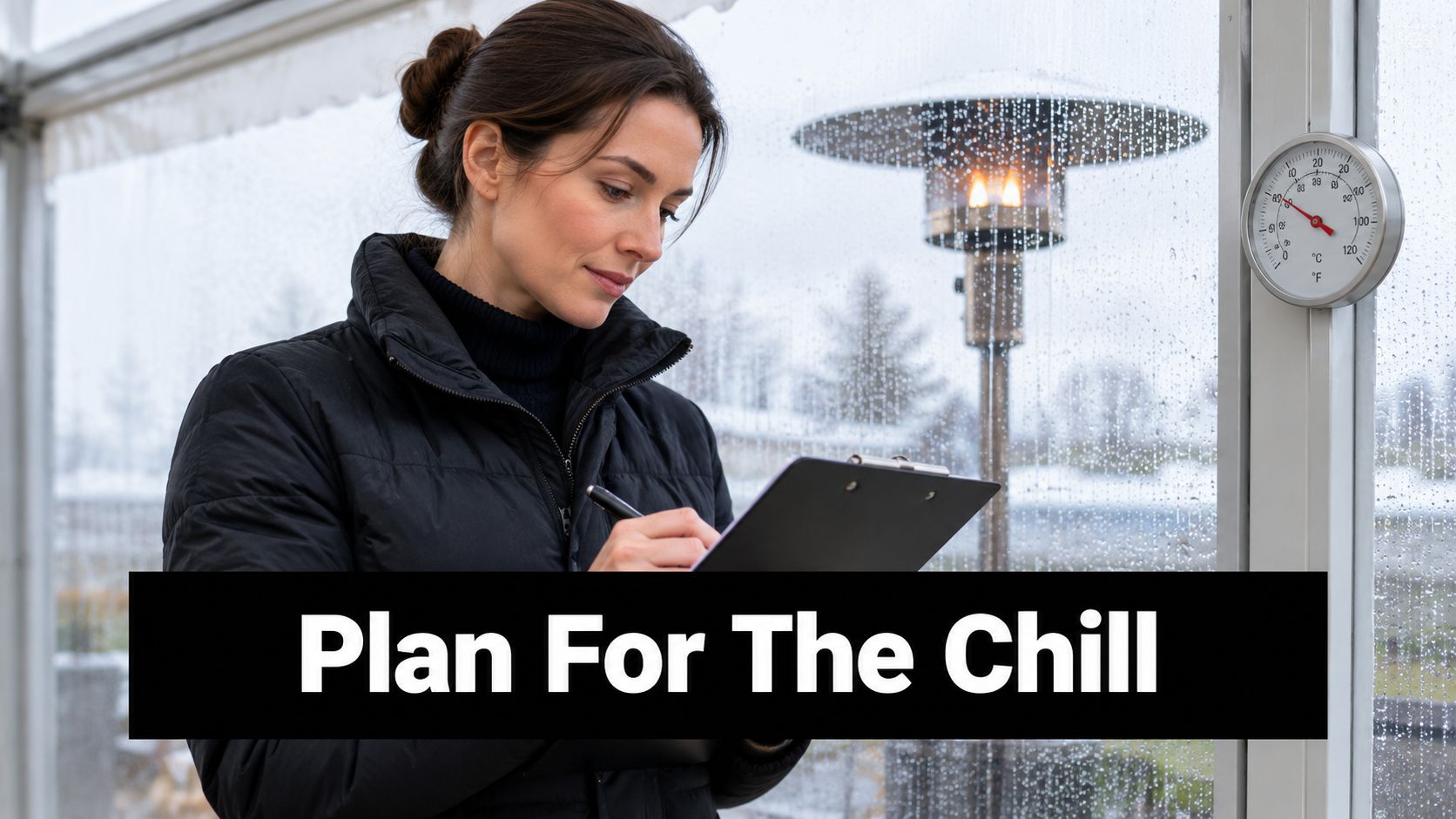
Build a transparent cost model
The hire rate is only one line on the job sheet. Electric heating also brings power demand, cable runs, distribution, and in some cases generator support. Fuel-fired systems bring delivery access, safe cylinder or tank placement, and refuelling arrangements that do not interfere with guests or block service routes. I always advise clients to price the operating setup, not just the heater itself.
For electric systems, start with a simple estimate:
Estimated electricity cost = heater power in kW × operating hours × £0.243
That uses the UK government's reported average non-domestic electricity price of 24.3 pence per kWh, including Climate Change Levy, in Q2 2025. It is a planning figure, not a promise. Your actual cost may move up or down depending on tariff, generator choice, cable losses, control settings, and how efficiently the heat is held inside the marquee.
The expensive mistake is usually poor control, not the heater on its own. A unit running hard because sidewalls are flapping, vents are blocked in the wrong place, or catering doors are left open will cost more than a properly set system matched to the structure. The same applies to fuel. Bad cylinder placement can lengthen duct runs, complicate changeovers, and create awkward service movements at the busiest point of the event.
Use marquee hire pricing guidance to compare package costs, but keep a contingency line for weather changes, backup capacity, and extra fuel or power time. The sensible model is a base setup for expected conditions, plus a clear trigger for adding sidewalls, increasing output, or extending running hours if the evening turns colder or wetter than forecast.
For practical visual guidance on planning a winter setup, watch the following resource after reviewing the written checklist. The video walks through a winter marquee setup on a real site, showing heater placement and how the sidewall arrangement affects warmth and airflow.
Final Checks Before Your Heated Marquee Event
The final inspection should bring the whole setup together. A temporary marquee needs to be erected by competent persons and supported by written safety or compliance certification. The structure should be capable of dealing with wind and bad weather, and the fabric should be durably flame-retarded, with suppliers able to provide evidence where required.
Check the site, structure and exits
Event guidance recommends positioning ordinary marquees at least six metres apart, with larger structures such as a big top separated by 12 metres, as outlined in fire-safety advice for temporary structures. Marquees should be clear of significant hazards, including substations and power lines, while entrances and exits remain accessible to occupants and emergency services.
A University of York marquee procedure gives a more detailed example for non-electrical heating. It specifies indirect systems positioned outside the marquee at least six metres from the structure, with flame-retardant warm-air ducting. It also requires an oil fuel tank to be at least six metres from the marquee and bunded where oil-fired heating is used. The procedure calls for at least two exits, each 1,800 millimetres wide, separated by a minimum angle of 45 degrees, with no point inside the tent more than 18 metres from the nearest exit. These are useful planning references, although the site's competent person must confirm the applicable arrangement. See the University of York marquee fire-safety procedure%20(VS2.4%20-%20Dec%2023).pdf) for the documented framework.
Run the handover checklist
Before guests arrive, confirm:
- Certification: Written structure, equipment and engineer documentation is available.
- Ventilation: High- and low-level openings are unobstructed.
- Fuel routes: Cylinders, tanks, hoses and connections are secure and outside public circulation.
- Heater placement: Exhausts, ducts and appliances are clear of décor, furniture and exits.
- Electrical routes: Cables are protected from water, vehicles and pedestrian traffic.
- Controls and alarms: Controls work, relevant alarms are tested and staff know the shutdown process.
- Emergency access: Escape routes, emergency lighting and site entrances remain clear.
- Support contacts: The organiser has the supplier's on-site or emergency contact details.
For organisers who need a wider framework covering site hazards, responsibilities and emergency arrangements, a comprehensive event risk assessment can help structure the conversation between the venue, organiser, supplier and competent engineer.
If you're arranging a wedding, Mehndi celebration, corporate event or community gathering in Croydon, Premier Marquee Hire can discuss the marquee, heating approach, power, access and guest flow together. A free site survey and CAD layout can help you visualise capacity and heater placement before you commit to a date.
Premier Marquee Hire provides marquee heating options for events across Croydon, London, Surrey, Middlesex and Kent, with delivery, installation, fuel provision and collection arranged as part of the service. Visit Premier Marquee Hire to request a pressure-free quotation, arrange a free site survey and plan a safer, more comfortable event from the outset.
Sorry, the comment form is closed at this time.