

27 May Marquee Hire in North London: A Complete 2026 Guide
You're probably starting with a rough idea rather than a finished plan. You know the date, you have a guest list that keeps changing, and you're trying to work out whether a marquee will fit your North London site and still feel polished once tables, catering, and entertainment go in.
That's exactly where most good marquee projects begin. Marquee hire in North London works brilliantly when the planning starts with the site and the event brief together, not with a guessed size from a price list. North London gives you everything from generous family gardens to narrow urban plots, and the difference between a smooth build and a stressful one usually comes down to access, layout, and honest space planning.
As a London-wide team based in Croydon, we see a clear pattern. Clients often focus first on style, but the strongest plans begin with practical questions. How many people are really attending? Are they dining, mingling, dancing, or all three? Can the structure get into the garden without trouble? Once those answers are clear, the rest becomes much easier.
First Steps Defining Your Event Vision
Before anyone talks about frames, flooring, or lighting, pin down what your event needs to do. A marquee isn't just shelter. It's your dining room, bar, dance venue, circulation space, and weather plan in one structure.
In London, marquee events span a very wide range. Fairytale Marquees says its North London wedding marquees can seat from 20 to 600 guests in one space, or accommodate 10 to 2,000 standing, with typical hire fees in the broader London market ranging from £2,250 to £7,000 per day and larger events averaging £4,500 per day according to its North London marquee guide. That range tells you something important. Guest count changes everything, but so does event format.

Start with what guests will actually do
A seated wedding breakfast and a standing drinks reception are not the same planning exercise. The headcount might look similar on paper, but the footprint changes once you add dining furniture, waiting space, and service routes.
Ask yourself:
- Will guests be seated for a full meal: If yes, you need room for tables, chairs, serving routes, and comfortable movement.
- Will it be mostly standing: That can reduce dining furniture, but it often increases pressure around the bar, entrance, and social zones.
- Is there a change of use through the day: Ceremony, meal, speeches, and dancing each need their own layout logic.
Build your brief before asking for prices
A proper enquiry should include more than “space for 100 people”. It should describe the event properly. That gives you a quote that reflects the actual build rather than a headline figure that grows later.
Use a brief like this:
- Guest numbers. Separate day guests from evening guests if they differ.
- Event style. Formal dining, casual party, corporate gathering, Mehndi, community celebration.
- Non-negotiables. Dance floor, DJ, stage, bar, catering tent, lounge area, children's corner.
- Site basics. Garden, patio, driveway, venue lawn, courtyard.
- Timing. One-day event, multi-day use, winter setup, evening-only function.
Practical rule: If an item matters to the event experience, put it in the first brief. If you leave it out, it may not be included in the structure size.
Think about feel, not just numbers
Two events with the same guest count can need very different marquees. A wedding with round tables, a proper dance floor, and feature lighting wants breathing room. A family garden party may suit a more compact arrangement if the house handles part of the catering and guest flow.
The best early decision is simple. Decide whether you want the space to feel efficient, comfortable, or generous. Most clients prefer comfortable, but they often describe it too tightly at first. That's where realistic planning saves money and stress later.
Choosing the Right Marquee Type and Size
There are plenty of marquee styles, but for most North London sites the primary choice comes down to traditional pole marquees versus frame marquees. Both can look excellent. They just solve different problems.
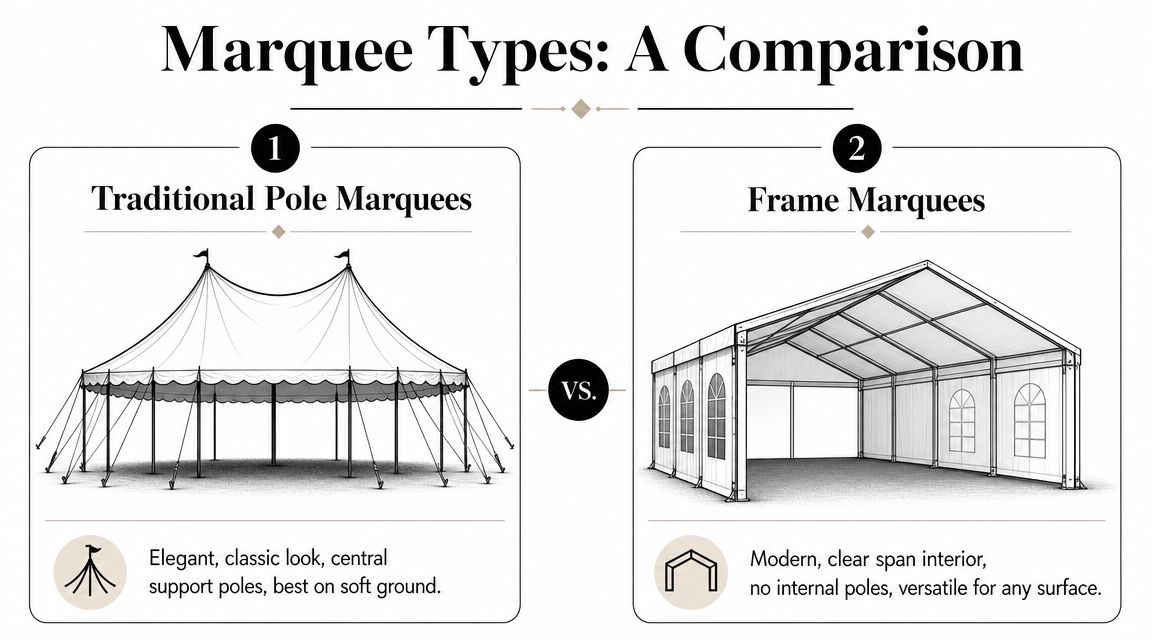
Traditional pole marquees versus frame marquees
| Marquee type | Best for | Main advantage | Main trade-off |
|---|---|---|---|
| Traditional pole marquee | Classic wedding settings, open lawns, softer ground | Strong visual character and elegant peaks | Internal poles affect layout and it generally suits softer ground better |
| Frame marquee | Gardens, patios, urban plots, mixed surfaces | Clear interior with no internal poles | Visual style is cleaner and more modern rather than traditional |
For North London homes, frame marquees are often the practical winner. They're easier to adapt around patios, tighter boundaries, and more awkward footprints. If the garden has a tricky shape or you need every usable metre, an unobstructed interior makes layout much easier.
A larger-scale setup can also be configured in modular sections rather than one blunt rectangle. If you're considering a bigger event, this guide to large marquee hire in London is useful for understanding how scale affects planning.
A quick visual helps when comparing structure styles in real settings:
Size is about layout, not just attendance
A common mistake people make is asking for a marquee “for 100 guests” as if that answers the question. It doesn't. You need to know what those guests are doing inside it.
A realistic size decision usually depends on:
- Dining format. Round tables, banquet rows, or mixed seating all use space differently.
- Entertainment. A live band, DJ booth, or stage changes the usable floor area.
- Service functions. Bars, catering support, gift tables, cake display, cloak space, and waiting areas all need room.
- Circulation. Guests need to move comfortably without squeezing behind chairs or bunching at pinch points.
If you only size the marquee for the chairs, the event will feel tight before the starters are served.
What works in practice
For a small private garden event, compact layouts can work very well if the host uses the house as part of the operation. Guests may circulate between indoor facilities and the marquee, and the structure mainly handles dining or shelter.
For weddings and larger parties, that shortcut usually doesn't work. Once you add formal seating, a dance floor, and a bar, the marquee needs to operate as a proper venue. That means allowing enough width and depth for guests to move naturally, not just enough room to fit furniture.
The right answer is rarely the smallest marquee that can physically fit. It's the smallest marquee that still lets the event function properly.
Planning Your Layout for the Perfect Event Flow
An empty marquee always looks bigger than it will feel once the event goes in. That's why layout work matters so much. Good event flow is what makes the space feel calm, usable, and enjoyable rather than crowded and improvised.
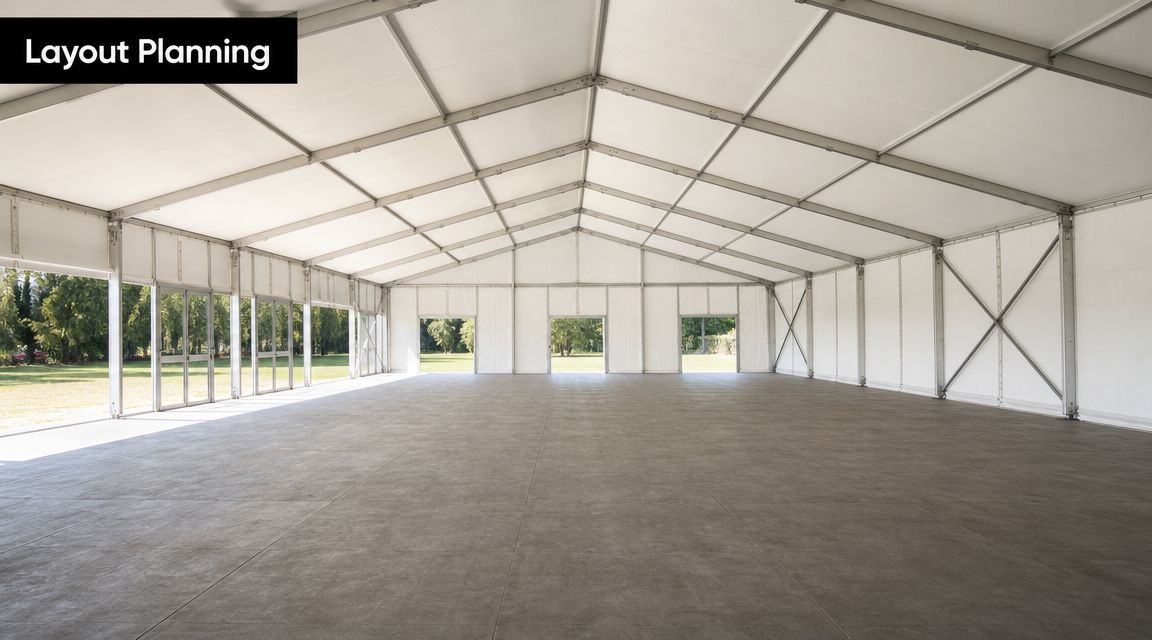
Why a CAD layout matters
A site survey should lead to a proper plan, not just a verbal estimate. Good Intents notes that a professional site survey must include a measured footprint, a load-path check, and ground-condition assessment before a quote is finalised, and that requesting a CAD layout helps verify whether catering, dance floors, and other elements fit within the planned space in its guidance on wedding marquees on uneven ground.
That matters because most layout problems start long before build day. They begin when nobody has drawn the room properly.
A useful CAD layout should show:
- Table positions so you can see actual spacing, not just theoretical capacity
- Entrance points and how guests arrive into the space
- Bar and service zones so queues don't block circulation
- Dance floor placement in relation to dining and quieter seating
- Catering and back-of-house areas if they sit within or beside the marquee
A common flow problem
One layout mistake appears again and again. The bar is placed too close to the entrance because it seems convenient. Guests arrive, stop for drinks, and create a permanent knot of people at the front of the marquee. Staff then have to pass through the same space carrying trays, and late arrivals walk straight into congestion.
A better arrangement usually puts the bar where people can gather without blocking movement. The entrance should feel open. Guests should be able to enter, orient themselves, and move toward their table or the social area naturally.
The easiest way to test a layout
Try this before approving any plan:
- Walk the guest journey. Imagine arriving, finding your seat, going to the bar, visiting the dance floor, and returning to your table.
- Walk the staff journey. Picture catering teams carrying plates, clearing tables, and reaching service areas without crossing the busiest social spaces.
- Check the changeover moments. Speeches ending, evening guests arriving, or dancing starting often create pressure points.
On-site habit: If you can't point to where the queue will form, the queue will decide for you.
A well-planned marquee layout doesn't feel “designed” in an obvious way. It just works. Guests move easily, the room reads clearly, and the event has a natural rhythm from arrival through to the last dance.
The Critical North London Site Assessment
A North London garden can look perfect in the estate agent photos and still be the wrong site for a marquee build. We see this regularly on jobs booked from our Croydon base. The lawn is generous, the house is attractive, and the client assumes the structure will drop straight in. Then we arrive at a Barnet property with a 90-degree turn down a side passage, or a Highgate garden where the fall across the lawn changes the whole flooring plan.
That is why the site assessment decides the job long before styling choices do.
Abacus Marquee Hire points out that North London events often involve narrow gardens and difficult-access properties, and that those practical constraints can affect both cost and whether installation is possible at all on its page about North London marquee hire. That matches what we find on real site visits. In this part of London, the challenge is rarely just footprint. It is the route in, the ground under the structure, and the time available to build it safely.
What usually causes problems
Each postcode has its own pattern. In Islington and parts of Muswell Hill, access is often tighter than the garden suggests. In Finchley and Barnet, parking restrictions and loading distances can slow a build if they are not planned early. In Highgate, slope is often the hidden issue.
The points that need checking are straightforward:
- Access width and turning space for frames, flooring panels, and equipment
- Steps, level changes, and narrow passages between the unload point and the build area
- Ground conditions such as soft lawn, uneven surfaces, or recently prepared areas
- Gradient across the site which affects levelling, sub-flooring, and door positions
- Trees, walls, sheds, and fixed planting that reduce the usable shape of the pitch
- Controlled parking and loading windows that affect labour time and vehicle planning
A garden can be large enough on paper and still be inefficient to build in. That matters because difficult access usually increases labour, lengthens installation, and can limit the marquee type you should choose.
What a proper site visit should answer
A good survey is a working assessment, not a box-ticking exercise. I want to know three things before we confirm a North London build. Can the equipment reach the site safely? Can the structure sit level and secure? Can the crew install and remove it within the site rules?
Here is what we check on site:
| Site factor | Why it matters |
|---|---|
| Access width and height | Confirms whether materials can be moved in by hand and how long the build will take |
| Ground condition | Affects anchoring method, floor stability, and protection for the lawn |
| Gradient | Determines whether a level sub-floor is needed and which structure is practical |
| Overhead obstacles | Branches, cables, and rooflines can restrict position and clear height |
| Power routes and hard surfaces | Helps plan generators, catering support, and safe cable runs |
One useful comparison is with dry hire venues in London that come with their own operating constraints. A venue may remove the side-access problem, but it often replaces it with fixed loading slots, supplier rules, and strict breakdown times. The principle is the same. Check feasibility first.
Local knowledge changes the solution
North London experience consistently pays for itself in practical ways. On a sloping Highgate lawn, the answer may be a raised floor rather than trying to force a simpler setup that will never feel level inside. On a narrow Barnet side return, we may recommend a structure and build sequence that can be hand-carried in smaller sections. On a controlled residential street, we may split delivery timing to avoid problems with neighbours, parking enforcement, and school-run traffic.
Clients usually focus on the marquee they want. Installers focus on the site they have. The best projects do both.
Good site assessment work gives you clear answers early. What size is realistic. What access method is workable. Whether the budget needs to allow for extra labour, flooring, or traffic management. Once those points are settled, the rest of the planning becomes much easier and the event day is far less likely to produce expensive surprises.
Creating Ambiance with Add-ons and Weatherproofing
A North London marquee often looks straightforward on paper. Then the temperature drops after sunset in Muswell Hill, guests start arriving through a side gate in Barnet, and a garden that felt dry at noon is soft underfoot by evening. The jobs that hold the event together are usually the ones clients leave until late. Flooring, lighting, heating, and how people enter the structure.
The shell matters, but the feel of the event comes from the specification inside it. In practice, the strongest setups are planned as one package, not as a marquee with a few extras added at the end. That matters even more on North London residential sites, where access limits, neighbour considerations, and uneven ground can affect what lighting rig, floor build, or heating layout will work.
Atmosphere starts with comfort
Good ambience is built from the floor up. If guests feel the ground move under a dining chair, struggle in heels, or walk into a dark entrance, the styling budget has been wasted. A finished interior feels polished because the practical decisions were made properly first.
On a flat, dry lawn, simple matting may be enough for a casual gathering. For weddings, dinner parties, and corporate events, a boarded floor with carpet usually gives a better result. It feels firmer, looks cleaner in photographs, and copes better with the traffic between bar, dining area, and dance floor. On sloping Highgate gardens, that floor may also need levelling work before any interior dressing starts.
Lighting needs the same level of thought. Functional light gets people in, seated, and served safely. Feature lighting changes the mood once daylight drops. If you are comparing options, our guide to lighting for marquees explains what each setup does on an event night.
A strong atmosphere plan usually includes:
- Entrance and pathway lighting so guests arrive confidently and safely
- Dining and service lighting that is bright enough for catering and table use
- Mood lighting for the evening, especially around the bar and dance floor
- Flooring matched to the event type rather than the cheapest base that fits the footprint
- Furniture and linings that suit the tone of the event and the scale of the structure
The best-looking marquees are rarely the most decorated. They are warm, well lit, and comfortable to spend six hours in.
Weatherproofing changes how the event feels
Weather planning should be done at the same time as the styling choices. I have seen plenty of clients focus on table design and leave heating until the week of the event. In North London, that is usually the wrong order. Evening temperatures fall quickly, and gardens in areas like Highgate or Hampstead can hold damp air once the sun goes.
The right setup depends on the season and the site. Full sidewalls help retain heat, but they also change ventilation and guest flow. Heater choice depends on the marquee size, the floor system, and how often doors will be opened. A wide front opening may look inviting, but it can also dump heat every time a taxi arrives unless the entrance is planned properly.
Weatherproofing usually means getting four things right:
- Enclosed sidewalls or a partly enclosed layout based on the forecast and event style
- Heating sized to the marquee volume, not guessed from the guest count alone
- A floor system that stays stable on soft or uneven ground
- An entrance arrangement that limits drafts and wet foot traffic
Summer bookings need this planning too. A June or July event can still turn cold after dark, especially if the marquee is set up in an exposed garden or open terrace. Guests stay longer and relax more when the internal temperature is steady and the floor feels dry and solid.
Winter events can work brilliantly in a marquee, but only if they are designed for winter from the start. That means proper enclosure, dependable heating, and an interior layout that feels intentionally warm rather than half-open and underprepared.
Understanding Costs and Your Booking Checklist
A good quote should be clear enough that you can understand what you're paying for without chasing basic answers. If the pricing looks tidy but the specification is vague, that's when clients get caught by omissions.
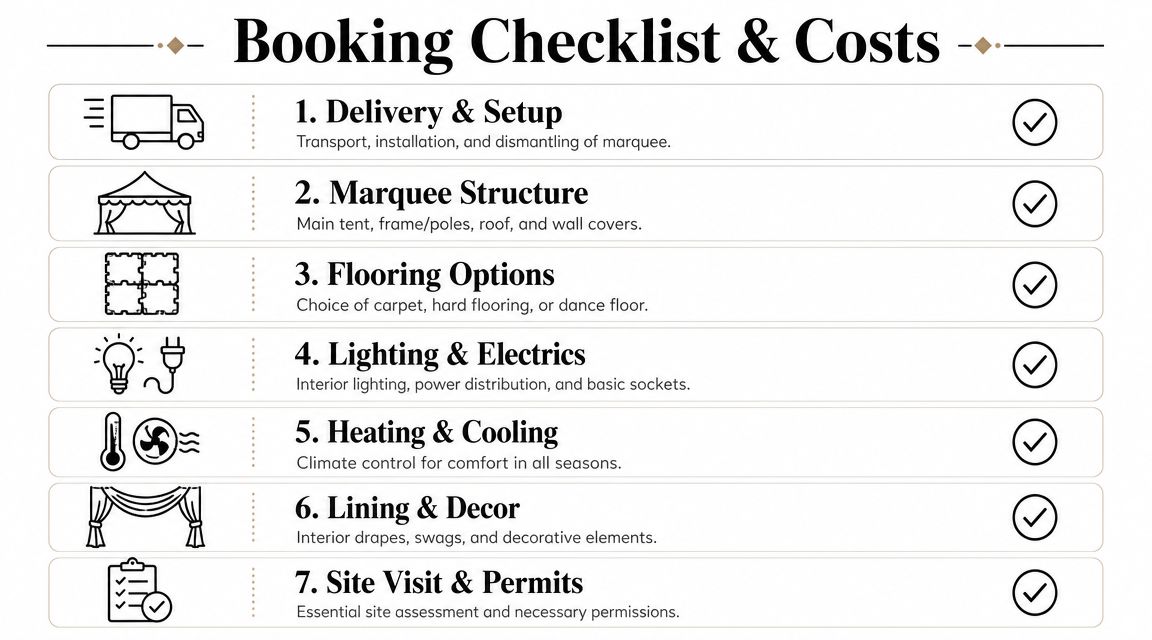
What a quote should spell out
A proper marquee hire quote should identify the structure, build method, and all agreed extras. It should also make clear whether the figure covers delivery, installation, and dismantling.
At minimum, check for these items:
- Structure specification. Type of marquee, size, and intended layout use
- Flooring and interior items. Carpet, hard flooring, dance floor, furniture, linings
- Lighting and climate items. Power distribution, lighting package, heating if required
- Access assumptions. Whether the quote depends on straightforward access or a confirmed site survey
- Build and removal. Installation and dismantling arrangements
Review quality before you book
Marquee industry guidance from Marquees Nottingham warns that one of the most common planning failures is underestimating space, and it also recommends checking recent reviews because reputable providers should show consistent positive feedback in its article on top marquee mistakes to avoid. That's sensible advice.
Sparse galleries, unclear specifications, and weak recent reviews often point to the same problem. The company may be quoting too loosely.
A practical booking checklist
Before you sign anything, ask these questions:
- Has the site been surveyed properly? If not, the quote may still be provisional.
- Will I receive a layout drawing? You need to see how the event fits, not just hear that it fits.
- What exactly is included? Structure, flooring, lighting, heating, furniture, delivery, removal.
- What assumptions has the company made about access? North London sites often change the build plan.
- Can they show recent work and recent reviews? Current evidence matters more than old marketing photos.
A strong booking process should feel calm and specific. If you're still unclear about the build after receiving the quote, the paperwork isn't finished yet.
Frequently Asked Questions About Marquee Hire
Do I need planning permission for a marquee in my garden
Usually, temporary private-event marquees don't require formal planning permission, but there can be exceptions. If the property has restrictions, sits in a sensitive location, or the event involves noise, licensing, or unusual duration, check early rather than guessing.
How long does installation and removal take
That depends on the structure size, access route, flooring system, and site conditions. A compact garden marquee is naturally simpler than a full wedding build with flooring, lighting, and ancillary areas. On tighter North London sites, access often affects timing more than the marquee size itself.
What if my garden is sloped
A sloping site doesn't automatically rule out a marquee. It does mean the installation method, flooring approach, and exact positioning need more care. This is one of the main reasons a measured site visit matters.
Can a marquee go on a patio or hard surface
Often yes, but the answer depends on the structure type and the anchoring method available for that site. Hard surfaces can work very well, especially in urban gardens, but they need the right build solution rather than a one-size-fits-all approach.
What if the weather turns bad on the day
The proper answer should already be built into the plan. Sidewalls, suitable flooring, secure installation, and heating where needed are part of good event preparation. If those elements are treated as optional extras at the last minute, you're relying on luck.
How far in advance should I book
As early as you can once the date and site are reasonably firm. The important thing isn't just securing the marquee. It's allowing time for the survey, the layout, and any adjustments the site may demand.
If you're planning an event and want straightforward advice on marquee hire in North London, Premier Marquee Hire can help you assess the site properly, understand the options, and move from rough idea to workable event plan with a clear quote and no pressure.
Sorry, the comment form is closed at this time.