

03 Jun How to Hire Marquee for Your London Event: 2026 Guide
You're probably here because the venue question has become the whole event question.
Maybe the family home in Purley suddenly feels too small for a wedding breakfast. Maybe a company summer event in Bromley needs shelter, branding space and a proper bar without booking a hotel ballroom. Maybe you've found a beautiful garden in Croydon, but you're now wondering whether guests, caterers, toilets, power, flooring and the British weather can all fit into one workable plan.
That's exactly where marquee hire starts to make sense. A marquee gives you control over the setting, the layout and the atmosphere. It can be formal, relaxed, corporate, family-focused or somewhere in between. The challenge isn't whether a marquee can work. It's getting the decisions right early enough that the day runs smoothly.
Your Complete Guide to Hiring a Marquee
A lot of people still think a marquee is a last resort if they can't find a venue. In practice, it's often the opposite. It's the option people choose when they want flexibility that fixed venues can't offer.
In London and the South East, that flexibility matters. Garden sizes vary wildly. Access can be awkward. Guest numbers shift. Some events need a simple covered space for drinks, while others need a full temporary venue with dining, a dance floor, heating, toilets and service areas. The good news is that this isn't an improvised corner of the events world. The UK marquee-and-tent hire market is a mature industry, with dedicated market reports analysing the top 260 companies, which points to a professional supplier base serving everything from weddings to large corporate events, as noted in Plimsoll's UK marquee and tent hire market report.
Start with the event, not the structure
The best marquee plans begin with a short list of practical decisions:
- Guest profile: Are people mainly standing, dining, presenting, dancing, or moving between zones?
- Event style: A wedding reception needs different flow from a launch event or community gathering.
- Site reality: A flat open lawn in Sutton behaves very differently from a split-level garden in Streatham.
- Season and time of day: A summer afternoon drinks party is one brief. A November evening celebration is another.
That's why it helps to treat marquee planning as event planning first. If you want a broader checklist for invitations, timelines, suppliers and run-of-show thinking, GroupOS' event planning insights are a useful companion resource alongside the physical marquee planning itself.
Practical rule: The marquee is only one part of the venue. Access, flooring, power, catering space and guest flow usually decide whether the setup feels effortless or stressful.
What a good hire process looks like
A sensible hire marquee process is usually straightforward when handled properly:
- Define the event brief
- Estimate the required space
- Survey the site properly
- Choose the structure style
- Add the right flooring, lighting, heating and furniture
- Review an itemised quote and layout plan
- Lock in the installation schedule
That order matters. People often jump straight to marquee style because it's the visible part. In reality, size, site conditions and season tend to shape the right answer long before the styling choices come in.
Sizing Your Marquee From Guest Count to Layout
The first mistake most clients make is asking for a marquee size before deciding how the event will work.
A guest count on its own isn't enough. One hundred people for a drinks reception needs a very different footprint from one hundred people seated for dinner. Add a dance floor, a bar, a DJ setup or catering access, and the structure changes again.
The planning figures that are actually useful
For capacity, UK planners typically use 0.8 to 1.0 m² per person for standing events and 1.5 to 2.0 m² per person for seated events, with an additional 2 to 3 m² per 10 guests for a dance floor, according to this UK marquee sizing guide.
That gives you a starting point, not a final answer.
For example, a seated wedding for 100 guests usually needs space for the dining layout first. If you then add a dance floor, top table, gift table, bar, cake table and a route for staff carrying plates, the marquee has to do more than just fit chairs inside it.
Marquee Capacity Quick Guide
| Guests | Standing Reception (e.g. Drinks Party) | Seated Dining (e.g. Wedding Breakfast) |
|---|---|---|
| 50 | about 40 to 50 m² | about 75 to 100 m² |
| 80 | about 64 to 80 m² | about 120 to 160 m² |
| 100 | about 80 to 100 m² | about 150 to 200 m² |
| 150 | about 120 to 150 m² | about 225 to 300 m² |
Those ranges help you sense-check a layout. They don't include every extra area your event may need.
What people forget to include
The hidden space users almost always miss is the space between things.
Guests need room to move. Staff need room to serve. Musicians or DJs need a workable setup area. If the weather turns wet, entrances and transition points become much more important because people won't spread into the garden as freely as they would on a dry day.
A typical London-area layout may also need:
- A catering zone: Especially if prep or plating is happening on site.
- A bar area: Not just the bar unit itself, but the queue space around it.
- Entrance protection: Porch sections, matting or covered walkways can stop mud and congestion.
- Storage corners: Gifts, prams, coats, stock and cleaning items always need somewhere to go.
A marquee that looks right on paper can still feel cramped if circulation hasn't been allowed for.
A quick real-world way to think about it
Take a Dulwich garden wedding. The lawn might technically hold the dining footprint for 100 guests, but if the caterer also needs a rear service tent and the side access is narrow, the more practical option may be a different configuration rather than choosing the largest rectangle that fits.
That's where a specialist can refine the first estimate into a real plan. If your event is smaller and you're weighing whether a compact setup might work better, this guide to small marquee hire in London is a helpful reference point.
Think in zones, not just square metres
A good layout usually has at least three separate intentions:
- Arrival and welcome
- Main guest area
- Service and support space
Once you break the event into zones, it becomes much easier to decide whether you need one larger structure, linked sections, or a simpler footprint with a cleaner flow.
Choosing Your Marquee Style and Features
Size tells you what you need to accommodate. Style tells you how that space will behave.
In London gardens and mixed-use venues, the biggest practical choice is usually between a clear span marquee and a more traditional pole-style structure. Both can look excellent. They just solve different problems.
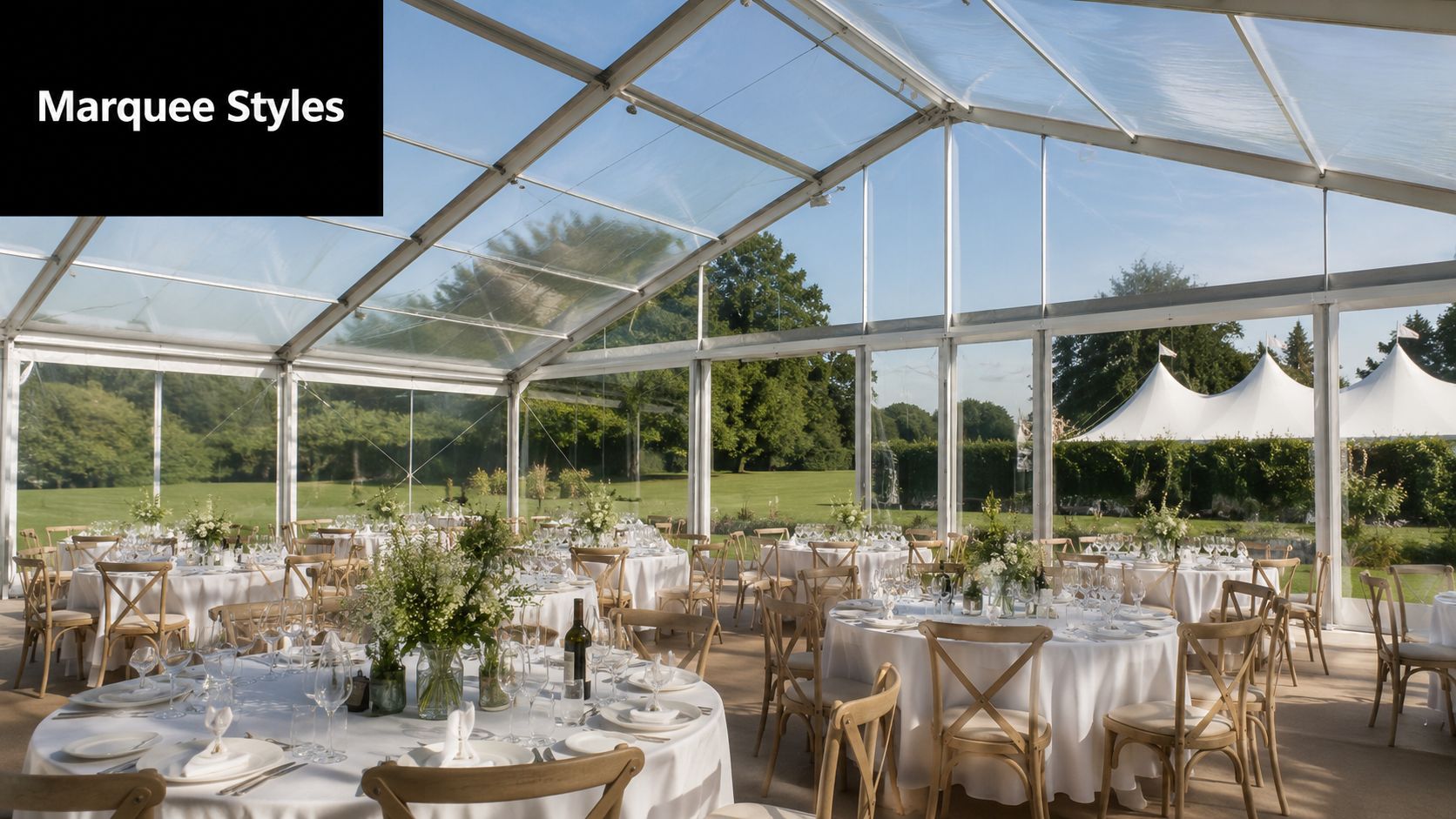
Clear span or traditional
A clear span marquee gives you an open internal area without centre poles. That makes furniture layout easier and usually gives you more freedom with staging, dining plans, dance floors and formal flooring systems. It's often the more practical choice for corporate use, weddings and winter work.
A traditional structure has a softer, more classic look and can suit relaxed summer events beautifully. The trade-off is that internal poles and different anchoring needs can affect layout options.
Here's the simplest comparison:
Clear span marquee
- Better for formal dining layouts
- Easier to pair with hard flooring
- Strong option for all-season events
- Usually more adaptable for branding, glazing and linked spaces
Traditional style marquee
- Attractive for garden parties and countryside aesthetics
- Can create a more classic visual feel
- May be less flexible internally depending on layout needs
The features that change the feel of the event
A marquee's appearance doesn't come from the frame alone. Most of the finished atmosphere comes from the specification around it.
The biggest visual choices tend to be:
- Clear walls or windows: Good when the garden, skyline or venue backdrop is part of the experience.
- Clear roof panels: Strong for evening events, especially with festoon or warm overhead lighting.
- Interior linings: These soften the frame and create a cleaner formal finish.
- Entrance treatments: Doors, porches and walkways matter more than people expect.
For many clients, the best result is a practical structure with a lighter visual treatment rather than the most decorative option on the list.
A video walkthrough often helps people picture the difference between a plain shelter and a finished event space:
Match the marquee to the site, not just the mood board
A sleek clear-roof marquee may be perfect on a broad lawn in Beckenham, but less suitable if the only viable position in a compact Croydon garden means building close to fences, trees or neighbouring structures.
That's why the best style decisions are always tied to installation reality. The structure has to look good, but it also has to go in cleanly, operate safely and leave enough room for everything around it.
The Crucial Site Survey for London Gardens
The site survey is where a good marquee plan becomes a realistic one.
This is the stage many first-time clients underestimate, especially in London. They measure the lawn, assume the marquee will sit on it, and only later discover that the side gate is too narrow, the path turns sharply, the garden slopes more than expected, or the ideal footprint blocks the caterer's access.
What a survey looks like on a typical home setup
Take a family event at a house in Purley. On first glance, the garden seems straightforward. There's lawn space, side access and a patio near the house.
Once you walk it properly, more detailed questions appear. Can installation equipment get through the gate without damaging walls or planting? Does the team need to maneuver around corner turns? Is the patio level with the lawn, or does the marquee need to bridge between surfaces? If the event runs into the evening, where does the power come from?

The details that decide what's possible
A key challenge in marquee hire is planning for awkward access and irregular sites, not just size. The feasibility of a 3m, 5m, 6m, 9m, 12m or 15m span, handling corner turns, or connecting structures to buildings are all practical decisions usually settled during the survey, as highlighted in this guide to marquee solutions for awkward spaces.
In practice, the survey normally checks four things closely:
- Access route: Gate widths, alleyways, steps, shared drives and vehicle approach.
- Ground conditions: Grass, paving, mixed surfaces, drainage, slope and hidden obstacles.
- Obstructions overhead: Trees, wires, lights, conservatories and rooflines.
- Service position: Power, water, waste points and catering proximity.
Irregular gardens need creative layouts
Many South London gardens aren't neat rectangles. They taper, step, curve, or have outbuildings in inconvenient places. That doesn't rule out a marquee. It just means the answer may be modular rather than obvious.
A narrower section can work as an entrance run or catering annex. A covered walkway can connect the house to the main event space. Sometimes the right decision is to reduce span width and increase length. In other gardens, it's better to split functions across linked structures rather than force everything into one footprint.
The question isn't only “Will a marquee fit?” It's “Will people, staff and equipment move through the site properly all day?”
When venues matter too
The same logic applies to private estates, school grounds and outdoor wedding sites. A field may offer plenty of area, but the planning issue might be power, surface conditions or distance between guest parking and the event space. If you're still comparing options, this guide to venues for marquee weddings can help you think beyond simple location aesthetics.
Essential Extras for Comfort and Style
This is the point where many budgets either become sensible or become wasteful.
People often call these items “extras”, but the most important ones aren't decorative add-ons. They're what make the marquee usable, comfortable and polished. Without them, the structure can feel temporary in the wrong way. With them, it feels like a proper venue.
Flooring first
If the event involves formal dining, smart dress, elderly guests, children, heels, or wet weather risk, proper flooring is not optional.
A soft or uneven base changes everything. Tables wobble. Chairs don't sit level. Guests notice mud at entrances. Staff carrying trays have a harder job. The event may still happen, but it won't feel well executed.
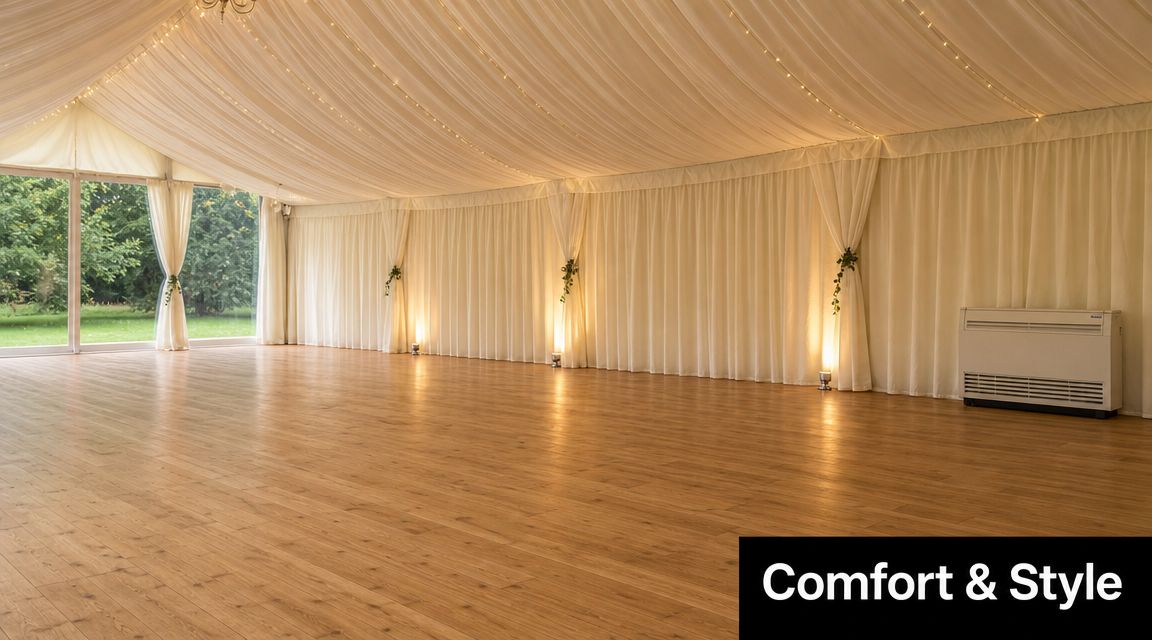
For winter or shoulder-season events in the UK, a comfortable marquee requires a specific combination of insulated hard flooring, powerful indirect heating and sufficient generator power, as explained in this practical winter marquee planning guidance. That's the difference between a marquee that merely stands up to the weather and one that feels comfortable to spend an evening in.
If you're weighing surface options in more detail, this article on flooring for marquee events is worth reading before you approve a quote.
Comfort, atmosphere and function
The strongest marquee setups usually balance three categories.
Comfort
This is what guests feel physically.
- Hard flooring: Gives stability and improves the finish immediately.
- Heating: Essential for colder months and often still useful in shoulder season evenings.
- Entrance protection: Porches, matting and walkways stop the weather coming inside with the guests.
Atmosphere
This is what turns a blank frame into an event room.
Lighting does most of the heavy lifting. Warm overhead lighting, feature lighting around bars or cake tables, and subtle wall washing can make the same marquee feel elegant rather than stark. Linings also make a big difference if you want a softer wedding finish.
Function
This is what keeps the event running.
Think generators, catering tents, toilet units, bars, furniture, staging and storage. None of these are glamorous in a quote, but they're usually the pieces that prevent operational headaches on the day.
Working principle: Spend on the items guests will notice with their feet, their temperature and their first impression.
Don't forget the parts that last after the day
A well-designed marquee event often looks brilliant in photographs because the structure gives you control over lighting and background clutter. If you're planning memory-table details, guest interaction and post-event keepsakes, these event photo book design tips from EventUploader can help you make the most of the space you're building.
The key point is simple. A hire marquee isn't finished when the frame goes up. It's finished when guests can arrive comfortably, move easily, stay warm, dine well and enjoy the space without noticing the logistics underneath it.
Budgeting Quotes and Your Booking Timeline
A good marquee quote should answer questions before you ask them.
If it only gives you a single headline figure for “marquee hire”, it's too vague to compare properly. Value lies in the breakdown, because that's where you see what's included, what's missing and what may become an extra later.
What should appear clearly on a quote
Look for itemisation rather than bundled wording. A proper quote will usually separate the key elements so you can understand the build.
Check for:
- The structure itself: Size, style and any linked sections
- Installation and removal: Delivery, build, dismantle and collection
- Flooring and entrances: Especially if the event is formal or weather-sensitive
- Lighting, heating and power: Not just the products, but whether power provision is included
- Furniture and ancillary hire: Seating, tables, bar units, toilets, catering space
- Commercial terms: Deposit, payment schedule, cancellation terms and VAT
If something important to your event isn't listed, assume it isn't included until confirmed in writing.
Booking at the right time
The most popular dates usually move first. Summer weekends, wedding-heavy bank holiday periods and major corporate event windows rarely reward last-minute planning.
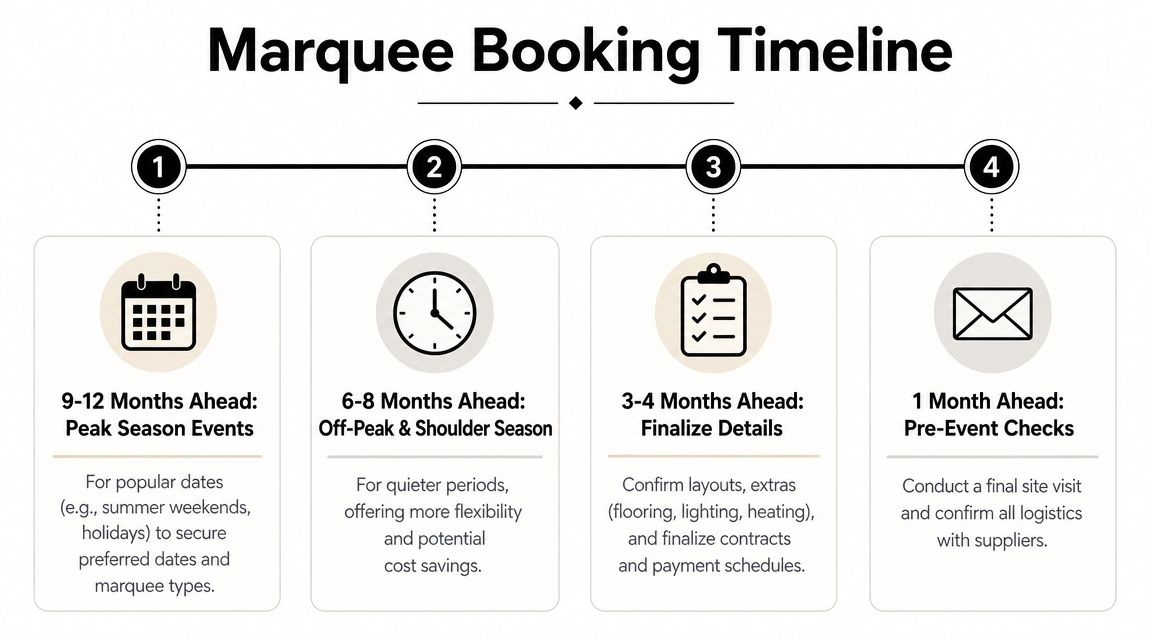
A sensible booking rhythm often looks like this:
- Early enquiry: Start as soon as you have a likely date and rough guest count.
- Site survey and revised quote: The practical specification is sharpened at this stage.
- Layout sign-off: Confirm dining plan, dance floor, entrances and support areas.
- Pre-event checks: Reconfirm timings, access and final supplier coordination.
Red flags to take seriously
Some warning signs are easy to miss when you're focused on the headline price.
- No site survey offered: That can be a problem for London homes and awkward venues.
- Loose wording around flooring or power: These are common cost-creep areas.
- No clear plan for wet or cold conditions: Especially risky outside peak summer.
- Unclear install timing: You need to know when the site will be occupied and cleared.
The strongest quotes don't just tell you what you're buying. They show that the supplier has thought through how your event will be built.
Marquee Hire Questions for London Events
Do I need planning permission for a marquee?
Sometimes no, sometimes you need to check. It depends on the site, the duration, the type of event and local council requirements. Residential gardens, school sites and public land all need slightly different thinking. If noise, road access, licensing or extended use are involved, it's worth confirming early rather than assuming a temporary structure removes every approval issue.
How long does installation take?
That depends on the structure size, the access route, the surface and the specification. A straightforward garden setup is very different from a full event build with flooring, heating, lighting and linked service areas. What matters most is that installation and removal timings are agreed in advance so other suppliers can work around them.
Can a marquee work in a small Croydon or South London garden?
Often yes, but only if the layout is designed around the access and the usable footprint. Tight side returns, steps and awkward turns are common locally. Smaller or modular sections can solve a lot, especially when the event brief is realistic about guest flow and support space.
What happens if bad weather is forecast?
A sensible marquee plan assumes weather variability from the start. That means choosing the right flooring, thinking about entrances, and making sure heating and power have been considered where needed. The best weather contingency isn't a last-minute panic plan. It's a specification that already expected the weather to misbehave.
Can the marquee connect to the house or another building?
Sometimes yes, and it can be a very smart way to improve flow, especially for catering access or guest arrival. The key is whether levels, access points and the structure dimensions make the connection workable. This is one of those details that looks simple on paper and needs proper surveying on site.
What's the biggest mistake people make when they hire marquee space?
They plan the main guest area and forget the support requirements. Catering, toilets, power, bar queues, entrances and circulation usually decide whether the setup feels generous or squeezed. Guests rarely comment on the span width. They do notice if they're cold, queuing, or struggling to move around comfortably.
If you're planning an event in Croydon, London or the surrounding counties and want clear advice before you commit, Premier Marquee Hire can help with site visits, layout guidance and straightforward quotations suited to your event.
Sorry, the comment form is closed at this time.