

27 Jun Event Toilets Hire in Croydon & London: Plan Your 2026 Event
If you're planning a marquee wedding in a Croydon garden, a summer party in Purley, or a corporate function on a temporary site in London, the toilet question usually arrives a bit later than the exciting parts. The marquee is chosen. The lighting starts to make sense. Catering is moving. Then someone asks, “What are we doing about loos?”
That's a normal point in the process, and it's much easier to sort than generally expected. Good event toilets hire isn't about guessing or panicking. It's about matching the right units to the event, putting them in the right place, and making sure every guest can use them comfortably.
For outdoor events, toilet planning sits alongside flooring, power, catering access, and guest flow. It isn't glamorous, but it has a direct effect on how an event feels. If guests don't have to queue for too long, don't have to trek across muddy ground, and don't feel awkward using the facilities, you've done the job properly.
First Steps in Planning Your Event Toilet Hire
Most clients start with the same concern. They don't want toilets to spoil the look of the event, but they also don't want guests relying on the house or venue loos and creating problems halfway through the day.
That's especially common around Croydon and Greater London, where many marquee events happen in family gardens, school grounds, temple grounds, parks, and private venues with limited permanent facilities. Space often looks generous on paper, but once you factor in the marquee, catering tent, bar, generator, walkways, and furniture, the site becomes much tighter.
A sensible starting point is to think about toilets as part of the event layout, not as an afterthought. That's particularly true for marquee setups, where guests spend most of their time in one main zone and need nearby facilities that are easy to reach without affecting the atmosphere. If you're already thinking through the broader setup for a local event, a practical guide on marquee hire in Croydon helps frame how all the moving parts fit together.
Start with the event, not the toilet catalogue
The wrong way to approach event toilets hire is to browse units first and hope one looks about right.
The better approach is to answer a short set of practical questions:
- What kind of event is it: A wedding, a community festival, a staff event, and a birthday party all create different guest expectations.
- Where is it taking place: A garden in South Croydon behaves very differently from an open field in Bromley or a paved courtyard in Dulwich.
- How long will guests stay: Demand changes sharply between a short daytime gathering and a full-day event with evening use.
- Who needs to use the facilities: Older guests, children, wheelchair users, and formally dressed wedding guests all shape the decision.
Practical rule: If the toilets feel easy and unobtrusive to guests, the planning was probably right.
Think in terms of guest experience
People rarely compliment the loos at an event, but they always notice when they're inconvenient, cramped, poorly placed, or not suitable for everyone attending.
That's why toilet hire works best when it's treated as a guest comfort decision. For a smart garden reception in Sanderstead or a polished corporate event in Wimbledon, the standard expected by guests is different from a casual open-air sports day. The units should fit the tone of the day, the layout of the site, and the level of finish you want overall.
Choosing the Right Toilets for Your Event
Not every event needs the same kind of unit. That sounds obvious, but a lot of planning mistakes come from treating all portable toilets as interchangeable.
A wedding guest arriving in formalwear at a marquee reception won't expect the same setup as visitors at a public community event. The best choice depends on appearance, comfort, queue handling, and how visible the facilities will be on site.
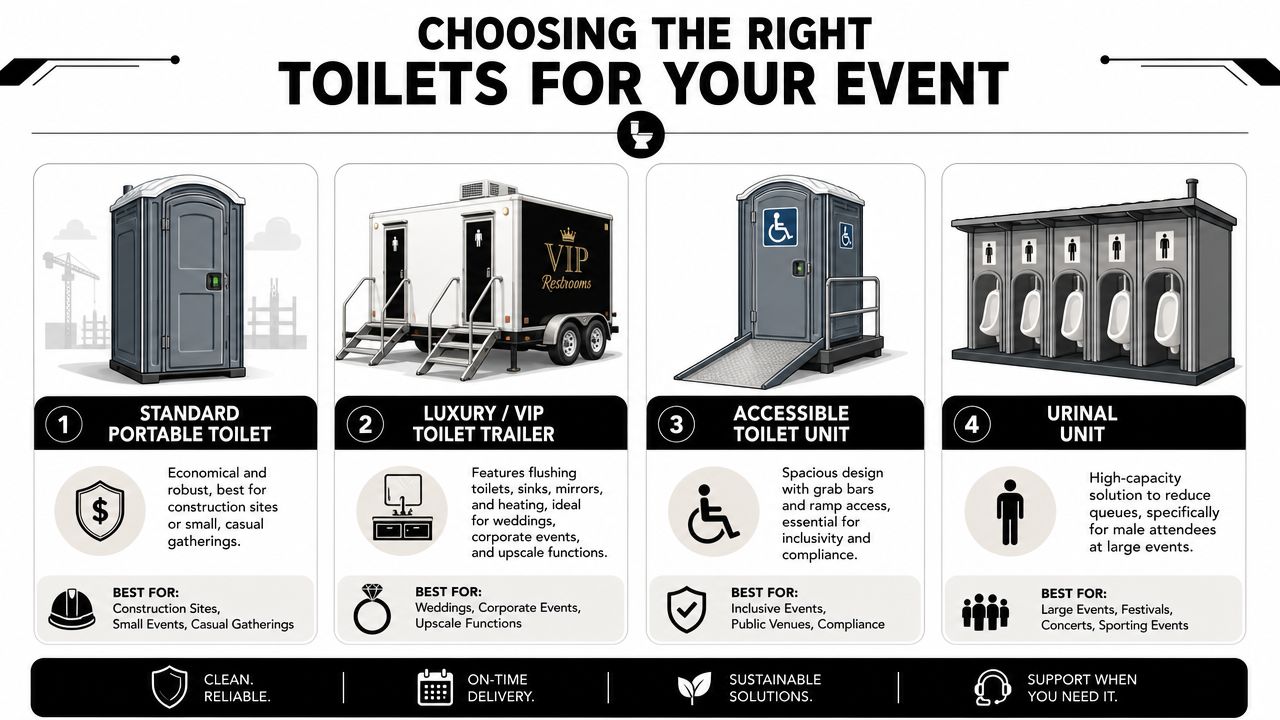
Standard units and where they work best
A standard portable toilet is usually the practical choice for durable, high-footfall use. They suit casual events where budget matters and appearance is less central to the guest experience.
That can work well for:
- Community events: School fairs, sports days, public celebrations, and council-run outdoor gatherings
- Back-of-house use: Crew, contractors, security staff, and suppliers on larger sites
- Simple private events: Informal gatherings where the toilets are tucked away and expectations are straightforward
These units do the job, but they can feel out of place at a polished reception or premium corporate function.
Luxury toilets and premium guest expectations
For weddings, corporate hospitality, and higher-end private events, luxury toilet trailers are usually the better fit. Guests expect proper basins, mirrors, lighting, and a more finished interior.
One useful benchmark comes from a UK high-spec event loo listed with a footprint of 112 cm wide x 122 cm deep, a height of 227 cm, a door height of 193 cm, and a 360-litre waste capacity, which is helpful when planning layouts and servicing requirements on tighter sites in London and the surrounding boroughs, as shown by this UK event loo specification.
That matters because site planning isn't just about how many units you want. It's about whether they physically fit the access route, whether they sit comfortably near the marquee, and whether they need a more deliberate service plan over a longer event.
Accessible units and urinal units are separate categories
Accessible toilets shouldn't be treated as a nicer version of a standard cubicle. They meet a different need and should be planned separately. The same goes for urinal units, which can be useful on larger events where reducing queue pressure matters.
A quick comparison helps:
| Unit type | Best fit | Main advantage |
|---|---|---|
| Standard portable toilet | Casual and public events | Economical and durable |
| Luxury toilet trailer | Weddings and corporate events | Better finish and guest comfort |
| Accessible toilet unit | Inclusive event planning | Space and easier access |
| Urinal unit | Larger busy events | Helps reduce queues |
The best toilet choice is usually the one guests barely think about. It fits the tone of the event and works without fuss.
How Many Toilets Do You Actually Need
This is often the first question asked, and it's the one that causes the biggest problems when guessed badly. Too few units and queues build fast. Too many and you've spent money and site space where you didn't need to.
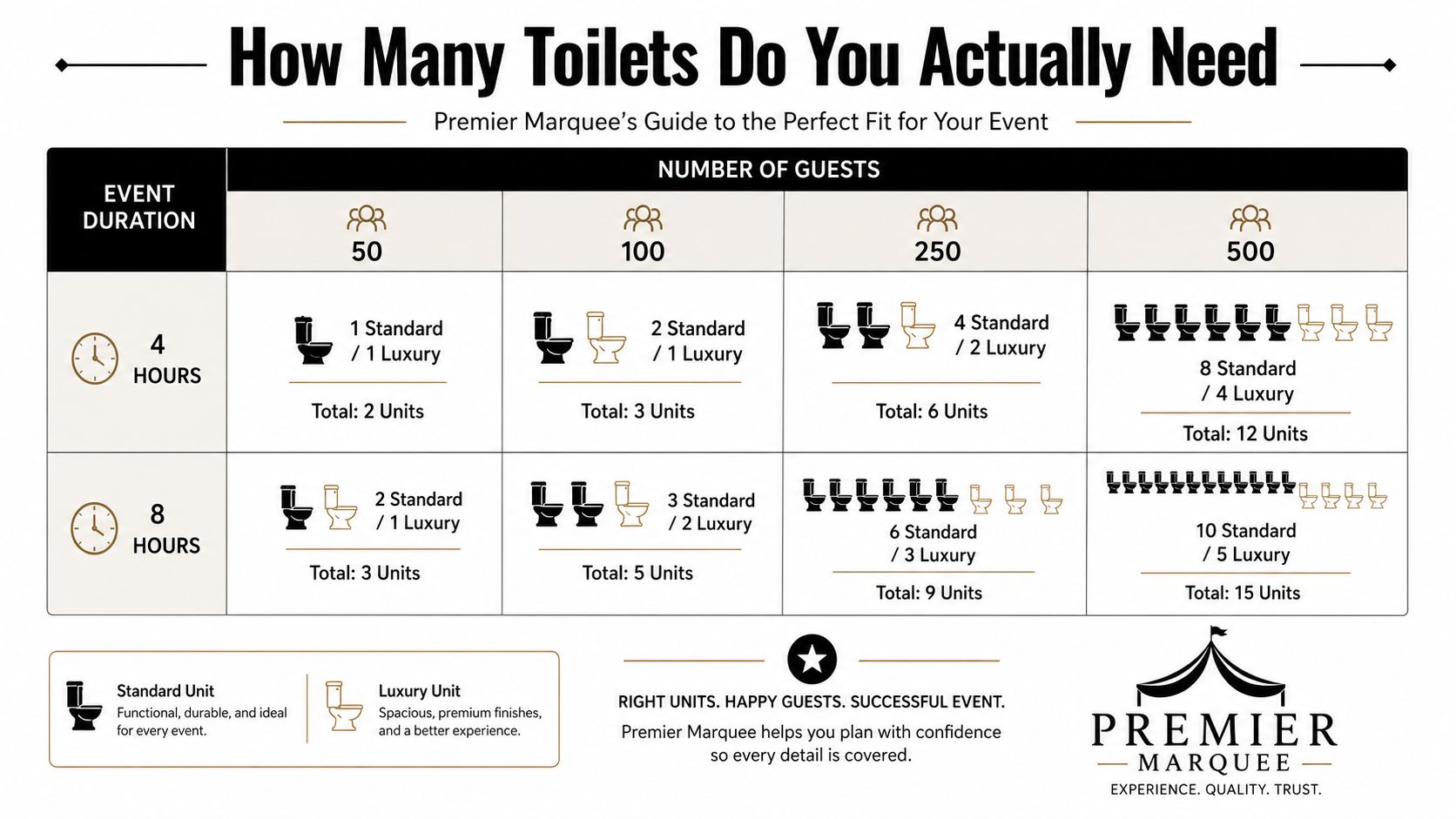
The most reliable method is simple. Size the toilets in order from guest count, then event duration, then alcohol service, and only after that add accessible provision separately and confirm delivery and collection access, following UK portable toilet planning guidance.
That same guidance recommends that a full-day event should start at roughly 1 toilet per 50 people, and that alcohol can increase usage by 20 to 30%, so the baseline should be increased before booking.
A practical way to calculate it
Start with your realistic attendance, not the optimistic version and not the minimum. Then apply the baseline.
If you're organising a full-day marquee event for a set number of guests, use the 1 toilet per 50 people starting point. Then ask two practical questions. Is the event short, or does it run through meal times and into the evening? Will alcohol be served throughout the day?
If the answer to the second question is yes, don't stay at the bare minimum. The guidance is clear that alcohol can raise usage by 20 to 30%, and that increase is noticeable in real event conditions because guest use tends to cluster before meals, after speeches, and during evening drinks.
What works in practice
For a private daytime function in a Croydon garden, the headcount may look manageable until you remember that everyone arrives and takes breaks at similar times. For an all-day wedding in Surrey or a corporate hospitality event in South London, the pressure points are even more predictable.
What works well:
- Using the full-day baseline first: It gives you a stable starting point.
- Adding for alcohol before booking: Don't leave this as a vague afterthought.
- Separating accessible units from the standard count: They serve a different planning purpose.
- Checking servicing expectations for longer events: Capacity and cleanliness matter as much as the raw number of toilets.
What usually doesn't work:
- Relying on the house toilets for the difference
- Assuming guests will spread their usage evenly
- Ignoring evening demand
- Treating a wedding and a casual daytime party as the same
A simple decision framework
Use this order when estimating event toilets hire:
- Set guest count based on likely attendance.
- Judge event length realistically. A reception that runs into the evening needs more resilience than a short afternoon celebration.
- Factor in alcohol service before finalising the number.
- Add accessible provision separately rather than burying it inside the standard total.
- Confirm access for delivery and collection so the plan works on the actual site, not just on paper.
Booking mistake to avoid: If your numbers only work when everything goes perfectly, you probably haven't allowed enough capacity.
Planning for Accessibility and Guest Comfort
Accessibility is where many outdoor events fall short, even when the organiser has good intentions. The common mistake is to think that adding more standard toilets solves the problem. It doesn't.
Industry guidance on this point is clear in practical terms. Adding more standard units is not the same as meeting accessibility needs, and planners increasingly need answers around wheelchair access, family-friendly provision, and inclusive facilities for mixed-age and mixed-mobility events, as discussed in this portable toilet accessibility overview.
Accessibility is a layout issue as well as a toilet issue
A dedicated accessible unit only works properly if a guest can reach it. That means looking at the whole route, not just the cubicle itself.
For marquee events, that often includes:
- Path width: Narrow temporary routes can make access difficult.
- Ground condition: Soft lawn, gravel, or uneven transitions can create real barriers.
- Distance from the main space: Too far away and guests are effectively excluded.
- Lighting: Evening events need a clear, comfortable route both ways.
This matters for more than wheelchair users. Elderly relatives, guests using sticks or frames, and parents helping children all benefit from more thoughtful spacing and easier access.
Family use and dignity matter too
A well-planned event doesn't force people into awkward workarounds. Families may need more room. Some guests need grab support and a simpler entry. Others need privacy and a calmer route away from the busiest crowd area.
For multi-day or higher-comfort outdoor setups, some planners also look at adjacent welfare arrangements. If your event includes camping, crew accommodation, or remote site use, this Lounge Wagon portable shower guide is a useful reference for understanding how temporary hygiene facilities can be planned more holistically.
What inclusive planning looks like on site
A better standard of event toilets hire usually includes a few straightforward decisions:
- Place accessible units near key guest areas: Not hidden at the far edge of the site.
- Keep the route level where possible: Temporary ramps and flooring transitions need thought.
- Allow turning and waiting space nearby: Crowded corners make access stressful.
- Think beyond compliance: Ask whether a guest can use the facility comfortably and independently.
A guest shouldn't have to ask for help just because the toilet route was treated as an afterthought.
Strategic Toilet Placement for Marquee Events
Placement is where many generic toilet hire guides become too vague to be useful. On a real site, especially in London and the suburbs, the question isn't only what to hire. It's where the units can go without ruining circulation, sightlines, or guest comfort.
That's even more important with marquee events because the toilet location affects entrances, food service, flooring routes, and evening safety.
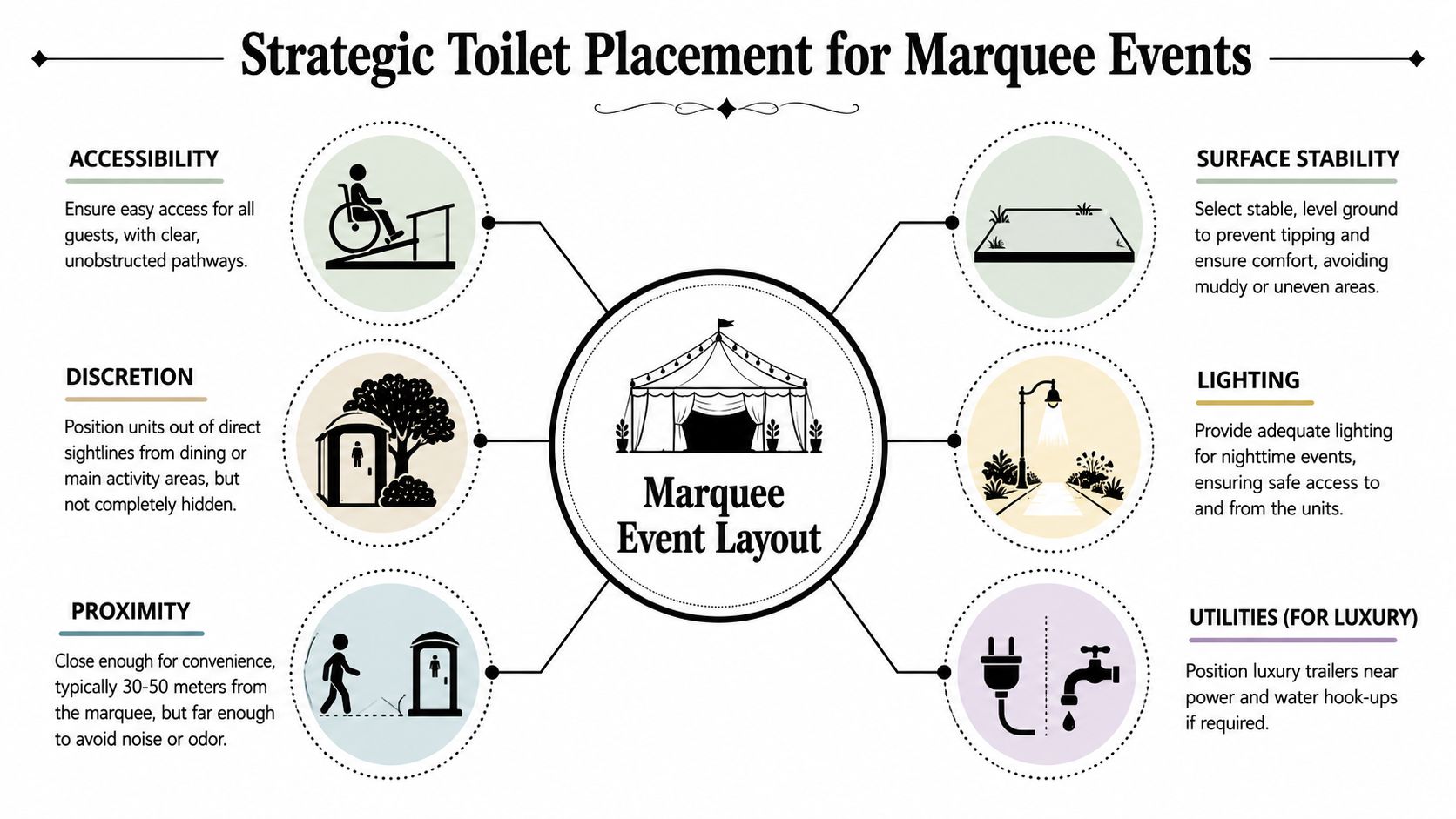
The placement rules that actually help
Independent siting guidance recommends placing toilets on flat ground, slightly off main pathways, downwind from guest areas, near but not inside food and drink zones, with lighting and service access considered from the start, according to this event toilet placement guidance.
Those principles sound simple, but they solve most real problems.
In practice, for a marquee event:
- Flat and firm ground keeps the units stable and pleasant to use.
- Off the main pathway stops toilet queues from blocking marquee entrances.
- Downwind positioning helps preserve the atmosphere around dining and seating areas.
- Near food, not in food space keeps facilities convenient without making them part of the visual focal point.
What dense London sites change
A large country field gives you room to hide mistakes. A garden in Purley, a school ground in Croydon, or a compact venue in Wimbledon doesn't.
On tighter sites, the best position is usually screened but obvious. Guests shouldn't be staring at the toilet block while eating, but they also shouldn't need directions every time. That often means placing units beside a hedge line, behind a service screen, or just beyond the main marquee edge with a clear route in and out.
If temporary flooring is part of the layout, it helps to coordinate the route early. Good pathway planning becomes even more important once heels, evening lighting, and damp ground come into play, which is why practical guidance on flooring for a marquee often sits alongside toilet placement planning.
A working site layout mindset
Think of the toilets as one piece of a service zone. They need:
- Guest access
- Discreet visibility
- Space for servicing
- Separation from dining and ceremony views
- Safe use after dark
A quick site-check list helps:
| Site question | Why it matters |
|---|---|
| Is the ground flat and solid? | Stability and comfort |
| Can guests reach it easily? | Convenience and inclusion |
| Is it out of direct marquee sightlines? | Better event appearance |
| Can service vehicles access it? | Setup and collection |
| Is the path lit for evening use? | Safety and confidence |
On-site habit: If you have to choose between “hidden” and “easy to use”, choose easy to use, then soften the look with screening.
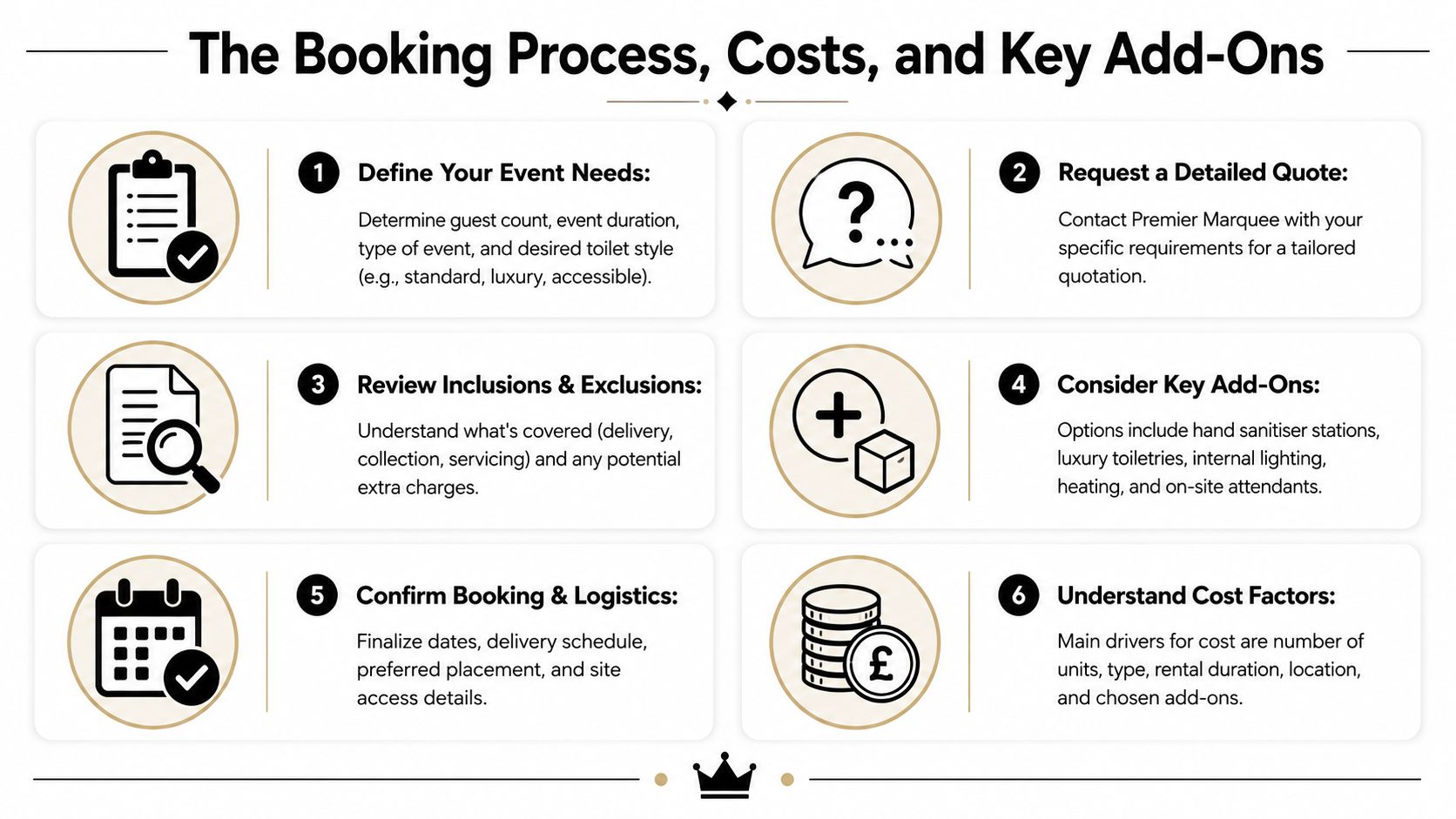
The Booking Process Costs and Key Add-Ons
By the time you're ready to book, the process should feel quite mechanical. You know the event type, the likely attendance, the style of toilet you want, and where the units can go. That's when the quote becomes meaningful instead of just a rough number.
This is also where it helps to think of event toilets hire as a proper event service, not a last-minute extra. The UK portable toilet hire market was valued at around £785 million in 2023 and is projected to exceed £1.3 billion by 2030, which shows how established event sanitation has become within the wider events sector, according to this UK event toilet market overview.
What usually affects the quote
The final cost normally shifts based on a small set of decisions rather than anything mysterious.
The main factors are:
- Type of unit: Standard and luxury setups sit at different service levels.
- Number of units: More capacity means more hire and more site space.
- Hire duration: Single-day and multi-day hires are priced differently in practice.
- Location and access: A tight urban delivery in London can be very different from a simple open-site drop.
- Servicing needs: Longer events may need more active maintenance.
Add-ons worth considering
Some extras are useful. Others depend on the tone of the event.
Common add-ons include:
- Hand sanitiser points: Helpful where guest movement is spread across the site.
- Vanity extras for premium events: Mirrors, toiletries, and a more polished internal finish.
- Lighting support: Especially useful when toilets sit beyond the main lit marquee area.
- Heating in cooler months: Worth considering for evening comfort.
- On-site attendant support: Sensible for larger or more formal events where presentation matters throughout the day.
For organisers comparing multiple suppliers, it can help to review broader procurement habits as well. This guide for event planners offers a sensible framework for asking the right questions without turning the process into a battle over the wrong details.
Why bundled planning is often easier
Toilet hire becomes easier when it's coordinated with the wider event package. The marquee footprint, the guest entrance, the catering route, the flooring, and the toilet access path all influence each other.
That's why clients often find it simpler to price the whole setup together rather than sourcing every element in isolation. If you're weighing up the broader budget side, this guide on prices for marquee hire helps put the facility costs in context with the rest of the event build.
Your Partner for Complete London Event Hire
Well-planned toilet hire does three things. It protects guest comfort, supports the look and flow of the event, and avoids the sort of problems people remember for the wrong reasons.
For marquee events in Croydon, London, and the surrounding areas, the details matter more than most generic guides suggest. The unit type needs to suit the occasion. The numbers need to be realistic. Accessibility needs to be planned properly. Placement has to work with the site you have, not the site you wish you had.
That's particularly true in dense urban and suburban locations, where gardens are narrower, access is tighter, and every piece of the layout has to earn its place. When transport and logistics are part of the wider guest plan too, some clients also find it useful to look at options like this guide on how to book mini bus with driver London for moving guests smoothly between ceremony, reception, and accommodation.
A good event setup feels straightforward to guests because someone has already thought through the awkward bits.
If you're planning an outdoor event and want one clear quote for marquees, flooring, furniture, and toilet facilities, speak to Premier Marquee Hire. The team offers practical advice, site-focused planning, and pressure-free quotations for events across Croydon, London, and the surrounding counties.
Sorry, the comment form is closed at this time.